Emergency Care Isn’t Health Care

Aaron Carroll and Austin Frakt attack the notion that we "have universal coverage because of emergency rooms":

Emergency care is important, but it’s not the same thing as health care. We know that people with depression require treatment, but in an emergency room we can’t do anything about it until they are ready to commit suicide. We may know that you would benefit from a hip replacement, but until it fractures, there’s not much that will be done in an emergency department. We may know you  have arthritis, or ulcerative colitis, or migraines, or lupus, or hypothyroidism, or any of a host of other disorders, but until they are life threatening – there’s not much we can do for you.

From The Annals Of Chutzpah

"[T]he administration’s flouting of the [War Powers Resolution] displays Obama’s fundamental hostility to the regular workings of the political process established by the Constitution and the traditions of American government. Just as the administration brushed aside the Constitution’s limits on the federal government’s powers over the domestic economy, so too it is ignoring a national security law it believes to be constitutional simply because it stands in the way of Democratic Party goals. … Obama’s results-driven process makes a mockery of the idea that the Justice Department is the agency in charge of interpreting and enforcing the law for the executive branch," – John Yoo.

Ryan J. Reilly unloads. As Greenwald drily puts it, "[Yoo] accuses President Obama of transgressing the proper limits of executive power by asserting the right to wage war in Libya without Congress."

Mitt’s Chances

117070723

Nate Silver handicaps the top-tier GOP candidates. He gives Romney a 40% chance of winning:

Mr. Romney is perceived as having run a slow-and-steady campaign — but he’s made the largest gains of any Republican candidate in the last two months, to an average of 26 percent of the vote in polls conducted in June from 18 percent in those conducted in April. Some of this is a result of other Republican candidates’ dropping from the field. Yet while candidates like Tim Pawlenty and Newt Gingrich have remained flat in polling, Mr. Romney has gained ground.

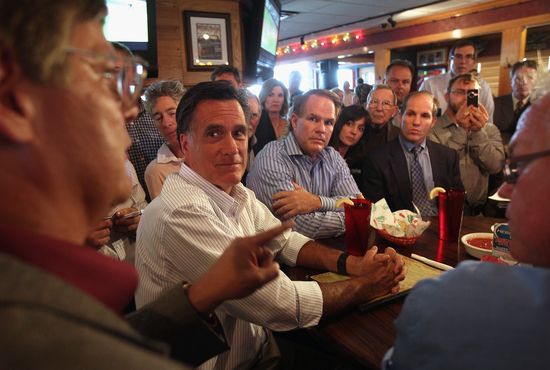
(Photo: Republican presidential hopeful Mitt Romney listens to small business owners at the Brewery Bar IV on June 20, 2011 in Aurora, Colorado. By John Moore/Getty Images)

What Teach For America Can’t Fix

Dana Goldstein profiles education historian Diane Ravitch:

Ravitch says she’s particularly offended by the suggestion—implicit in the media’s celebration of Teach for America, the organization that launched Rhee’s career—that perhaps teaching should not be a lifelong profession at all, but a bleeding-heart diversion for elite 20-somethings.

“To me, it’s like saying that we’re going to build up the Peace Corps so at some point we can replace the senior diplomats,” she says. “That’s ridiculous.” Ravitch—who says she’d probably apply for TFA if she were leaving college today—nonetheless thinks that instead of letting the much-publicized program suck up all the “psychic energy,” there should be college loan forgiveness for people who become teachers. “Then you would have so many people applying to join this field that you could select the top 10 or 15 percent,” she says.

Goldstein follows up at her blog:

People are always fascinated by political intellectuals who publicly change their minds. In Ravitch's case, after spending several hours speaking with her one-on-one about her beliefs, and immersing myself in her writing, I believe she is motivated very much by a desire to defend the idea of public schools as a shared societal institution. She rightly points out, I think, that many free market school reformers do not share her bedrock commitment to the idea that every neighborhood deserves a high-quality, government-run, publicly-accountable school.

Shoot Now, Focus Later

A way to focus blurry pictures after the fact:

This image gallery lets you play around with the feature. Allahpundit is intrigued but doesn't see a big market for it among normal photographers. He suggests "two obvious business strategies going forward":

One: Miniaturize the technology to the point where it’s cell-phone ready and then sell it to Apple or Google or whoever. Having a feature like this in the iPhone to let you sharpen up shoddy pics would be lovely. Two: Surveillance. Isn’t that the most obvious application for this? How many times have you watched a true-crime show where the perp walks by a gas-station camera 25 feet away and the best they can do to get a description of him is magnify his face until it’s a pixelated blotch? Universal focus would be a very tasty treat for security agencies. 

Would Pot Legalization Destroy The Drug Cartels?

 Sylvia Longmire insists it wouldn't. Adam Ozimek counters:

Say the higher end estimate of marijuana revenues from the Rand corporation is correct, and legalizing would reduce cartel revenue by 26%, or that the 60% number is correct and they will make back an implausibly high 50% of their lost revenue in other activities. This means something like a 30% decrease in lost revenues. If this leads to a proportional decrease in long-run drug related murders in Mexico, then based on the 15,273  drug related deaths in 2010, there would be 4,580 fewer deaths each year. That's a huge gain in welfare even if it falls short of the quixotic goal of "killing the cartels". The end of alcohol prohibition in the U.S. did not mean an end to the mafia, but it did lead to a significant decline in murders and in their power. Longmire has not presented a convincing case that the same would not be true in Mexico.

Warning Label Creep?

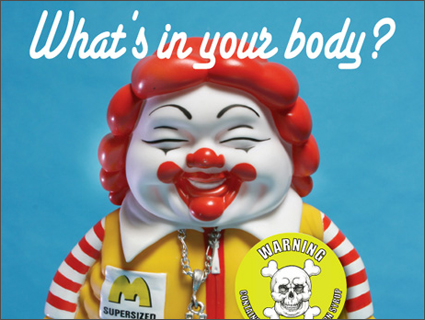
Fat-ronald

A reader writes:

I understand that cigarettes kill more people than car accidents and all other diseases combined, but this new warning design is on many levels laughable. If we go down this road with cigarettes, why not put pictures of people killed by drunk drivers on cases of Budweiser and pictures of diseased livers on bottles of Crown Royal? How about pics of infected and dead animals from cosmetic testing on Maybeline lipstick? Rotted-out teeth on Pepsi cans? Pictures of hugely obese people on Ben & Jerry's containers?

If tobacco products are going to be singled out now, what product category is next?

The FDA can find potential problems with a whole lot of crap that's on the grocery shelves. Placing alarming images on packages only further desensitizes the public. If the government agencies did some real public service announcements, done right and done well, by big city professional creative people, that clearly send the right message, it would go a lot further than the novelty packaging adaptations being proposed.

I think most American people have addictive personalities. If you take cigarettes away, it's going to be something else they smoke, drink, chew, or inject. Americans in general are lacking when it comes to nutrition and health. I'd like to see the insurance companies spend some of their profits to educate the public about healthy lifestyles, and not some brand-building, feel-good, jingly-jangly message, but more of a scared-straight kind of approach.

(Image by Ron English)

Educating The Incarcerated

A reader writes:

Important to note from that article on San Quentin is the immediately preceding sentence to your excerpt: "A plethora of academic courses are still offered, as committed faculty and graduate students from Berkeley, Stanford and other universities volunteer to teach courses there." The article implies that budget cuts have reduced the number of courses, but that is misleading. "Volunteer" is the key word here; by law no government money may be spent educating the incarcerated (think about that for a minute).

The program is administered by the Patten University Prison Project and all resources are donated, all instructors are volunteer. My wife was an instructor at San Quentin for a while; the program is tolerated by the administration because taking a college course is a carrot that can be withheld to enforce discipline. But it is difficult to run a college course when classes are canceled on no notice for lockdowns, resources are scarce, and the students may or may not have the freedom to actually do the homework between visits. One thing about those students though: they are certainly motivated.

The Daily Wrap

Today on the Dish, Andrew weighed in on Jewish American guilt over Israel, and thought a US vote for a Palestinian state wouldn't be such a bad thing. Andrew had faith that Americans would pave the way on gay marriage, and Obama wouldn't stand in the way. Congressmen did push-ups while we waited for movement in Albany, and Timothy B Lee urged illegal immigrants to out themselves.

Andrew reviewed Obama's speech on Afghanistan, and we collected the reax from the left and the right. Afghanistan troops could be replaced with contractors, Americans taught Afghan officials better PowerPoints, we wanted our war money back, and Larison witnessed a subtle shift in GOP interventionism. Internet pundits raged over libertarianism's Robert Nozick, a reader argued Rome never fell, and we pondered whether we'd want to be contacted by a more advanced tribe.

Huntsman had to differentiate himself from the other well-coiffed Mormon RINO, and a return to states' rights could help legalize marijuana. Inmates played tennis at San Quentin, and people confess to crimes they didn't commit, and incarcerate themselves to get healthcare. Texas determined America's textbook content, Susan Orlean railed against oversized houses, and despite trying, the government can't regulate cool. Dr. Pisaster defended Bristol's right to continue her relationship with Levi, which doesn't mean she wasn't raped. For the first time in history, human activity may be the primary driver of planetary change, and materialists got up in arms about spirituality on mushrooms. Animals acted like dicks, a pilot wanted more hot flight attendants, and the poseur alert got arty.

Quotes for the day here, here, and here, VFYW here, MHB here, and FOTD here.

–Z.P.