Leading From Behind

TjRP1

Ezra Klein endorses my understanding of how Obama sees his presidency:

When presidents succeed in presiding over great change, they do so by recognizing an existing opportunity, not squeezing one from the stone of existing opposition. Obama correctly saw that 60 Democrats in the Senate and 240 in the House had cleared the way for health-care reform. Bush realized that 9/11 opened the door for the Iraq War. Clinton understood that the preferences of the Republican Congress and the economic growth of the ’90s created space for a Democrat to balance the budget and reform welfare. Reagan sensed that stagnation had prepared the American people for a radically different economic philosophy. FDR knew to push America’s intervention into World War II by incrementally moving forward with arguments based on new events.

This is temperamental conservatism as Burke would understand it. You peruse the existing intimations, to use Oakeshott's formula. You guide what's emerging; you do not impose an ideological vision – like Paul Ryan's. Again this is why an old school conservative can see a lot of good in Obama. Compare his handling of Iraq and Afghanistan with Bush's. Bush was pure ideology and achieved modest results only when he dropped the ideology and addressed reality in 2006. Obama has been almost pure pragmatism – militarily and politically – on both. David Remnick says that Obama believes that "the price of getting too far ahead of the majority of the country would be politically ruinous and lead to the election of a conservative Republican":

At a fundraising dinner in 2008, in Montclair, New Jersey, Obama told one of his favorite stories about F.D.R. (He told the story apropos of the Israeli-Arab dispute, but it also pertains to gay marriage.) Obama recounted how when F.D.R. was confronted by the civil-rights leader A. Philip Randolph about the racial injustices in the country and the need for the President to use his powers and his bully pulpit, F.D.R. said he agreed but he would only take action when he was forced to do so by a popular movement. “Make me do it,” he told Randolph.

The Lost Decade Of War

Gregg Easterbrook entertains a counterfactual:

Add war costs back into  the economy and the U.S. GDP would be around $16 trillion today, an annualized growth rate of roughly 3 percent for the last decade. At that level of growth, unemployment would be lower, deficits would be lower and the national mood brighter.

China? Doesn't seem to have these problems.

Quote For The Day II

“Cantor and Kyl just threw Boehner and McConnell under the bus. This move is an admission that there will be a need for revenues and Cantor and Kyl don't want to be the ones to make that deal.”

That's the spin from a senior Democratic aide on the abandonment of the debt reduction talks by the last two remaining Republicans.

The issue is whether we are going to have this huge attempt at cutting the deficit without any raising of revenues at all, at a time when taxation is at its lowest as a percentage of GDP in fifty years and when marginal rates are lower for everyone but the poor than they were under Ronald Reagan. In my view, that is as irresponsibly ideological as it is unfair.

I favor very sharp cuts in Medicare – including means-testing where we can and every cost-control experiment that works. I favor ending corporate welfare, agricultual subsidies and the myriad tax breaks that make the code beyond the reach of most tax-payers. I support gradual, structural defense cuts to bring down the percentage of GDP we spend on defense to be similar to our NATO partners. 

But if we are to make these sacrifices, we simply have to ask for balance – and some contribution from those who have done so well in an era where so many have done so poorly.

The Tories in Britain have enacted unprecedented cuts in public spending. But they also raised taxes, as Reagan did five times, to target the debt from the revenue angle as well. Why cannot the US Republicans be as pragmatic as the British Tories? Why can they not accept that under the current circumstances, avoiding default and cutting the debt are more important that ideological purity on taxes, especially in such a relatively low-tax environment?

Waiting For Albany, Ctd

X2_6c23106

The latest from Day Three of the extended session:

Senate Majority Leader Dean Skelos said this morning that his GOP conference will discuss for the first time today whether to let the same-sex marriage bill come to the floor for a vote. Skelos did not give a time for this closed-door confab. The majority members have had several lengthy discussions about the issue of gay marriage in general, but have not yet officially wrestled with the question of whether they want to vote on the controversial issue or punt. … Skelos refused to say whether he believed the vote could take place in the middle of the night (to minimize TV coverage and allow for a quick getaway), as has been widely speculated.

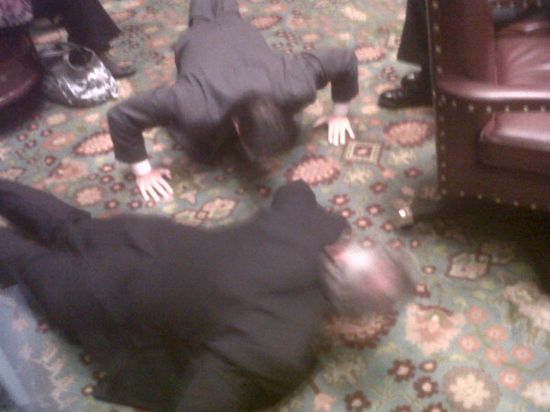
City Hall News tweets: "A lobbyist tells us "I hear we could be here Monday and Tuesday next week too." #swell". CHN also uploads the above photo and captions: "[Assemblyman] Jim Tedisco and [Senator] Greg Ball have a push-up contest on the @NYSenate floor #gettingbatty".

Bristol’s Innocence, Ctd

Dr. Pisaster pushes back against Dan Savage and Dish readers:

Every woman reacts differently to rape. There is no right way to respond to such a personal violation, and casting doubt on women’s claims of rape because they didn’t immediately accuse their rapist and run to the police, or even end their relationship with their rapist does a huge disservice to the many women whose experiences don’t fit the social “script,” of rape.

I appreciate that so many people are willing to call a spade a spade and see the incident as described by Bristol as rape, but the assumption that the claim is false because of how her relationship with Levi progressed after that night is appalling. It’s entirely possible that Bristol is lying, but it’s also possible that she is among the many young women who are unacknowledged rape victims, and the message I wish we were sending those victims is not, “What happened to you was wrong, but if you continued to have a relationship with your victim we won’t believe you/you deserved it,” but, “What happened to you was wrong, period, and you have the right to deal with it in your own way.” Doubt her story if you wish, but not for that reason.

Afghanistan Reax: From The Right

GT_Obama_Speech

Jon Huntsman:

Now it is time we move to a focused counter-terror effort which requires significantly fewer boots on the ground than the President discussed tonight. We need a safe but rapid withdrawal which encourages Afghans to assume responsibility, while leaving in place a strong counter intelligence and special forces effort proportionate to the threat. The War on Terror is being fought against a global enemy, and it is critical that we have the resources to fight them wherever they're found.

Andrew Bacevich:

To my mind, Obama's speech once again showed that he does not really wish to be a "war president." He understands—correctly—that the imperative of the moment is not to rebuild Afghanistan, but to rebuild America. He knows that the outcome of the war in Afghanistan will not determine the course of events in the 21st century. What happens in China or India, Europe or Russia is of far greater importance to our well-being. So there is something fundamentally absurd about a cash-strapped nation spending more than $100 billion per year in hopes of pacifying a country that lacks a legitimate government and that views Americans as unwelcome infidels.

Yet for whatever reason—politics? an unwillingness to overrule his generals?—Obama prefers to temporize rather than to make the tough call. So with his announcement of a barely more than symbolic plan for withdrawal, he allows a mindless war to continue. The presidential election of 2012 will reveal whether his calculation is a correct one. This time around, he won't have my vote.

Abe Greenwald:

Barack Obama is out of ideas. Done. Empty. Finished. Through. His grand pronouncement last night on the country’s direction: “America, it is time to focus on nation building here at home.” Powerful stuff indeed. And lifted directly from no less than 14 Tom Friedman columns.

Bill Kristol:

So why the choice of the end of summer of 2012? The budget savings are trivial. The increased risk of mission failure in Afghanistan is great. There is even a real chance of a snowballing lack of confidence in the United States over the next weeks and months in Afghanistan, in the region, and even around the world.

Kristol can hope, I guess. Jamie Fly:

Last night’s announcement should give pause to those Republicans who have been tempted to criticize the president from the left and exploit growing foreign-policy fatigue in the country. They should now think instead about making the case for renewed American leadership, because an unwillingness to lead is becoming the hallmark of the presidency of Barack Obama and one of his greatest vulnerabilities.

Butters:

Here's what I think the story is.  Petraeus loses, Biden wins.  And I respect the vice president, but I think we have undercut a strategy that was working.  I think the 10,000 troops leaving this year is going to make this fighting season more difficult.  Having all of the surge forces leave by next summer is going to compromise next summer's fighting season.

Max Boot:

There are many unfortunate aspects of President Obama’s decision to prematurely pull the plug on the surge in Afghanistan. Not least is it will be more difficult to maintain the bipartisan consensus behind the war effort. Indeed, it will make it harder to maintain a bipartisan consensus for a strong, forward-leaning foreign policy designed to defend freedom.

T-Paw:

Look how he phrased the outcome of this war: He said we need to end the war 'responsibly.' When America goes to war, America needs to win. We need to close out the war successfully, and what that means now is not nation-building. What it means is to follow Gen. Petraeus' advice and to get those security forces built up to the point where they can pick up the slack as we draw down.

Romney:

This decision should not be based on politics or economics. America’s brave men and women in uniform have fought to achieve significant progress in Afghanistan, some having paid the ultimate price. I look forward to hearing the testimony of our military commanders in the days ahead.

Jim Lacey:

Leadership does not mean splitting the difference. It means stepping up and doing whatever is necessary to reach your stated goals, or admitting that the goals are no longer worth the cost in blood and treasure and then withdrawing. Halfway measures almost guarantee a double loss: mission failure and wasted lives.

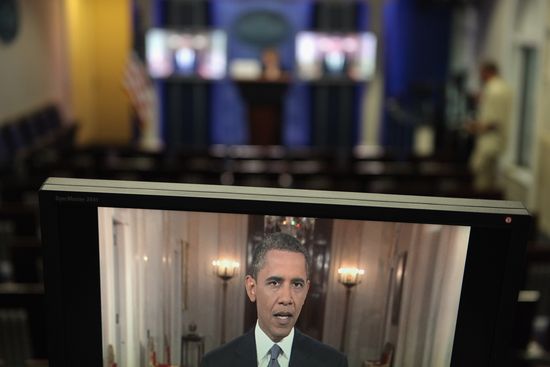
(Photo: U.S. President Barack Obama is seen on live television screens in the Brady Press Briefing Room at the White House June 22, 2011 in Washington, DC. Obama announced he will order 10,000 troops to pull out of Afghanistan this year, and another 33,000 troops by the end of next summer. By Chip Somodevilla/Getty Images)
Afghanistan Reax: From The Left

Afghanistan_withdrawal

Spencer Ackerman:

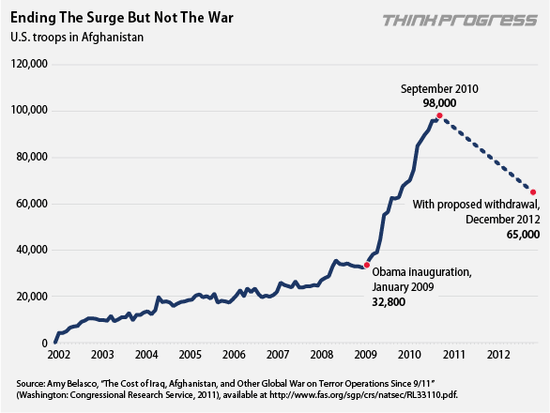
You don't need 88,000 troops in January 2012 to hunt Taliban. You need lots and lots of ISR, some good informants, commandos and some conventional forces to backstop them. The pre-West Point Surge 68,000 is still a ton. The charitable way to put it is Obama's being predictably cautious. The uncharitable way to put it is he's not grasped the implications of his own strategy.

Steve Benen:

Perhaps the most politically interesting about his remarks last night on U.S. policy in Afghanistan wasn’t related to the troop withdrawals or conditions for Taliban negotiations, but rather, the fact that he talked at some length about the U.S. economy in a speech about national security.

Juan Cole:

He’s starting the process of the winding down of the war. And I think, politically speaking, it’s necessary for him to do that now that the war is extremely unpopular domestically, and even now, a majority of Republicans are saying they want out, that some of the Republican presidential candidates are campaigning on ending the war and critiquing Mr. Obama for having escalated it, which is quite ironic because originally most Republicans supported the escalation of the war.

Michael Tomasky:

Virtually anyone sitting in the Oval Office would be sizing this up the way he is.

Matt Hoh:

Such a withdrawal, particularly without a change in strategy commensurate with America’s actual interests in Afghanistan, will only bring us back to where we in December 2009. Further, an 18 month long process will push the next decision point on the war to January 2013, effectively punting the war from the US’s 2012 election cycle. By not making significant cuts in our troops in Afghanistan and no real changes in our strategy, we will continue to be stuck in Afghanistan’s quicksand for years to come.

Michael Cohen:

Obama's decision to resolutely shift U.S. strategy is a critical recognition that the war in Afghanistan must begin to come to an end — and offers a potential path for accomplishing that objective. While many will likely quibble over Obama's statement that the U.S. is "meeting our goals" in Afghanistan, perhaps a victory lap is the cover that the President feels he needs to begin the process of de-escalation. Tragically, U.S. soldiers, Afghan security forces, and Afghan civilians will continue to be maimed and to perish in Afghanistan. But, for the first time in ten years, the light at the end of the tunnel of the U.S. war there is suddenly visible.

Julian Borger:

In fact, the immediate changes are slight, and inevitable if all Nato combat troops have to be out by the end of 2014. As Michael O'Hanlon of the Brookings Institution points out, the rate of drawdown will be initially be quite gradual. The US will still have 90% of its current forces in Afghanistan in 15 to 18 months time, and they will still be doing the same things in south and east Afghanistan. This announcement does mean a sudden switch from counter-insurgency to counter-terrorism.

A.J. Rossmiller:

Of the recent signals, political negotiations are by far the most important; the U.S. should do all it can to facilitate power sharing, which is the natural and inevitable outgrowth of a military stalemate. Taken together, these developments are constructive both in and of themselves and as indicators of President Obama’s evolving position on the conflict. After many years of little change, our Afghanistan strategy finally appears to be shifting fundamentally—and in the right direction.

Joshua Foust:

As pleasing as President Obama’s speech is, how we actually go about this process will matter tremendously. For the time being, all we have is Obama’s inspiring rhetoric and the dramatic shift in focus.