Superstar Economics

5764964940_884a15d280_b

Stephen Metcalf challenges Robert Nozick's "breathtaking defense of libertarianism" in Anarchy, State, and Utopia. Metcalf also tackles Nozick's Wilt Chamberlain example, which pits personal worth against the interference of taxes:

Nozick vanishes most of the known features of capitalism (capital, owners, means of production, labor, collective bargaining) while maximizing one feature of capitalism—its ability to funnel money to the uniquely talented. In the example, "liberty" is all but cognate with a system that efficiently compensates the superstar.

E.D. Kain has a roundup of the web's biggest criticisms of Metcalf's piece. Conor Friedersdorf runs through examples of libertarians fighting for things other than their own self-interest. David Boaz says that Nozick didn't disavow libertarianism later in life, as Metcalf claims. Yglesias counters that, while still Libertarian, Nozick "no longer embraced the doctrine espoused in his famous work of political philosophy" at the time of his death. Julian Sanchez (who interviewed Nozick years ago) grasps the larger issue at hand with the Chamberlain example:

Metcalf seems to imagine that this four-page argument—which occurs about a third of the way through a long, dense, and in places somewhat technical book—is in itself supposed to establish the injustice of taxation and redistribution, or the justice of real-world holdings arising from existing markets. Would that political philosophy were so easy! It’s not supposed to do that at all, of course: It is meant to develop an abstract point about the inadequacy of a certain (purely patterned) way of conceiving the criteria for evaluating the justice of property holdings.

Chait defends Metcalf:

Metcalf's point was that Nozick was seizing upon an unusual and deeply atypical example of wealth, and used it draw draw up rules to presumptively apply to all wealth. It's like using the example of a man stealing a loaf of bread to feed his starving children as the basis for our laws about property and theft. To object to such an exercise is not to deny that morally justifiable theft can exist. It's just a bad model to build an absolute moral defense of capitalism.

Mark Thompson thinks Chait is misreading Nozick:

The Chamberlain argument … exists for the limited purpose of demonstrating that inequality is not inherently unjust, or, even of it is, it cannot be rectified in a permanent manner without interfering with people’s lives in a manner that few would find acceptable.  Saying that inequality is not inherently unjust is a far, far cry from saying that it is inherently just, or even that it is more often than not just.

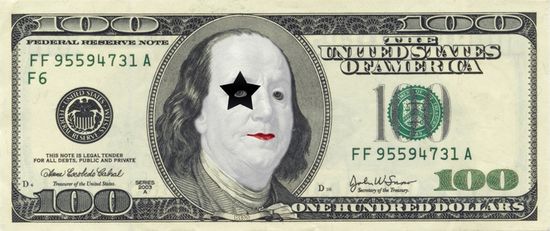
(Image by Molle William, from the "Make Your Franklin" project.)

Malkin Award Nominee, Ctd

A reader writes:

I don't mean to fight hyperpartisan fire with fire, but perhaps this would be a good opportunity to point out that one side of the spectrum does have disproportionate power over school curricula – and it's not the one Santorum thinks it is. You're probably aware that the Texas Board of Education has broad authority to rewrite textbook standards for any textbooks to be used in the state. By all accounts I've heard, since they're one of the largest markets, most major publishers tailor their books to fit Texan criteria and then use them elsewhere. Thus we have a group of 15 people, dominated by what seem to be crazy right-wingers, exercising great control over what children are taught nationwide.

Dish coverage here.

“We Stand Not For Empire”

Obama's speech:

This embed is invalid

There is, as with the Iraq withdrawal, no triumphalism. But destroying half of al Qaeda's leadership, including Osama bin Laden, as Americans struggle in a stubbornly sluggish economy, is good enough. The longest war in the history of America will come to an end … in three years' time. It will have lasted thirteen years. And Obama's pragmatism – his refusal to embrace either the Full McCain Jacket or the impulse to just get the hell out of there ASAP – has helped him. His moderation on this has allowed the pro-surge forces to have had their moment and their say, has scattered al Qaeda, and has provoked conservative voices of skepticism to emerge in the GOP to reshape the national debate. I see no groundswell against this sentiment:

We must chart a more centered course. Like generations before, we must embrace America's singular role in the course of human events. But we must be as pragmatic as we are passionate; as strategic as we are resolute.

The unknowable question is whether we have so inflamed the enemy that we cannot afford to withdraw without some risk to security. I would support taking that risk. Because the alternative to that risk is the corruption of unending and essentially un-American occupation. And, yes, perspective is necessary. When the nation is in desperate need of investment at home, it simply is not right to focus it, with dubious results, abroad. To continue in that vein would turn legitimate anti-interventionism into a more dangerous isolationism.

For more than 200 years, the United States would not have dreamed of occupying Afghanistan, the graveyard of empires. We intervened in a just cause, and, thanks to Obama's callibrated resilience and new focus on al Qaeda, and the brilliance and bravery of the armed forces, we have done our job. We can never care more about a country's future security than the people of that country care about it themselves. That much we have learned. And the core goals of that original impulse have been achieved. The perpetrator of 9/11 is dead, and, more to the point, discredited. And the neoconservative dream of a democratizing Arab world as the only ultimate solution to the threat of Islamism has come true.

Because the United States did not impose it.

The Daily Wrap

Today on the Dish, Andrew called Huntsman on redefining marriage from a Mormon point of view. Chait tested Huntsman's anti-interventionism, and Ackerman thanked him for at least raising the bar on foreign policy in the GOP. Pawlenty still couldn't hang with the big guns, Palin quit her own vacation (and then some), and Bristol dismantled her own innocence. Bachmann espoused late-stage Kim Jong-Il style crazy, Alex Klein thrashed InTrade, and Jon Stewart bested Fox in journalistic integrity.

We previewed Obama's speech on bringing the "troops" home from Afghanistan, and Andrew respected Obama's skill in playing both the hawk and the dove. We wondered whether the Libyan rebels would seek vengeance in Tripoli, a prison break in Yemen raised eyebrows, and Foreign Policy ranked the failed states. Morocco moved towards a Muslim democracy, China freed artist Ai Weiwei on bail, and Bahrain cracked down on human rights activists.

We awaited news from Albany, and, in the meantime, covered the competitive sport of beards. Tax payer receipts don't assuage American anger over taxes, and the CBO's chart on the long term budget sufficiently freaked us out. Switching sides is suspect, 216,600 prison inmates were raped in 2008 alone, and brain imaging could change the entire criminal justice system. Drug war horror stories under a police state continued, all fathers make sacrifices, and Dan Drezner dissed grand strategies. Andrew appreciated the salty goodness of America's immigration, cats spoke dog, untraveled Americans fall for the British accent, and parents have sex too.

Messiah watch here, dissent of the day here, creepy ad watch here, Malkin award here, hathos alert here, poseur alert here, quote for the day here, VFYW here, MHB here, and FOTD here.

–Z.P.

China A Little Bit Freer Today

Ai-weiwei-coca-cola

The Chinese government has finally released artist and dissident Ai Weiwei.  Peter Foster explains the significance:

Those who argue that highlighting egregious cases like Ai Weiwei’s is “counter-productive” (that’s usually code for “inconvenient”) have seen that argument weakened tonight. Some say that China, with its additional clout and importance in the world, now feels it is above responding to such pressure, but arguably the exact opposite is true. The more credible China wants to be and the bigger the say China wants in world affairs – in everything from Libya’s future to the leadership of the IMF – then the greater the pressure must be on China’s leaders to conform, in the long term, to basic international norms.

Previous Dish coverage here, here and here. The above photo is of ancient Chinese pottery remixed by Ai Weiwei. The WaPo features more of his work.

The Debt Time-Bomb

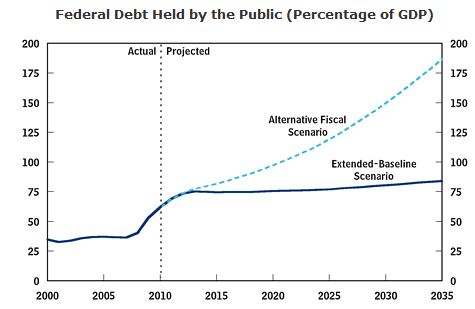
The CBO put out a new report on the long-term budget today. Money graph:

Federal_Debt

Don Taylor sighs:

The scary thing about the Alternative Fiscal Scenario is how politically plausible are the big picture assumptions that define this scenario that shows our cumulative debt being over 175% of the GDP in 2035.

Len Burman delivers more bad news:

[The Alternative Fiscal] scenario, as dreadful as it is, is wildly over-optimistic, because it doesn’t account for the effect of rising debt levels on interest rates and the economy.

Ezra Klein highlights a political sleight of hand:

This is a good time to remind everyone that when you hear politicians telling you that their plan cuts taxes or balances the budget, you always need to ask what baseline they’re using. Almost all the plans on the table, for instance, do less to balance the budget than simply doing nothing. But since they use a version of the “alternative fiscal scenario” as their baseline, they don’t have to admit that before they make the deficit somewhat better, they’re first planning to make it much, much worse.

Bahrain Bubbles Up

The Bahraini government has sentenced eight human rights activists to life in prison, provoking mass protests for the first time since the government's crackdown. (All but one of those imprisoned by the Saudi-backed Sunni regimi are from the Shia majority.)  Mackey is on top of it:

Bahrain’s state news agency reported that the men were convicted of “exchanging intelligence information with a terrorist organization working for a foreign country,” apparently a reference to Iran, which Bahrain’s government has accused of orchestrating demonstrations by Shiites to destabilize Sunni-ruled kingdoms in the region. Nabeel Rajab, the current president of the Bahrain Center for Human Rights, told Britain’s Channel 4 News that all the defendants had been abused in custody. “We know all of them were tortured,” he said. “Some were electrocuted, some were beaten, and some were sexually abused.”