Creepy Ad Watch

Creepy-ads

The Daily What has details:

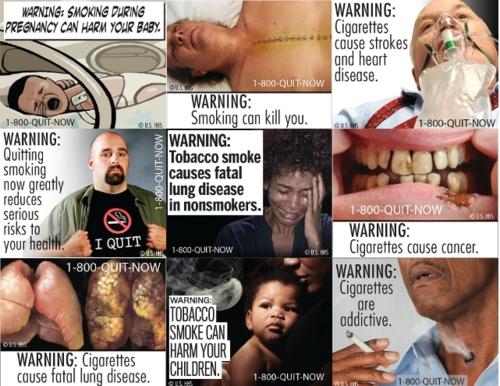
Making good on its promise, the FDA announced [yesterday] that it has informed cigarette manufacturers that they must affix large, graphic warnings to their tobacco products by October 2012. The gruesome labels are already standard in some 40 countries, and the US government hopes the nine images chosen as part of the most significant change to warning label policy in over 25 years will help persuade people to quit and/or avoid the cancer sticks altogether.

What say you? Will these labels convince you to stop smoking?

Samantha Henig thinks the ads are likely to backfire.

Dissent Of The Day

In reaction to our commemoration of the Green uprising, a reader quotes Machiavelli:

How vain the faith and promises of men who are exiles from their own country … so great is their desire to return to their homes that they naturally believe many things to be true, and add a great deal of others on purpose, so with what they say they believe and what they really believe, they will fill you with such hopes that if you attempt to act on them you will incur a fruitless expense or engage in an undertaking which will involve you in ruin.

Every time I read a post you have written about Iran, or the disputed 2009 elections, somehow this Machiavelli quote finds its way into my mind. Whether it is because the Twitter threads you post are in English rather than Farsi, or due to the amount of deference you give to the opinions of the Westernized sons and daughters of the former Pahlavi officials who fled Iran with its national wealth in 1979 never to return, I do not know.

To be clear, I have no love for the Iranian regime. But I do have a love of clear-eyed, intelligent analysis.

Americans return, again and again, to sources of information that have produced arguably the most ineffective policy towards a foreign government in US history; as a State Department official said last year, "we have an almost perfect 30-year track record of being wrong about Iran."

It is remarkable how little you quote someone like John Limbert when it comes to Iran. Limbert was an English teacher in Shiraz during the Shah's reign and one of the diplomats taken hostage by Iranian students. He was the most seasoned Iran expert under Obama, but retired after a fruitless year-and-a-half serving in a subordinate role to Dennis Ross. He is one of a handful of Americans who truly understand Iran. But he is also a proponent of rapproachment with Iran, and so he goes ignored.

I know you find Flynt and Hillary Mann Leverett to be vile. But they are two of a tiny handful of American officials to ever work directly with Iran, during our peak of cooperation in Afghanistan in 2002. They are also the only people in America to have put forth predictions about Iranian politics and be right, over and over again. Yet they, too, go unheeded.

The Leveretts' most recent post sums it up perfectly: "No matter how much energy Americans and others devote to it, the future of Iranian politics will not be shaped by wishful thinking." What Iran hobbyists and others never seem to appreciate is the importance of Iran's national independence. Of course the Iranian people wish to be free, or at least freer. That's an obvious given. But the fierce, nationalistic pride of a people being ruled by an indigenous, independent Iranian government for the first time since the Saffavid Empire is never taken into account. As Robin Wright said, "To understand Iranian nationalism, think of a proud, chauvinistic Texan – and then add 5,000 years". Iranians, in general, will never risk their national freedom for personal freedom.

There are people in the Iranian government who are open to relaxing restrictions on Iranian freedom and moving towards a truer form of democracy. Moussavi did not appear out of nowhere – he was Prime Minister during the Iran-Iraq War, and was allowed to campaign for President by the restrictive Guardian Council. Rafsanjani did not appear out of nowhere – he has been Iran's principal, behind-the-scenes power broker for decades. Ayatollah Khamenei wouldn't even be Supreme Leader without Rafsanjani. And Iran is not a monolithic dictatorship; Khamenei and Ahmadinejad are now bitter political rivals.

But I guarantee you that during the height of the Green Movement, official minds drifted back to 1953, when a "popular" movement rose up to overthrow the government of Prime Minister Mossadeq and install the Shah. Of course we now know that the movement in 1953 was fomented by the SAS and CIA. I highly doubt we even had the necessary assets in place in Iran to try that in 2009 (sanctions and no relations means no diplomatic or commercial cover for American case officers), but surely there were people within the Iranian government who legitimately believed that to be happening. And surely there were common Iranians who legitimately believed that to be happening.

My point is that Iranians will never be able to reform their system of government so long as there is a hostile relationship between the US and Iran. There are too many people, officials and common Iranians, afraid to support something like the Green Movement when it could be a CIA plot, and too many people willing to capitalize on that fear to remain in power. And ironically, every English-laden Tweet, every angry insult to Iran that you post, every anti-Iran op-ed in a newspaper – anything that furthers the gulf between the US and Iran – is a lead pipe to the kneecap of the reform movement.

I am happy to publish my critic's email. But for the record, many tweets were in Farsi, the millions of Iranians in the streets were not an illusion, and this blog has never published "angry insults" to Iran, only criticisms of its disgusting regime. There is a distinction.
The Mistakes Of Afghanistan

AP_AFGHANISTAN_MEDEVAC_110621

Greg Scoblete wishes we had waged a more narrowly focused war:

[I]t's worth pointing out that the U.S. was never supposed to a launch a war against Afghanistan. It was supposed to be against several hundred Arabs and a hodge-podge of other nationalities who had taken up shop in Afghanistan to plot terrorist attacks, plus a slice of the Afghan population that thought sheltering them was a good idea. When the Bush administration largely accomplished that in early 2002, it decided to snatch defeat from the jaws of victory by turning the war into a quest to give Afghanistan something it had not had in decades: a stable government.

Michael Tomasky blames Afghanistan failures on going to war "on the cheap" with "with only 12,000 troops to start." He warns Americans that we can't wash our hands yet:

[W]hat’s happening in Afghanistan and across the region is the beginning of a transformation toward freedom that will probably take at least two generations to make serious progress. The United States can’t sit off to the side while that happens. We have to stay engaged with these countries, and some of that engagement (horrors!) will inevitably involve military and intelligence work.

Really? Why exactly? The lesson, presumably, is that even a super-power can find it impossible to understand distant foreign conflicts very well. When such regions are in turmoil, intervention becomes even more fraught. Yes, we have interests and need to defend them, even as far away as Afghanistan. But minimalism and restraint are what matter here, no? Or is every intervention guaranteed to justify countless more?

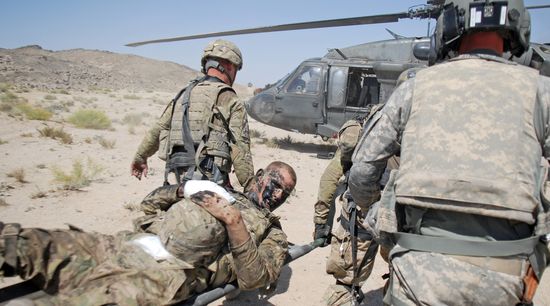
(Photo by Haraz N. Ghanbari/AP.)

Police State Watch

A 69 year-old Virginian man was shot dead after police raided his home because he was suspected of selling prescription pain killers illegally. Balko fumes:

Clearly this 69-year-old man who at worst was selling prescription painkillers (and again, we don’t yet have any evidence of that, other than an alleged tip from an informant, who will likely never be identified) knowingly, intentionally took on a team of raiding cops while armed only with a handgun. No need to question the tactics, here. No need to ask if it was really the smartest idea for armed cops to force their way into the home of a sick elderly man with poor vision to serve a search warrant for evidence of nonviolent crimes. No need to ask any further questions at all, really. Just put your faith in Chief Jordan and the integrity of his department’s not-at-all-predetermined investigation.

He follows up here.

Bristol’s Innocence, Ctd

Marlowe Stern reads Bristol's book so you don't have to:

Levi keeps replacing her finished wine coolers with new ones, and soon Bristol hits “that awful wall” that takes her from a “happy buzz” into “the dark abyss of drunkenness.” (Pg. 3) The last thing she remembers is sitting by the fire and laughing with friends, and doesn’t remember waking up in her tent the next morning “with something obviously askew.”

Bristol awakens in her tent, with no recollection of the night before. She looks over and sees Levi’s empty sleeping bag right beside hers, and hears Levi and his friends “outside the tent laughing.” (Pg. 3) Bristol quickly texts her friend to get over to the tent, and she immediately pops over and tells her, “You definitely had sex with Levi.” (Pg. 4) Despite being brought up in a Christian household determined to save herself until marriage, Bristol laments the fact that her virginity had been “stolen,”

Dan Savage looks up the rape laws in Alaska:

If you have sex with a person who is "mentally incapable; incapacitated; or unaware that a sexual act is being committed," then Alaska—quite rightly—says you're guilty of criminal sexual assault. And the statute of limitations hasn't run out on that night in the tent:

Under Alaska Statutes §12.10.010 prosecution [of sexual assault] may commence up to 10 years after the commission of the offense.

So will Levi be arrested?

A reader doubts it:

Let me get this straight. Are you telling me that, in 2008, when Palin was announcing Bristol's pregnancy to the world (just days after her nomination) that she was describing the aftermath of a rape? Why, then, would she instruct the campaign to say, "Bristol and the young man she will marry are going to realize very quickly the difficulties of raising a child, which is why they will have the love and support of our entire family."? Why would candidate Palin parade her daughter's rapist at the Republican National Convention? And why would Bristol get engaged for a second time to the man who violated her? 

Even if you could explain that last one with some domestic version of Stockholm syndrome, why would Sarah condone it, even temporarily?  Why, oh why, would Sarah (citing "redemption and forgiveness") support continued contact with the man who raped Tripp's mother?  Given what we know about the Palins and vendettas, I find it hard to believe that governor Palin would show more lenience toward such a man than she did to Trooper Wooten. Even the most defiant Palin supporter (perhaps especially they) should have a hard time believing this.

Another:

I'd rather not know anything about Bristol Palin's teenage sex life. But if she's going to put it out there – like a line on her resume – then the resume needs to be examined.

A Fully Extended Metaphor

Mark Krikorian aims for Tom Friedman heights:

[M]any Americans want the body politic to go on a diet. An immigration diet, certainly, but also a military diet, a foreign-policy diet, a government-spending diet, a debt diet (not to mention a diet from telling Americans what to eat). We are a middle-aged country now and, to continue the metaphor, the debt crisis and our over-extended overseas commitments are our warning heart attack — it’s up to us as a people to decide how we’ll respond. Will we cut back on the salt of immigration, the sugar of Wilsonian foreign policy, the fat of massive government debt? (Okay, I’m stretching the metaphor to the breaking point.) Or will we keep gorging ourselves and just hope that we’ll survive the next heart attack?

Push away from the table, America.

I'm non-gluten myself. I think that means I cut agricultural subsidies. I agree with Krikorian's sentiments over all, although the salt of immigration makes America taste delicious.

The Battle Of Tripoli

What happens if the Libyan rebels actually do break out and make it to Tripoli? A bloodbath is perfectly possible:

We know from Iraq, various African states, Bosnia and Afghanistan that turfing out a dictatorial regime which has made lifetime enemies leads to some frightening retribution. In Iraq, pilots, academics, the literati, those working on anything linked to nuclear science, business people with Ba'ath links, wavering co-religionists, those of other religion, various ethnic groups, suspected agents, the remnant middle class and more were targets for killing and kidnapping. This is what we face in Libya. Can the leadership of the Libyan Transitional National Council (TNC) hold back decades of aggrievement when its militias reach the capital?

Wanting Out

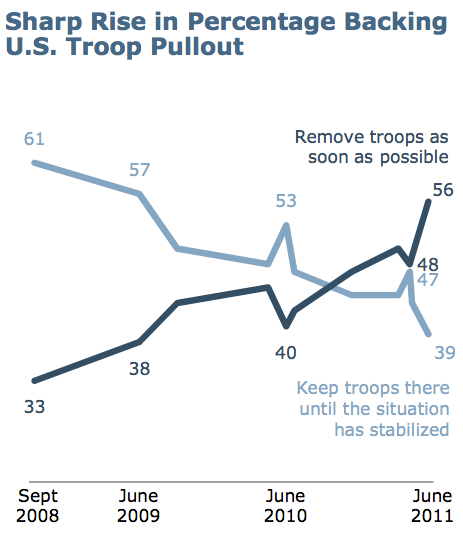
From Pew:

Afghanistan_Opinion

Mark Blumenthal finds several other polls trending in the same direction:

Both the Pew Research and CBS News polls, which have tracked these questions for two or more years, indicate a big jump in desire to withdraw U.S. forces since the killing of Osama bin Laden in early May. The Pew Research survey shows an eight-point jump over the last month (from 48 to 56 percent). The CBS News survey shows a 16-point jump (from 48 to 64 percent) since a survey conducted in the immediate aftermath of bin Laden's killing.

My point here. But notice Obama's skill in this. He defused the idea that he was a McGovernite by committing to the hawkiest strategy devised by the most gung-ho of the Cheneyites – McChrystal. McChrystal imploded, but the counter-terror campaign revved up under Petraeus with the coup de grace being bin Laden's killing. Now, Obama will try to get the benefit of both fighting a war successfully – unlike his predecessor – and of ending it as soon as public opinion has shifted decisively in his favor.

Leading from behind is an interesting meme. And Obama's decisions tend to look better when viewed in a rearview mirror.

Journalistic Integrity: Jon Stewart 1; Fox News 0

I have to say I thought Jon Stewart's correction on Fox News viewers was about as perfect as these things can be. He copped to his own hyperbole, and then provided a list of outright uncorrected untruths that Fox has propagated. The point here is not the untruths – although they are embarrassing for a news channel – but the lack of any correction.

Which is to say that a comedy channel has more dedication to accountability for factual errors than a putative news network. Which tells you almost everything you need to know.