Crime As Disease

David Eagleman imagines that advances in neuro-imaging will change the criminal justice system:

As brain science improves, we will better understand that people exist along continua of capabilities, rather than in simplistic categories. And we will be better able to tailor sentencing and rehabilitation for the individual, rather than maintain the pretense that all brains respond identically to complex challenges and that all people therefore deserve the same punishments. Some people wonder whether it’s unfair to take a scientific approach to sentencing—after all, where’s the humanity in that? But what’s the alternative? As it stands now, ugly people receive longer sentences than attractive people; psychiatrists have no capacity to guess which sex offenders will reoffend; and our prisons are overcrowded with drug addicts and the mentally ill, both of whom could be better helped by rehabilitation. So is current sentencing really superior to a scientifically informed approach?

The Numbers On Prison Rape

Lovisa Stannow relays a disturbing reality:

The U.S. Department of Justice recently released its first-ever estimate of the number of inmates who are sexually abused in America each year. According to the department’s data, which are based on nationwide surveys of prison and jail inmates as well as young people in juvenile detention centers, at least 216,600 inmates were victimized in 2008 alone. Contrary to popular belief, most of the perpetrators were not other prisoners but staff members—corrections officials whose job it is to keep inmates safe. On average, each victim was abused between three and five times over the course of the year. The vast majority were too fearful of reprisals to seek help or file a formal complaint.

Queuing Up For Failure

Failed_map

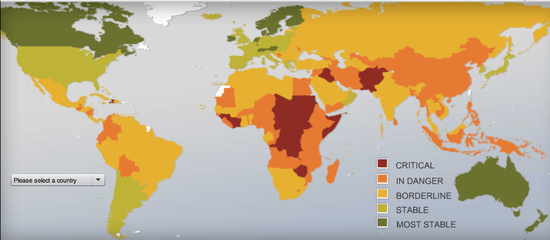
Foreign Policy ranks the failed states of 2011:

Haiti, already a portrait of misery, moved up six places on the index, battered and struggling to cope with the aftermath of January 2010's tragic earthquake, which left more than 300,000 dead. Another former French colony, Ivory Coast, rejoined the top 10, grimly foreshadowing its devastating post-election crisis this year, while fragile Niger leapt four spots amid a devastating famine.

Africa's promise and peril are likely to figure prominently again this year, with 27 African countries scheduled to hold presidential, legislative, or local elections throughout 2011. As much as elections can contribute to democratic progress, they are often a flashpoint for conflict — conflicts that invariably send already fragile states back up the ranks of the index.

Interactive version of the above map here.

Switching Sides

Libby Copeland uses the story of ex-gay Michael Glatze to make a broader point, which I alluded to here, about "people like this who go from one extreme to another":

These are folks who leap from one side of a deeply polarized debate waaay over to the other side, and come out just as bombastic and sure of themselves as ever. I’m thinking of David Horowitz, one-time Marxist and Black Panther supporter turned vitriolic conservative. … I’m thinking of Charlene Cothran, a black lesbian who, after a religious revelation, began to use her gay lifestyle magazine Venus to renounce homosexuality. Glatze is not just a fascinating window into cultural politics; he is also a type.

The Daily Wrap

Today on the Dish, Huntsman launched his candidacy and impressed Andrew as a candidate Obama should fear for all the right reasons. Huntsman still had his detractors, and Jazz Shaw feared Obama's defensive tactics could backfire. Rick Hertzberg classified Sullivan's conservatism, and we became Rome when we started calling ourselves Rome. Palin got punked by her hometown newspaper, Bristol talked smack about Meghan and Cindy McCain, and Sarah wooed us with her unintentional poetry. Elsewhere in political gotcha, Chris Wallace got his facts wrong, but Jon Stewart blurred his own as well.

Balko debunked criminal justice myths, Avent checked in on housing, and Serwer dismantled the moral universe of jokes. We searched out ways to squeeze money from the tax code, and Bruce Bartlett schooled Pawlenty on whether Reagan's tax cuts paid for themselves. Economic bubbles more closely resemble tumors, and crime may solve itself. We kept tabs on gay marriage progress in Albany (and Wisconsin), Obama shifted his stance as he governs like a community organizer, and the law could aid the religious liberty of churches. We continued to plumb the spiritual power of psilocybin, readers corrected Andrew on Glatze going ex-gay, and we assessed how the public views HIV.

We could be on the brink of winning in Libya, we steadied ourselves to drawdown troops from Afghanistan, and Kiera Feldman exposed Birthright's one sided storytelling. Andrew gave ridiculous Drudge headlines some love, Alan Jacobs rebelled against online curating, CNN aped the Dish's VFYW, Canadians rebelled with a riot kiss, and Americans have always been stupid.

Quotes for the day here and here, chart of the day here, cool ad watch here, quote for the day here, FOTD here, MHB here, VFYW here, and contest winner #55 here.

–Z.P.

The Power To Make War

6a00d83451c45669e20154330e6140970c-800wi

Amy Davidson wonders why Obama is reluctant to get congressional approval for the Libyan War:

Is it because he thinks that he can’t get their approval (which should cause him to ask why), because he thinks it’s just a lot of trouble (so are a lot of things worth doing, not to mention ones the law requires of us), or because he’s caught in some web of self-delusion—since he’s not the sort of President, or person, who gets involved with wars, this can’t be one? (It is generally a bad sign when policy decisions provoke politico-psychological speculation.) Or is it a matter of principle—a belief that Presidents shouldn’t have to ask Congress for permission for anything short of D-Day? That might be the most dangerous answer of all.

Ackerman takes "the most cynical interpretation":

Maybe Obama would welcome congressional interruption of the war. That would give him the exit strategy he's so sorely lacked for Libya from day one.

Meanwhile, in the country we're not at war with, a coalition airstrike killed 15 today, including three children.  Campbell Clark sees civilian deaths as the main threat to the mission's success:

The military mission in Libya that began as the enforcement of a no-fly zone and has escalated to heavy air strikes is now facing a test of international and public support: not because of a high death toll of Western combat troops, as in Afghanistan, but because of another toll that goes with air strikes – civilian deaths of the Libyans whom the mission is mandated to protect.

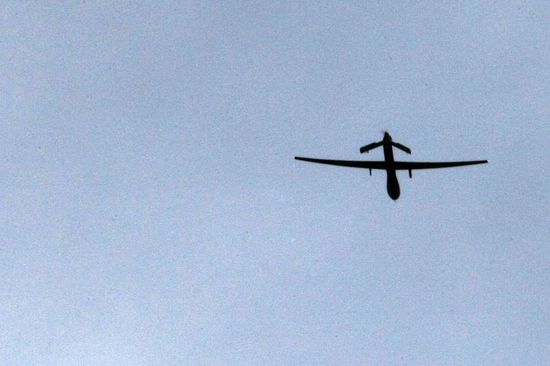
Over in Yemen, Sadeq al-Ahmar, a former Saleh ally and influential tribal leader, calls on Saudi Arabia to prevent Saleh's return, saying it would lead to "sedition and civil war."  Gregory Johnsen warns against the US drone war in this context:

If the US continues to pursue this same flawed strategy it will continue to get the same flawed results – more AQAP recruits and a stronger, bigger organization.  And eventually it will expand this war into something it can't kill its way out of – intensifying or doubling-down or whatever you want to call this new development will yield the same, only more so.

(Photo of a US Predator drone by Joel Saget/AFP/Getty Images.)
Quote For The Day III

"Suppose we enacted a modest fiscal stimulus program specifically designed for maximum job creation. My personal favorite is a tax credit for firms that add to their payrolls, but there are other options. And suppose we combined that with a serious plan for reducing future deficits—and enacted the whole package now. Then we could, in a sense, have our cake and eat it, too.

A package like that is not fantasy. I believe that a bipartisan group of economists, if given the authority, free of political interference, would design some version of it. But that's not how budget decisions are, or should be, made. And as long as one political party clings to the idea that government spending kills jobs, it's hard to see how we extricate ourselves from this mess," – Alan Blinder, WSJ.

The notion that Herbert Hoover was right has become quite a dogged meme on the reality-challenged right. It's bonkers.

Huntsman’s Slim Chances

Massie asks whether Huntsman is "running for the Vice-Presidency or as a marker for 2016":

Huntsman will continue to get a good press (hiring John Weaver, John McCain's image-guy/strategist was a smart move) and that press won't be enough. Nor will many people vote for Huntsman because of his foreign policy credentials: as Spencer Ackerman says, being a diplomat don't give you much suction or juice these days. Anyway, when the C-word comes up we know that Huntsman is going to say something sensible about how America shouldn't be too worried too soon by too much of anything that China might do. Most of the other "leading" contenders will advise Americans to press the panic button and this, I am afraid, will be more effective than anything Huntsman can say.

Chait is more blunt:

The posture of maximal opposition to Obama is the one single thing upon which the entire party agrees. The notion that a dissenter against that consensus might win the presidential nomination is not merely a longshot but totally absurd.

Some GOP Sanity On Marriage Equality

Who else but:

… Huntsman was asked specifically about the growing likelihood of a same-sex marriage bill being passed in New York. Would he seek to overrule Empire State lawmakers should he end up in the Oval Office? "I would respect the state's decision on that," he replied.

The answer, while brisk, nevertheless sets Huntsman apart from his fellow Republican presidential candidates. Other members of the field have offered sympathy for state sovereignty on matters of marriage. But they have usually couched that by saying they would support a federal ban on same-sex marriage as well.

The New Household Gap

Household

Ryan Avent checks in on the housing market:

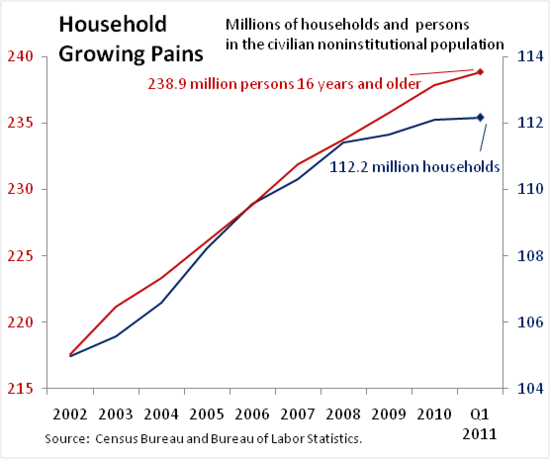
America doesn't simply face a situation in which housing has failed to keep pace with the growth in population. Since the onset of recession, household growth has fallen short of population growth as families doubled- and tripled-up on housing to economise. There are now nearly 2m fewer households than one would expect given growth in population. As economic conditions improve, many individuals and families now living with others in order to save money will seek their own homes. That should spark a period of catch-up household growth, which should in turn spark a large rise in rents and new construction.

Chart from Mark Doms.