Father’s Day Reflections

Jeffrey Goldberg considers why Thomas Vander Woude chose to drown in a collapsed septic tank in order to save the life of his 20-year-old son, who has Down syndrome:

I’m reasonably sure an atheist would sacrifice his life for his child. But I also don’t doubt that Thomas Vander Woude’s powerful faith cleared the path into the tank. A person who has an articulated calling, who believes in something larger than himself, could more immediately accept the gravity of the moment.

TNC reflects on his own father in The Beautiful Struggle:

He wouldn't bend to the will of a backward world and wouldn't allow us to bend either. I was sure that everyone else my age was frolicking in pagan October masks, eating hamburgers and pie a la mode, backstroking through a lake of Christmas presents, while I meditated among stacks of tofu and books. Even after I got Conscious, I felt I'd been robbed of time, that I had been isolated in a series of great childhood events. In my father's house, values ripped us from the crowd. Dad called it enlightenment. But to me it just felt lonely.

Tony Woodlief ponders the meaning of the holiday:

So on Father’s Day we remember what our fathers have done for us, and unless we and they are saints, we remember what they have not done for us, and so perhaps on Father’s Day we forgive, too. We forgive, and we pray, those of us who are fathers, that we might be forgiven as well, some day, for the thousand little neglects, and the dozen graver sins. We pray forgiveness for the stretches of time when we are not fully their fathers, when instead we yearn to belong more fully to ourselves, forgetting that you can never love richly and deeply so long as it is yourself you seek.
Why Netflix Surged

Jonathan Knee argues that "content isn't king":

[T]he dirty little secret of the media industry is that content aggregators, not content creators, have long been the overwhelming source of value creation. Well before Netflix was founded in 1997, cable channels that did little more than aggregate old movies, cartoons, or television shows boasted profit margins many times greater than those of the movie studios that had produced the creative content.

“Saboteurs” And “Germs”

That's what Assad called protesters in an address to the nation today. Needless to say it didn't go over well:

Protesters have taken to the streets across Syria to denounce a speech by President Bashar al-Assad, saying his address did not meet popular demands for sweeping political reform. Rallies were held in major cities including Homs, Hama, Latakia and in Damascus suburbs.

AJE has some reax from political figures.  Daniel Serwer sees the end of the regime on the horizon:

He is unlikely to leave easily or soon, though like any decision by a single person timing is unpredictable.  It is clear however that the foundations of his regime are shaken.  His promise of amending the constitution to allow a multiparty political system would spell the end of the Ba’athist autocracy.  He may try to renege of course, but Syrians show no sign of willingness to accept restoration of the status quo ante.  One way or the other, we are witnessing the end of the Assad regime.

Israeli Defense Minister Ehud Barak gives it six months.

(Video via Mackey)

Following In Reagan’s Footsteps

Peter Beinart remembers the Gipper's modest foreign policies and urges GOP presidential hopefuls to imitate it:

What contemporary conservatives forget about Reagan was that while he spent billions trying to roll back communism, he shared the American people’s profound desire never to fight another war like Vietnam. Military interventions that we today remember as trivial—like America’s 1989 invasion of Panama—terrified Reagan. In fact, he refused to topple Manuel Noriega, even when hawkish advisers pushed him, because didn’t want to start “counting up the bodies.”

Chart Of The Day

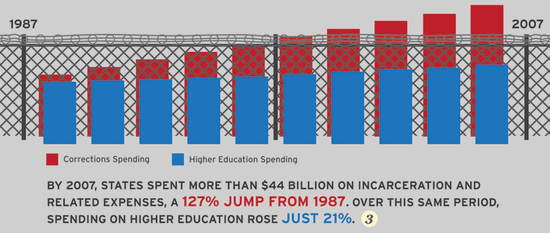
The ACLU has a sobering infographic on incarceration statistics. A detail:

Education_Incarceration

Eric Sterling explains how the Anti-Drug Abuse Act of 1986 came into being:

At the time, the Senate was controlled by Strom Thurmond and the Republicans. They looked at it and said: "OK, well if the Democrats have a sentence of five years to 20 years, let's up it to 10 years to 40 years. And if the Dems say 20 grams, we’ll make it 5!” Nobody looked at the proper ratios based on how harmful it was. It was completely detached from science. Nobody could say that crack was 100 times more dangerous than powder.

The Secret Wars

Jonathan Bernstein isn't too worried about Obama side-stepping Congress on Libya. Instead, he fears "cases in which the president authorizes new conflicts in secret":

I'm far more concerned, to tell the truth, about extensions of the "War on Terror" into various locations outside of Afghanistan. Since those actions are covert operations, it's far too easy for the president to keep Congress in the dark. If that's happening, and I worry it is, it's a far more serious violation of the Constitutional balance even if the president could make a decent case that those actions are authorized by Congressional action way back in 2001, because if Congress is ignorant of important actions then Members cannot judge for themselves, as they are entitled to do, whether they want those actions to continue.

A Lost Decade?

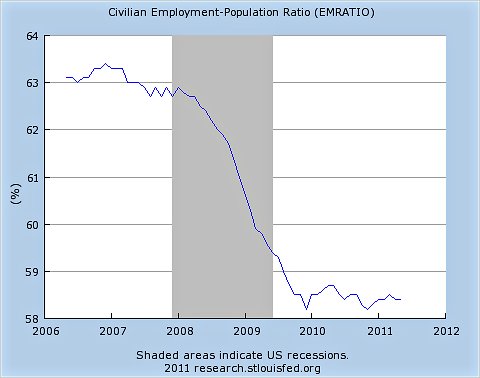
The employment-population ratio:

Employment_Ratio

Paul Krugman predicts a lost decade:

What you see isn’t a recovering economy that may be stumbling; you see an economy that has stopped its free fall, but hasn’t really been recovering at all. I’d say that the burden of proof right now is on those who claim that we aren’t on track for a lost decade.

The ______ In Libya

Andrew Exum is dumbfounded by the Obama administration's attempt to label the Libyan War something other than a war:

[T]his latest episode, which to most Americans I suspect looks like a bunch of eggheads arguing about how many bombs you have to drop for it to be "hostilities" and, while they're at it, how many angels can dance on the head of a pin, is simply one of the stupidest things I've read in some time. It does not pass the laugh test, and the administration has handed an empty net to anyone looking to score points off of this. Just incredibly stupid.

Equality Coming To New York? Ctd

Not today either:

Senate Majority Leader Dean Skelos, R-Nassau County, emerged from a three-way meeting with Gov. Andrew Cuomo and Assembly Speaker Sheldon Silver, D-Manhattan, to say that discussions were continuing on working out the religious exemption language in a same-sex marriage bill. As Skelos notes in the video [here], it was the first three-way meeting between Cuomo, himself and Silver in several weeks.

But the legislative session, which officially ends today, will go on: "Skelos said he expected to remain in Albany for several more days in order to lockdown the outstanding issues." New Yorkers can help by contacting their state senators here.

Why Would Someone Go Ex-Gay?

Ben Reininga reads the NYT's magazine profile of ex-gay Michael Glatze:

Glatze was well educated, professionally successful, romantically fulfilled, and, for all intents and purposes, happy being gay. He had no reason, or no readily apparent one, to renounce homosexuality — no deeply religious past or parents ready to renounce him. And yet, he did it. … On one hand, the struggle for gay rights is based on the idea that you should be able to have sex with and love whomever you choose — man or woman. On the other hand, this guy's not quietly falling in love with women; he's making a case against the gay-rights movement at pretty crucial time.

No, he's making a case for the gay rights movement. The gay rights movement is about enlarging the freedom for everyone not to be gay but to be themselves. If Glatze sees his future as straight, we are fighting for his right to live that way, with no judgment or discrimination and with respect. All we are asking for is the same in return.