This should be an Olympic event – and she'd surely win:
Month: June 2011
The Ripples Of The Green Wave
Isobel Coleman reflects on this year's protests in Iran:
Both Mousavi and Karroubi are under house arrest. They and their wives have been held since February, without any charge or trial, after calling for protests in solidarity with the Arab Spring. The Coordination Council of the Green Path of Hope, the Green Movement’s decision-making body, invited Iranians to participate in a “silent march” through the heart of Tehran on Sunday. Thousands braved their way into the streets, walking quietly and wearing green scarves with their hands and faces painted green, some with photos of Mousavi pinned to their clothes. But far fewer than the million people the Green Movement had hoped for appeared. Still, the government took no chances. It lined the streets with security forces that in many spots seemed considerably to outnumber the silent marchers.
A Tehran Bureau correspondent describes the newer tactics of the regime:
In some ways, the fact that the demonstration happened at all illustrated the resilience of core opposition supporters. Aside from their high numbers, security forces have become increasingly skilled at surveillance and repression. Equipped with new, top-end gear, they have been trained to disperse crowds and avoid escalation of open violence. As lines of riot police partitioned the main thoroughfare from its adjoining neighborhoods, plainclothesmen combed through the crowd and pulled protesters into the side streets, where they could arrest them more discreetly.
Reanimating The Uprising
Dish readers in NYC might want to catch a screening of The Green Wave tomorrow at Lincoln Center. From the Sundance review:
[Writer-director Ali Samadi] Ahadi used a thousand entries in Iranian blogs [to] create two fictional students, whose hopes, fears and experiences with terror at the hands of government security thugs filter through the movie. Poor quality videos from YouTube and the like give the movie its crowd scenes and sequences of brutal violence.
A reader updates:
DC readers can also catch a screening on Wednesday at the AFI Theater in Silver Spring, as part of its excellent SilverDocs film festival. (I don't work for them; I just love that theater.)
What If Azadi Had Been Tahrir?
A reader with family in Iran reflects on the anniversary:
The economy is in really bad shape, at least as far as my family is concerned. Now that the Iranian government cut so many subsidies, especially the gas one – everything else in Iran has increased in price quite dramatically. Even though Iran is oil rich, gas is as expensive there as it is in Europe. The cost of food staples like bread and meat
(currently about $16/kilo) are way up. Salaries are down. The working class is getting its ass kicked – even some people employed by the government went unpaid for many months. Sales in my mother-in-law’s fashion boutique are way down over the past year, and my brother-in-law, who is a businessman, says sanctions are not just hitting the elites, but making business harder for everyone.
The other thing I personally think is so important looking at how we in the West handled that story, is what it started in how seriously we now take social media as a primary source, even if a flawed one. Yes all the Twitter Revolution stuff was mostly bullshit and too-good-to-be-true stories like Austin Heap turned out to be a fraud, but something started that summer that resulted in someone like Andy Carvin having a brand new position in journalism. It did turn citizen journalism, or rather citizen international journalism, on its head – and we have been reaping the rewards since.
Finally, one of the things I’ve wondered is could the green movement protesters have won if they had not just silently marched to Azadi Square the week after the election, but occupied it and held it the way the Egyptians held Tahrir.
In the end, my feeling is that obviously the govt could have opened fire like the Chinese or Syrians did, but that the one thing the protesters did which made themselves easy to contain at relatively little cost was to break up and go back at night to their homes and dorms, etc. If they had never left the streets, never ceded their ground … who knows. They just did not have the leadership or plans in place that the Egyptians did, it was too spontaneous and emotional, also too aligned to the ’79 revolution’s methods, and I really hope that some smart young Iranians are preparing for the next spark, to pull everything and everyone together and the next time take the whole system down.
Did The Green Movement Fail?
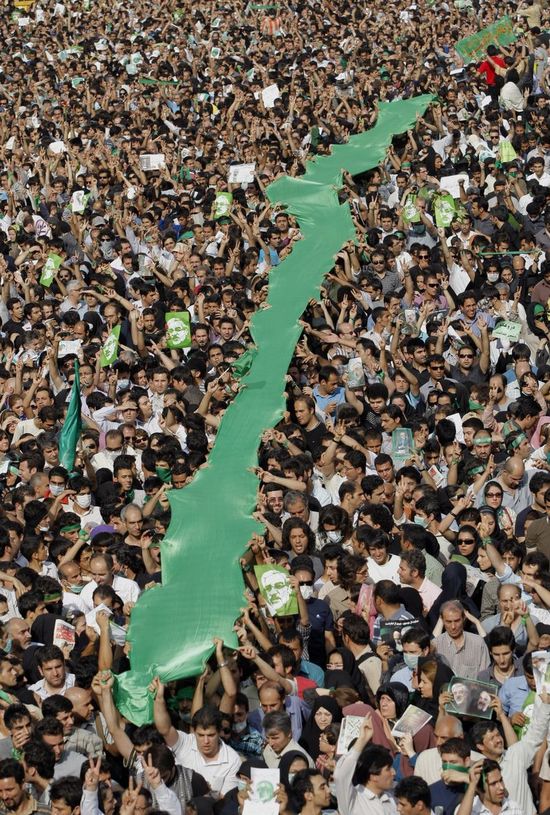
Ramin Jahanbegloo, an Iranian dissident in exile, refuses to consider the movement a failure:
[T]he Green Movement has achieved its goal by gaining the moral high ground, revealing to the world the true face of the Islamic regime, and draining away much of its political legitimacy. Further, it has hastened the end of Khomeinism by exposing the existent political rifts within the Iranian political power.
Maryam Sinaiee quotes Green activist Ali Alizadeh:
The problem with the movement is not the incarceration of the figures considered as the leaders of the movement, but rather its voluntary self-limitation of demands and tactics, its lack of long-term strategy … and its failure to produce a momentum around the incarceration of its symbolic representatives.
Yasaman Baji reports on strategic impasse within the movement:
The larger dilemma at this point for the Green movement, according to an Iranian political analyst who asked to remain anonymous out of fear of reprisal, is that intra-conservative conflicts are beneficial to the Greens, but lack of action could weaken the movement.
Conn Hallinan keeps an eye on the economy:
[T]he economic situation is inherently unstable. So far the government has managed to keep unrest under control by cash outlays and forcing the merchant class—many of whom support the Green opposition—to keep prices artificially low. This forces many merchants to operate at a loss. "Eventually prices will have to be allowed to float," says Poorzad, "and when that happens inflation will go up sharply."
David Rosenberg warned last month about foreign policy implications:
Right now, the battle is confined to the corridors of power in Tehran. But analysts say it could eventually manifest itself in a more aggressive foreign policy as Ahmadinejad tries to demonstrate his independence and score points with popular opinion.
There are also signs that Russia and China are losing patience with Iran. Hussein Ibish situates the Green Movement in the context of the Arab Spring:
The fact is that in spite of Arab unrest and the optimism of the Iranian ruling faction, they have not yet accrued a single tangible, strategic or stable benefit from these uprisings.
Face Of The Day: June 20, 2009

Live-blogging from that awful day here. Money quote:
1.47 pm. A reader writes:
Has it occurred to you that all the unbelievable imagery of the protests is, pixel by pixel, etching itself in the memory of the world and of course now or later back through the satellite dishes and Internet connections into the brains of all Iranians, as an indelible revolutionary iconography that will, over time, supplant the revolutionary mythology of the Republic's founding, on which so much of the regime's legitimacy depends? The way I see it, that truly horrific footage of the conservatively dressed woman bleeding out will do more damage to Ahmadi and Khamenei than any military strike ever could. I think the old Revolutionary era is ending.
These are moments in history whose salience it is simply impossible to know as they happen. But today has already demonstrated both the total bankruptcy of the current Iranian regime and the immense bravery, humanity and genius of the Iranian people.
One of the readers most deeply involved in our June 2009 coverage writes today:
Wasn't Neda basically the first person to ever die that publicly on the Internet?
Certainly on YouTube, because though earlier that week videos had been left up on YouTube of violence where people had just been killed, or blurrily shot in the background – they were not like Neda that moment after she was shot. She dies so up close; you can look into her eyes as they go from life to nothing. And as soon as it was uploaded it was downloaded and reloaded more times then we will ever know. It was obviously a key moment in Internet history.
I know Nicholas Berg was beheaded online and lots of other terrible videos had appeared by then, but not like that on YouTube, not launched into the public consciousness like that. Nobody that obviously innocent had so vividly died online like she did. The entire Web-connected world watched it happen, and it felt like it was as live as any television broadcast, perhaps more so because it was so personal, so raw and reloadable – you could imagine the feelings of the people that recorded it with cell phone cameras just like the ones we had, and how they ran to upload them, to show the world what they had personally seen. The event was even recorded simultaneously by more than one amateur cameraman, who individually uploaded them, thus providing the kind of verification most of those videos from Iran never had.
You could be the President or Ayatollah, or somebody's grandparent in Nebraska, or a high school student in Indonesia and you watched the same one or two videos of Neda. It was a singular, universal online experience – completely unfiltered yet still absolutely and instantly understandable – and delivered to our Facebook and Twitter feeds without our permission, plastered across the blogs we already read. Neda's video made it OK to watch all those other videos that have come after it. It became normal to seek them out and watch them, just as it was normal to turn on the TV and flip to the news.
And I don't think we have been desensitized; in fact, I think we have been re-sensitized. We have learned how to witness the cruel realities of this world without feeling like perverts or voyeurs. We want to see because we know it's so important that we see. It was not just reality TV either, not a car chase on MSNBC – we didn't have to wait for the gatekeepers to tell us, we just had to click, to search. Go try to find a Nicholas Berg video and they are on fringe websites and messageboards which have the intention to shock. Neda is on YouTube with the Bieber tributes and sneezing kittens.
She'll be dying there forever. So will all the Egyptians, Yemenis, Libyans and others whose deaths have been uploaded since. Even a gravestone won't last that long.
Tweets Of The Day: June 20, 2009
A flashback:
12.21 pm. Sodium metabisulfite Na2S2O5 mixed with water (5% solution) cures CS tear gas. Wash eyes with solution
Deeply concerned on what will happen in the coming hours..
My heart is pounding fast as I'm hearing about dead ppl lying on streets in Tehran
Will chemical warfare B next by the gvmt to kill ppl? Seems they're doing anything 2 stop pplBassij opened gunfire on people near Sadeghieh, West of Tehran.
hospital source – Tehran hospitals report hundreds of casualtys –
Unconfirmed – The Army will not follow orders to kill the people
European embassies reportedly open doors for injured, tell families to take them there.
People of Iran – be ready to take people from the streets tonight and give protection
Tehran is burning with the blood of our Martyrs – The streets are full of dead
from a source in tehran: As of an hour or 2 ago, I feel like I'm in a police state for the first time.
It's a delicate dance. Life continues to go on, but as of late this afternoon Basij are everywhere.
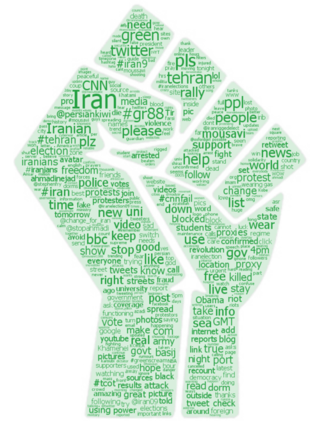
Go here for the full feed from that first week of bloodshed, and here for the second. My take on the role of Twitter and other social media here.
Remembering June 2009: “Two Young Men In Black And Green”
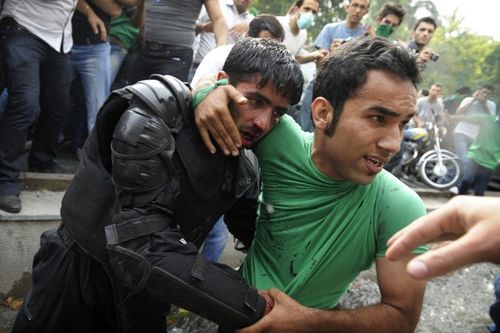
Dish coverage of the first day of widespread violence, June 13, here. A sample:
The BBC has disturbing video of protestors being beaten, and here are images of the protests on Flickr, which is where the above picture is taken from. The NYT's Lede blog has a good round-up of the news coming out of Iran, and, via Insta, another video of Iran protesters. One of the comments says that the protesters are chanting, "Freedom, Freedom, Freedom, Death with this Government."
A weekend wrap of the initial protests – with links to videos, photos, news and commentary – here. A reader wrote of the above immediately iconic photo:
I live in Berkeley and have a lot of Iranian friends in the community here. In 2002 my husband and I went to Iran spending time in Tehran, Shiraz and Esfahan. I feel incredibly lucky to have traveled there and for the perspective I gained on a horribly misunderstood country and people. Through my friends and time spent in Iran, I feel connected to the culture. I'm reading the post-election coverage with tears in my eyes, imagining the disappointment of the people.
The picture of the two young men, one in a green t-shirt, the other a riot policeman sent me over the top – it portrays two young men united by their lack of freedom and the strong spirit of love that is part of the culture. That is why this regime will not last much longer.
Remembering June 2009: “What Now?”
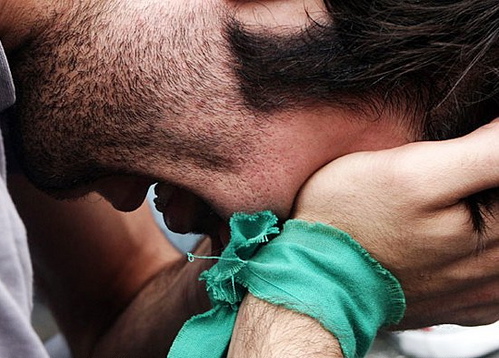
Dish coverage of the first reports of a stolen election here. My reaction that day was as follows:
It's far too early to make sense of what is happening, and what just happened in Iran. It could be another episode of tragic suppression of stirrings of democracy and reform in that theocratic state. It could be a new, more significant marker in the regime's loss of legitimacy among its educated classes. It could possibly lead to real unrest, as riots today revealed, and a much less stable regime. It could lead to an even more disturbingly aggressive and know-nothing government, threatening the world and the region with weapons of mass destruction, precipitating awful conflict. Or it could mean that many of us have been deluding ourselves in thinking that there is not widespread popular support in Iran for hardline religious conservatism.
How the US and Israel and the Arab states react will depend on the next few days and weeks. But if the regime hardens still further, the silver lining is that it could help garner more international support for much more serious economic sanctions and international isolation. It could accelerate the possible Israeli-Sunni alliance against Iran, which might help broker an Arab-Israeli settlement.
Of course, I hope for real resistance in Iran and a weakening of the regime. Despite tactical disagreements, most Westerners want that to happen. And now, even more obviously than before, vast numbers of Iranians despise this dictatorship and want it gone. That's the promise of the green revolution. It will not die because the yearning for freedom never does. But the struggle never ends.
(Photo by Farjad Rajabali)
Remembering June 2009: “Something Is Happening In Iran”
It’s two years to the day since the Green Movement met its moment of truth. In honor of the fallen and of those still languishing under the coup regime, we offer a few flashbacks and reflections on that extraordinary period. Dish coverage on the eve of the Iranian election can be found here and here. The following email sent to us on June 11 best encapsulates the moment:
I just saw your post requesting input from voting Iranians, and I’ve lived most of my life abroad and go to an American university, I will vote tomorrow at an Iranian embassy. My family’s four votes will go to Mousavi.
I’m not voting for Mousavi because I’m a fan of his politics, although I haven’t read anything objectionable among his stances yet. The vast majority of Iranians sincerely believe in Iran’s right to nuclear power (not weaponry), and think Iran should have good relations with the US
but want to have their grievances aired. Much as you and I may disagree with these notions, Mousavi can’t go against them yet. Karroubi is more of a reformist candidate, and of course, some of the hundreds of candidates who got left on the cutting room floor would have been better choices, but you play with the hand you have.
I agree with you that something is happening in Iran. Although I haven’t been there this election season, what I hear from my cousins is that people are really into this election. There has been street fighting and non-stop political debates on university campuses. In a secretive society where having your political opinion too well-known can get you in trouble, tens of thousands of people are showing up every day at rallies that brazenly call the incumbent a liar and a thief. Mousavi’s supporters aren’t just among the young, middle class, and female either – plenty of people in the smaller cities and provincial capitals are flocking to him.
Part of me feels like this might be a make or break moment for reformists.
If Mousavi wins, the conservatives will do everything they can to undermine him, the way they did with Khatami. But if he loses, the situation becomes far worse, because, as Ahmadinejad has indicated in widely publicized private comments, there’s no way he’ll win and NOT try to make himself president-for-life. Iranians seem to have two paths: they can either elect a Gorbachev, make some sacrifices, and hopefully get an improved political system in a couple of decades, or they can elect a Saddam and watch as their country goes down the road of Iraq.
One more thing: do not discount the power of vote rigging. I expect the vote to be close, but anything that gives Ahmadinejad more than 60% of the vote has definitely been rigged. Of course, there are also more subtle ways of modifying the outcome: bussing his supporters to the booths with state funds, running out of ballot paper in the voting booths of Tehran, voter intimidation by armed thugs, and so on.
Anyway, the main reason I’m writing to you is to thank you for your attention to this very important issue. I know Iran isn’t the most important country in the world by any metric, and is always in the news for the wrong reasons, but it does surprise me that so many American politicos, on both sides of the political aisle, who claim to have the best intentions of the Iranian people at heart are totally ignoring this important election. God bless you and Josh Marshall. If the worst does indeed happen tomorrow, at least there will be some record of the nation’s resistance in the mainstream American political dialogue.
Regardless of the final count tomorrow, I think this will be a huge milestone of democracy in the Middle East. While Iranians have in the past made bad choices, they are WAY ahead of their peers in the Muslim World when it comes to democracy. In 1905, before the vast majority of Muslim states even declared independence, Iran already had a constitution and the right to vote given to all men. Iran had an actual revolution the year after, where people fought the monarch’s men in the streets so they could protect their new rights. From 1940 to 1952, Iran actually had an almost functional democracy, while most of its neighbors either had dictators or monarchs. Iranians brought about another revolution for expanded political rights in 1979, before most of the Eastern European nations threw off the yoke of Communism. Let’s hope they teach a thing or two to their neighbors again tomorrow.
 The Dish