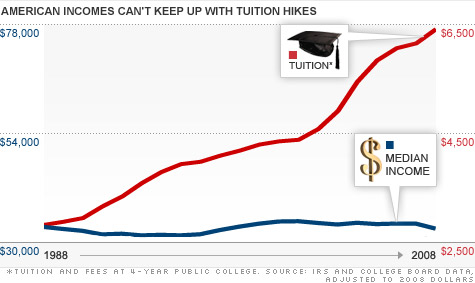
Annalyn Censky does the math on higher education costs:
In 1988, the average tuition and fees for a four-year public university rang in at about $2,800, adjusted for inflation. By 2008, that number had climbed about 130% to roughly $6,500 a year — and that doesn't include books or room and board. If incomes had kept up with surging college costs, the typicalAmerican would be earning $77,000 a year. But in reality, it's nowhere near that. In 2008 — the latest data available — the median income was $33,000. That means if you adjust for inflation, Americans in the middle actually earned $400 less than they did in 1988.
I share the concern, expressed by many atheists, that terms like “spiritual” and “mystical” are often used to make claims, not merely about the quality of certain experiences, but about the nature of the cosmos. The fact that one can lose one’s sense of self in an ocean of tranquility does not mean that one’s consciousness is immaterial or that it presided over the birth of the universe. This is the spurious linkage between contemplative experience and metaphysics that pseudo-scientists like Deepak Chopra find irresistible.
But, as I argue in The Moral Landscape, a maturing science of the mind should help us to understand and access the heights of human well-being. To do this, however, we must first acknowledge that these heights exist.
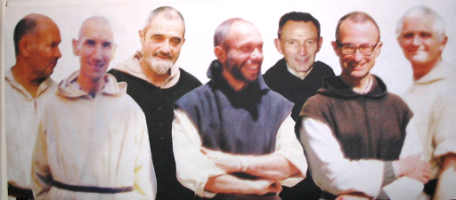
I finally managed to see the Cannes Grand Prix winner, about a small group of monks serving an impoverished local community as Jihadists slowly approach. It is not a spoiler to say it does not end with the physical survival of most (but not all) of the monks. And this farewell letter by the head of the Order, Frere Christian, captures the film’s core message:
Should it ever befall me, and it could happen today, to be a victim of the terrorism swallowing up all foreigners here, I would like my community, my church, my family, to remember that my life was given to God and to this country. That the Unique Master of all life was no stranger to this brutal departure. And that my death is the same as so many other violent ones, consigned to the apathy of oblivion. I’ve lived enough to know, I am complicit in the evil that, alas, prevails over the world and the evil that will smite me blindly.
I could never desire such a death. I could never feel gladdened that these people I love be accused randomly of my murder. I know the contempt felt for the people here, indiscriminately. And I know how Islam is distorted by a certain Islamism.
This country, and Islam, for me are something different. They’re a body and a soul.
My death, of course, will quickly vindicate those who call me naïve or idealistic, but they must know that I will be freed of a burning curiosity and, God willing, will immerse my gaze in the Father’s and contemplate with him his children of Islam as he sees them. This thank you which encompasses my entire life includes you, of course, friends of yesterday and today, and you too, friend of last minute, who knew not what you were doing. Yes, to you as well I address this thank you and this farewell which you envisaged. May we meet again, happy thieves in Paradise, if it pleases God the Father of us both. Amen. Insha’Allah.
The story is a true one, based on the assassination of the monks of Tibhirine in Algeria in 1996, by a Jihadist gang. The film, directed by Xavier Beauvoix, is about how one confronts and defeats evil, in a fallen world. It reminded me powerfully of Camus’ The Plague, especially the spiritual evolutions of Camus’ Pere Paneloux and Beauvoix’s Frere Christian and their brutal educations in the ways of love and death and responsibility. The other obvious parallel is between Camus’ Dr Rieux and Beauvois’ Frere Luc, two doctors who continue to “fight the plague” one band-aid after another. Camus, an existentialist, gave his opponent, the man of faith, a spiritual growth in his novel. And in this movie, we also see the rigid authoritarianism of an abbot evolve into the humbler, more Christ-like, leader from behind. It is rare that a film can credibly reveal faith germinating in and transforming a human soul, and also the dark night of despair and faithlessness that is always never far away.
The movie, moreover, is about our religious war, which is why I hope more Americans see it, even though its factual origins lie long before the conflict tore through the sky in Manhattan. We see the choice between a corrupt government and a resistance of twisted, wicked, murdering theocrats. We see the need to oppose evil, not to mistake it – and yet, crucially, the necessity not to empower it by adopting its own logic of fear. Once you fight Jihadism with Jihadism, religious violence with religious violence, you have merely entered a vortex of self-destruction. You cannot “win” the war that way in the end, although you can snag a few Pyrrhic battles along the way.
What Christian says in the quote above – which is verbatim the note he specifically left behind to be read in case he were murdered – is that only hope conquers fear, and that only true faith can conquer false faith. There is a Christmas scene in which local Jihadists assault the monastery and demand medicines (the Midnight Mass in the Youtube above immediately follows that confrontation). Christian insists that he will not speak with anyone with weapons inside the monastery walls. This is a place of peace he insists. He is unarmed and defenseless but his manifest integrity disarms the thugs temporarily.
And outside, he calls the Jihadist leader’s bluff by knowing the real Koran as well as he does. The name of Jesus literally defuses the conflict. This is the moment of hope here – before darkness descends again: a mutual Muslim and Christian reverence for Jesus. From that moment on, the monks’ faltering, doubt-riddled, fear-ridden, gradual decision to risk martyrdom rather than compromise their faith seems to come from almost outside of them, beyond them.
Like many, I reacted to the outrage of 9/11 with anger, grief, and a righteous desire to do something to defeat this evil. I did not yet see that responding with more violence could not solve the problem and might even worsen it. I can still see the justice and necessity of warfare against theocratic terrorists – against al Qaeda in Afghanistan and Yemen, for example, as long as it is conducted with constitutional checks and balances, acute concern for civilian casualties, and within the laws of war. And one thing Of Gods And Men does not disguise is the wickedness and depravity of religiously motivated mass murder. At one point, even Pascal is cited:
“Men never commit evil so fully and joyfully as when they do it for religious convictions.”
But I also learned that believing that something is evil does not necessarily make you good. I learned that the Iraq war was an appalling lapse into anarchy and mass murder, paved with good intentions as well as, let’s face it, a desire for revenge. I also saw the country I love adopt and legitimize an absolute evil, torture, to fight back. I have been changed by this decade. I worry about anyone, on any side of the debate, who hasn’t been.
Over this decade, I have learned never to conflate Islamism with Islam, and never to equate the West with unalloyed goodness, and yet I have also never doubted the need to fight Jihadism as well. I have learned that there are many ways to defuse Islamist terror – including the amazing democratic revolutions these past few months, or the unsung triumphs of patient intelligence gathering, or a more careful security apparatus – which avoid the trap of mere violence.
I have retained my core belief that the war we are in is, at root, not that of Islam and Christianity, or Jew vs Arab, or Sunni vs Shia, but of secularism (which cherishes freedom of religion) against theocracy (which seeks to extirpate all but one heretical version of one religion). But I also see the increasing danger of war in an age of technological means of mass destruction, and the terrible danger of creating more Jihadists by fighting them too crudely. If we embrace a war of civilizations, we guarantee the risk of ending all civilization.
The only answer to this dark place is love and forgiveness. The only answer to fear is hope. The only workable response to twisting religion into murderousness is patiently unfolding it back into love. Amen. Insha’Allah.
a sweeping majority of Israelis – 63.5%, to be exact – think the Jordan valley is part of Israel; in other words, not part of the West Bank; or, in plain words, don’t understand why or how Israeli presence there is being called into question.
After the 1967 war the Green Line disappeared from maps in Israel. When I first visited Israel in the mid-1980s the maps I got there—and all those I saw—showed no border between Israel proper and the West Bank-Gaza (or with the Golan heights). Moreover, Israeli maps from ’67 to the peace treaty with Egypt showed no border with Egypt either; Israel continued into the Sinai until the Suez canal (or to the buffer zone after the Sinai II agreement).
Similarly, Arab maps show no Israel at all. It's increasingly clear to me that a two-state solution is as far away as ever, so far as the Israelis are concerned. Greater Israel has been internalized as Israel. That's also why so many Jewish Americans are formally opposed to the settlements, yet manage always to prevent any serious action against them.
One [study], of starlings, concluded that these birds become optimistic or pessimistic based on living conditions. Another showed bereavement in baboons. Pessimism and optimism and bereavement are not fleeting feelings. Studies like these show that animals' emotional states are not just a series of snapshots. They are beings who have long-term emotional states.
(Photo: A hoary marmot wandered through a park sniffing each flower. Balcombe cautions: "We should be guarded before we assume that we're the only gourmands in the world.")
Rebecca Goldstein sees a spike for Spinoza, partially because of "the heightened public interest in the raucous debates between science and religion":
Spinoza’s identification of God with nature […] makes an invaluable contribution to this issue—precisely because it’s subtle. As does his attempt to establish morality on the purely secular grounds of the scientific study of human nature.
[W]hatsoever can be perceived by the infinite intellect as constituting the essence of substance, belongs altogether only to one substance: consequently, substance thinking and substance extended are one and the same substance, comprehended now through one attribute, now through the other. So, also, a mode of extension and the idea of that mode are one and the same thing, though expressed in two ways.
This truth seems to have been dimly recognized by those Jews who maintained that God, God's intellect, and the things understood by God are identical. For instance, a circle existing in nature, and the idea of a circle existing, which is also in God, are one and the same thing, displayed through different attributes. Thus, whether we conceive nature under the attribute of extension, or under the attribute of thought, or under any other attribute, we shall find the same order… Wherefore of things as they are in themselves God is really the cause, inasmuch as he consists of infinite attributes.
"It has a long way to go before it can even be called simplistic," – Hitch on David Mamet's conversion to the Breitbart-Goldfarb totalist version of conservatism.
I.e. reification and then hatred of "liberals," which can mean anything and anyone from Colin Powell to Noam Chomsky. We are surely now way past the decadent stage of the left-to-right intellectual migration. All we are seeing now on the right is initiation into a faction.
Everybody was arguing about whether he is an anti-semite or not an anti-semite. What I say in the book is, even though his behavior was despicable, are we obliged to think somebody is or is not something? Isn’t it possible for somebody to have both racist and non-racist parts of their brain that can be coexisting in a single person — where he might say things at one point and feel bad about it at another point? To say that somebody has true colors — that there’s sort of one thing this person is — isn’t nuanced enough with our understanding of modern neuroscience. People are complex in this way. They contain multitudes.

 The Dish