Life Isn’t Fair (And When It Tries To Be, It’s Very Expensive)

Ostap Karmodi reprints an old interview he conducted with David Foster Wallace in 2006:

[A]t least in America, one of the things that drives us crazy is our professed ideal to try to be fair to everyone. To try not to exclude or discriminate. And in some ways America has made progress in realizing as a culture for instance how terribly black Americans have been treated, how unfairly women have been treated, how handicapped people have been discriminated against by things as simple as staircases that wheelchairs can’t get up. What you see in America right now, though, is yet another backlash. It’s so expensive and so difficult to try to be fair to everybody, and it ends up with so much litigation and so many people howling for their rights, that many on the right wing and many in business simply want to throw up their hands and say “Fuck the whole thing and let’s just go back to the state of Nature and war of all against all.” This all gets really tricky.

My personal belief is that because technology and economic logic has gotten so sophisticated, cruelties can be perpetrated now that would have been unimaginable two or three hundred years ago. Therefore we are under more of a moral obligation to try very very very hard to develop compassion and mercy and empathy.

“A Hybrid Of Oprah And Reagan”

Mark Joseph, author of Wild Card: The Promise and Peril of Sarah Palin, thinks the former half-term governor will sit out 2012 and run for president later. How's this for wishful thinking:

She should step out of the spotlight, and spend time reading the great works of her movement — Rusher, Buckley, Chambers, Friedman, Hayek, Johnson, Solzhenitsyn, Sowell, etc. — and grapple with how to apply those principles to the Internet age.

She should host a syndicated daytime TV talk show that mixes politics and pop culture and earn the trust of the American people over the next decade. That would allow her to overcome the awkwardness and syntax issues that seem to plague her from time to time. If she did that, she could become a powerful force, a sort of hybrid of Oprah and Reagan.

Face Of The Day

117006537

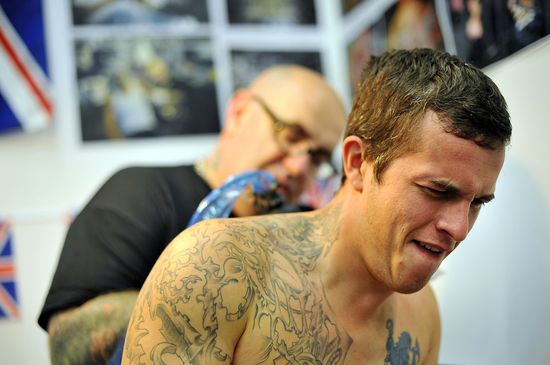
Shephen Shine, 27, who was injured in Iraq in 2007, in pain as he is tattood with a regimental tattoo during Ink For Heroes on June 18, 2011 in Catterick, England. Ink For Heroes is a charity event to raise money and awareness of the soldiers that get injured during service, with all proceeds going to both 'Help The Heroes' and 'The British Legion'. Injured soldiers can also get tattooed for free during the event. By Bethany Clarke/Getty Images.

Fiction vs Facebook

Lisa Lebduska questions the habits formed on social networks:

Like all tools of such ubiquity and power, Facebook must be recognized for what it is — a medium that invites carefully polished reflections of our favorite self. But writers generally write for readers other than that self. …

How often do we ask students to hear, read and truly understand a viewpoint different from their own? How often do we expect them to think of someone, anyone, other than themselves? The ability to imagine a perspective other than our own — the idea of an audience consisting of curious minds rather than adoring fans — defines our most effective writers.

Zadie Smith's essay on Facebook is worth revisiting:

What is your relationship status? (Choose one. There can be only one answer. People need to know.) Do you have a “life”? (Prove it. Post pictures.) Do you like the right sort of things? (Make a list. Things to like will include: movies, music, books and television, but not architecture, ideas, or plants.)

Philosophy Is Knowing How To Die

A theory:

There is a point beyond which philosophy, if it is not to lose face, must turn into something else: performance. It has to pass a test in a foreign land, a territory that’s not its own. For the ultimate testing of our philosophy takes place not in the sphere of strictly rational procedures (writing, teaching, lecturing), but elsewhere: in the fierce confrontation with death of the animal that we are. The worthiness of one’s philosophy reveals itself, if anywhere, in the live performance of one’s encounter with one’s own death; that’s how we find out whether it is of some substance or it is all futility. Tell me how you deal with your fear of annihilation, and I will tell you about your philosophy.

A Poem For Sunday

Aerial

"Miracles" by Walt Whitman:

Why, who makes much of a miracle?
As to me I know of nothing else but miracles,
Whether I walk the streets of Manhattan,
Or dart my sight over the roofs of houses toward the sky,
Or wade with naked feet along the beach just in the edge of the water,
Or stand under trees in the woods,
Or talk by day with any one I love, or sleep in the bed at night
with any one I love,  …
These with the rest, one and all, are to me miracles,
The whole referring, yet each distinct and in its place.

The full poem can be found here.

(Image: Aerial Views by Bernhard Lang)

Ideologies 101

A history teacher picks apart causation and blame in history studies:

What’s striking about conversations involving this topic is the extent to which students are willing (often through no fault of their own) to attribute events to ideologies – as if Nazism itself were responsible for the Holocaust. Regarding Nazism (and Fascism, too), I stress that, without Nazis, Nazism (as an ideology) would have been unable to do, well, to do anything. This, I think, is key: that students confront the idea that systems of belief are not, in and of themselves, capable of destruction. Ideology becomes dangerous – in a historical sense – when individuals activate their core tenets.

My italics.

Erotica As Religion

Carmela Ciuraru remembers the impact of the French erotic novel The Story Of O, written in 1954 by Pauline Réage:

In her disciplined effort toward transcendence, O is not unlike a zealot giving herself to God. O’s devotion to the task at hand takes the form of what might be described as spiritual fervor. She loses herself entirely—and, after all, the loss of self is a goal of prayer. If O is willing to sustain her devotion all the way through to her own destruction, so be it. She wants to be “possessed, utterly possessed, to the point of death,” to the point that her body and mind are no longer her responsibility. “What does a Christian seek but to lose himself in God,” Aury, a devout atheist, once said. “To be killed by someone you love strikes me as the epitome of ecstasy.”