Hitchens shares his thoughts on death:
Hitchens shares his thoughts on death:
Unagidon contemplates its recurring presence in his life:
My old friend Brother [Depression] forces me to live in the present. Not in some Zen way of “be here now”, but in a more primitive way of always arm wrestling with the devil. And behind all of this my faith has changed. Being a modern man, I want to believe that attitudes precede action. In our culture, this applies to faith, creativity, and to happiness; all will be well if we can just get our mind right (first). Having done this our actions will then flow out naturally in righteous spontaneity. But Brother D causes me to focus on the now. There is no time to get my mind right first. And although he is an exhausting friend to have, like a big dog that never sleeps and always wants to play, I find that at least a little, and a little more each day, I am finding myself blessed to have him around.
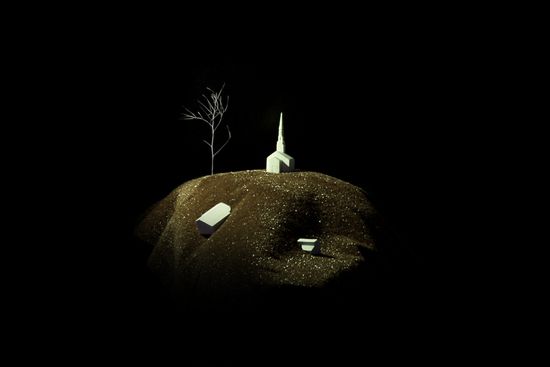
Emma Marris catches up with evolutionary biologist David Sloan Wilson, who has shifted towards something that looks more like community organizing. One of Wilson's recent projects in Binghamton, New York, is trying to understand the function churches serve in the community:
Wilson's trait of interest is the 'openness' of churches. Traditional protestant denominations, of which Wilson is fond, tend towards openness: details of belief and moral codes are individual, arrived at after prayer and discussion. Newer, conservative churches that adhere strictly to the Bible as a literal text would be considered less open. Wilson would like to understand from an evolutionary perspective why the membership of open churches in Binghamton is currently declining, but 'closed' churches are booming.
Perhaps uncertain times create a fearful and socially isolated populace, interested in firm and clear guidance. Or perhaps closed churches uplift their members or focus on group solidarity and recruitment. When people's economic and educational situations are better they may become attracted to more open churches. And Wilson says it is possible that the open churches, by allowing congregants to draw their own conclusions in matters of faith, predispose them to losing faith altogether. Wilson hopes to test these ideas.
(Image: Canonicus begets the Lily-Whites by Jon Bobby Benjamin)
Clifford Longley answers (gated) the question of free will from a religious perspective:
We do not make entirely free choices; we go around, usually, acting in character. … This seems like very old wisdom: one can almost hear the voice of the psalmist. To become virtuous, learn the habit of acting virtuously; then your instinctive or impulsive actions will be in step with your virtuous character, and will be moral.
Omri Ceren raises an interesting point on the free will of communities as a whole:
We can, together, in the context of collective deliberation, design things that incline us to be more or less moral. That remains true even if our individual “decisions” to participate were in a sense unwilled, and if our future “decisions” will come entirely from our brains. Even if each of us cannot be more or less moral, we can together construct more or less moral institutions.
(Hat tip: Mark Vernon)
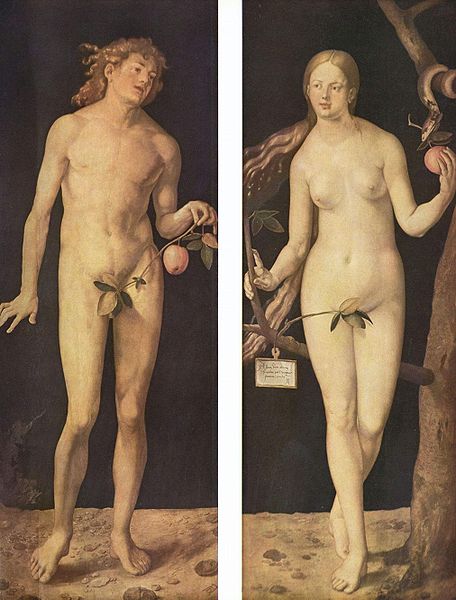
Christianity Today searches for a historical Adam and Eve. Philosophy professor Michael Ruse tries to reconcile theology with science:
When did a Nobel Prize winner ever change his or her mind in the face of a reinterpretation of the Trinity? It may be true that this is a one-way process, but in no way does this imply that theology is inferior. The changes are part of theology. If we are made in the image of God (and Augustine was right here), then we have the power of reason and the ability to learn and understand the world that God created. We have the ability and the obligation. This means doing science, however uncomfortable it may be.
Russell Blackford and Jerry Coyne critique the logic.
(Image: Adam and Eve by German artist Albrecht Dürer via Wikimedia Commons)
In Humanism: A Very Short Introduction, Stephen Law writes:
The view that we cannot say what God is, only what God is not… has its attractions, perhaps the most obvious being that, if you never say what God is, you can never be contradicted.
Mark Vernon extends the thought:
Imagine you have lived all your life in a landlocked country, where there is no talk or sight, let alone comprehension, of the sea. There's not even the word. Then, one day, you venture across the horizon and after a long journey reach the end of land. And you see it. The sea. Astonished, you contemplate the view for a while and then you head back to your fellows. You try to describe what you've seen. It's not land, you begin. It's not hilly or mountainous, you continue. It's not possible to walk across it. It's not covered with grass and trees. It's a bit like that lake, only it has no apparent bounds and it does weird things like approaching the land and then retreating from it, day by day.
You take the point. … Similarly, as Aquinas says of God, it's not that mere mortals can have no knowledge of God, but because by definition what God truly would be lies beyond comprehension, that knowledge will always be provisional and hedged with mystery.
Brett Salkeld posits that it might be:
The fact is that virtually every couple will go through times when their drives, tastes, and bodies seem less compatible and when they seem more compatible. And, as most marriage counsellors will tell you, in this their sex lives mirror the rest of their lives together. The real problem about the search for “sexual compatibility” is that it abstracts sex from the broader relationship. It makes good sex the result of a biological fluke rather than the natural outcome of a loving relationship.
Eric Barker quotes a study of 2035 married individuals:
Is it better to test sexual compatibility as early as possible or show sexual restraint so that other areas of the relationship can develop? … Both structural equation and group comparison analyses demonstrated that sexual restraint was associated with better relationship outcomes, even when controlling for education, the number of sexual partners, religiosity, and relationship length.
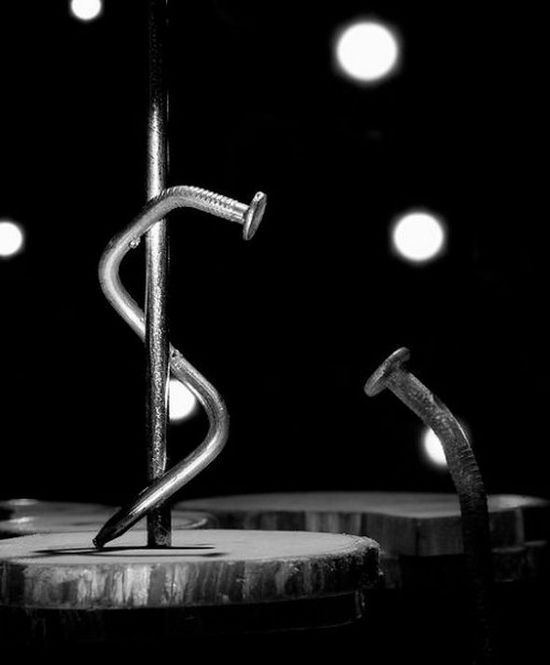
(Photo: from a series by Czech photographer Vlad Artazov)

Munich, Germany, 7 pm
Susan Orlean bemoans the findings of a new study that tested students' basic knowledge of history:
Most fourth graders can’t say why Abraham Lincoln is an important historical figure? Wow…. Being able to reel off a list of dates in history, while useful, is so much less important than understanding why those dates matter…
When a machine can do something better and faster than a person can, I am happy to let the machine do it. (Why tie your shoes when you can use Velcro? Why add a long list of numbers when a calculator can do it faster and more reliably?) But understanding who we are and how we came to be the way we are? That’s not Googlable now, and I hope it never will be.

Marilyn Monroe, from a photo essay of famous people hanging out with their vinyl records.
(Hat tip: Xeni Jardin)
 The Dish