The Organ Bank

Scott Carney visited an Indian refugee camp known as Kidneyvakkam, named because so many of its female residents have sold their kidneys:

One of these women, her name was Rani, gave up a kidney because her daughter had actually tried to commit suicide because she was in a very difficult marriage … In order to treat her, the hospital needed a certain amount of cash — I think it was about $1,000 — and [Rani] didn’t have any money so she did the only thing she could, which was to sell her kidney because an organ broker just sort of approached her very quickly. And that’s a pretty common situation.

NPR features an excerpt from Carney’s new book, The Red Market, where he tallies his total worth according to his organs.

Summer Movie Morals

Reihan reads deep into "Super 8":

For all of our learned passivity, movies like "Super 8" remind us that we are stronger and smarter and braver than we've come to believe, or at the very least that we want to be. More than any major motion picture in recent memory, it connects with something deep in the American character. It captures our long-buried desire to be the authors of our own lives. And as we endure an endless barrage of campaign ads between now and November of next year, we'd do well to remember that. No politician can give us a sense of purpose and direction, or deliver us from our fear of the future.

Koh Really?

106560563

A case-study in the responsibility of government or the corruption of power? Jack Goldsmith – no virgin in the brothel of legal defenders of presidential power – puts the velvet boot in:

Legal Advisor Harold Koh … spent his entire academic career studying and writing about presidential war powers, including the War Powers Resolution.  Based on this academic record, one would not have expected Koh to push an unusually narrow interpretation of the WPR.  Nor would one have expected him to have supported the original constitutional justification for unilateral presidential intervention in Libya.  To get a flavor of what one might have expected, consider what Koh’s former colleague Bruce Ackerman said in support of his nomination to lead State-L:

This is the real importance of the Koh nomination.  President Obama has selected one of the few lawyers who probed deeply into the constitutional implications of presidential unilateralism and how it might be controlled.  Koh would be taking his position as legal adviser at one of the rare moments when it might be politically possible to consider a National Security Charter that aims to restore an effective system of checks and balances.

This is not how things have worked out.  One wonders why. 

Indeed one does. Goldsmith speculates here.

It seems to me that that Libya decision was a truly fateful one – a moment when the Obama administration briefly became the Clinton administration. Maybe this well-intended but rash and foolish intervention – egged on by the exact same crowd that gave us Iraq -  was a function of the necessary compromises in making a primary runner-up such a powerful – and effective – figure in foreign policy. But for those of us who saw Obama as a corrective to the mindset of the Clintons and the Bushes, there is more than a little reason to feel abandoned – and anxious about the country and this presidency in this ill-begotten clusterfuck of a not-war.

(Photo: US State Department legal adviser Harold Koh (L) answers a question as he stands next to US Assistant Secretary of State Michael Posner during a press conference following the United States' first review before the United Nations (UN) Human Rights Council, on November 5, 2010 at the UN Offices in Geneva. By Fabrice Coffrini/AFP/Getty Images.)

Romney: Not That Pro-Life

He explains his moderate and reasonable position here, in refusing to sign an anti-abortion pledge demanded by a pro-life group. I’m a little stunned by his willingness to resist pandering so far – specifically on Afghanistan with the neocons and abortion with the theocons. These are the things one expects once someone (let alone Romney!) has wrapped up the nomination, not still seeking it – from religious fundamentalists and America Fuck Yeah interventionists.

K-Lo follows the leader; others not so much.

A Poem For Saturday

Warinart

A 20-year-old Bahraini student and poet named Ayat al-Qurmezi has been detained since March and was sentenced this week to one year in prison. From her poem "Khalifa":

Hear me:
You, the elder,
the "good man", who "safeguards justice"
(so you have always declared),

if I were to make excuses for you,
I, for you,
for the things you have done,
I would only look the fool,
for you would continue in your ways,
and murder us as "traitors".

The full poem is here. Sophia Jones lists other poets punished in the Middle East:

Waleed Mohammad al Rumaishi had his tongue cut out after reciting poetry in support of embattled Yemeni President Ali Abdullah Saleh. In 2009, civil servant and poet Moneer Said Hanna wrote a five-lined satirical poem about former Egyptian President Hosni Mubarak, and is now serving a three year sentence, as well as paying a fine of over $16,000. Syrian poet, Faraj Bayrakdar, now fuels the revolution from Sweden after enduring over 13 years of torture in prison where he would carve pens from wood splinters and make ink from tea leaves in order to write poetry.

Robert Frost said that poetry is what gets lost in translation, but for Ayat al-Qurmezi and her fellow dissident poets, the message is quite clear.

(Image from "Art of Innovation,” a series by Geliographic, a studio based in Moscow via Nag On The Lake)

King Barack I, Ctd

6a00d83451c45669e20154330e6140970c-550wi

Charlie Savage's scoop on how the illegal war in Libya came to be deemed legal by the president who launched it is devastating on many levels.

First off, a president very punctilious when it comes to process, essentially demoted the Office Of Legal Counsel. He sought legal advice – against precedent, from other lackeys lawyers on his administration to get the decision he wanted n the first place, and treated the OLC's usually definitive decision as just one among many. Remember Bush? What he did was stack the OLC with second-rate lackeys lawyers who would reliably provide specious "legal" reasons to justify even the most brazen of law-breaking, as in the use of torture. Obama was not quite so crude. Instead of stacking the OLC, he bypassed it. Jack Balkin makes the obvious point:

Obama's strategy, like Bush's, also short circuits the normal process of seeking opinions from the OLC; it simply does so in a different way.

By bypassing a careful set of procedures designed to produce careful legal opinions, George W. Bush was able to say that he was following the OLC, or at least a rump of the OLC. But he was effectively undermining the OLC's function as an honest broker of executive branch opinions. Obama also bypassed this same careful set of procedures by canvassing various lawyers until he found opinions he liked better than the OLC's. If one is disturbed by Bush's misuse of the process for vetting legal questions, one should be equally disturbed by Obama's irregular procedures.

There's no inherent Constitutional bar on the president making the final decision on legal matters. But the tradition of an independent legal entity at the Justice Department to provide objective analysis is designed to prevent the president cherry-picking legal decisions as he sees fit. From Bush to Obama, we have now seen conclusively that the presidency is out of control when it comes to war and peace. Given the obvious irregularities that brought the president to such a betrayal of a core campaign message, and his previous statements on presidential war-making power, we need this Congress to fight back.

The Congress needs to vote to end this war, illegally begun, illegally continued, and defended with a presidential hauteur more fitting a monarch than a president. If we cannot restrain or shame even Obama in the face of this individual act of war, how on earth will we ever prevent future presidents from doing more? If we do not stop this legally unaccountable war-making machine now, when will we?

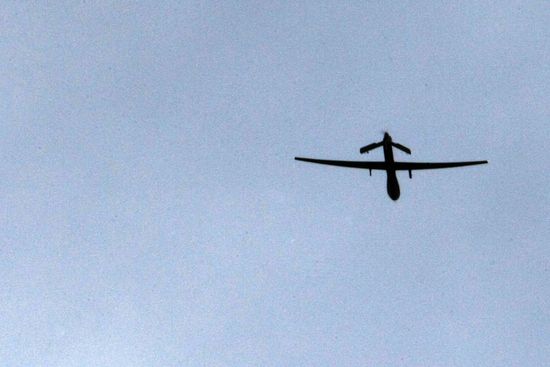
(Photo: A US 'Predator' drone passes overhead at a forward operating base near Kandahar on January 1, 2009. By Joel Saget/AFP/Getty Images.)