Equality Coming To New York? Ctd

Not today. The hold-up centers on concerns over protections for religious institutions:

Asked for specifics, [Senate Majority Leader Dean] Skelos brought up the issue of adoption services offered by Catholic churches. The majority leader could offer no timeline of when the bill might come to the floor, saying: “I’ve told you all along, with our conference this is going to be a very deliberative process and members on both sides are raising concerns.”

A group of pro-equality faith leaders insists there are plenty of protections in place already. Ari Waldman looks back at the dramatic week:

Three Democrats in the normally-dysfunctional who voted against same-sex marriage in 2009 switched to yes. Then one Republican, and then another Republican, putting the total number of supporters in the Senate at 31 (32 are needed for passage). Pro-gay rights Mayor Mike Bloomberg, the single largest contributor to New York State Republicans over the last decade, then spent his Bloomsday (haha!) in Albany, lobbying Republican Senators for support. Ted Olson, who along with David Boies is representing the pro-gay marriage side in the Perry case, then wrote an open letter to New York Republicans, pushing the conservative case for gay marriage.
Olson's letter here. Follow developments in Albany here.

A One-Way War

Amy Davidson unpacks the Obama administration's self-serving redefinition of war:

Is the point that, while we are bombing Libya, we are doing it from a distance, out of Qaddafi’s forces’ range, so there aren’t “exchanges” of fire, just one-way barrages—hostility, rather than hostilities?

By the same reasoning, it wouldn’t count as war if any overwhelming force attacked anyone who couldn’t effectively hit back; that exemption could apply not only to cruise missiles and drones but to a column of tanks rolling into a village. Is the only concern of the War Powers Act—is our only concern about war—whether our own soldiers can be shot? Aren’t we also interested in making sure there is some accountability when our government decides to shoot?

The Case Against Rick Perry

Home_States

Ed Kilgore tests the governor's weak spots:

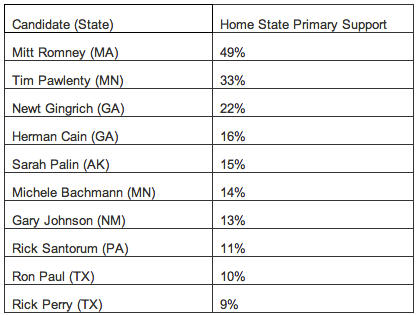
[W]hile Perry has become a Tea Party favorite, he has done so in part by making inflammatory statements that may trouble even a healthy number of Republican primary voters, the most famous of which was his suggestion that secession might be on the table for Texas. In addition, he’s also made threats to withdraw the state from the Medicaid program—with only the vaguest suggestion of how or whether poor families would receive medical treatment—and even sought the power to opt Texas out of Social Security, a rather egregious stomping on the third rail of politics.

PPP finds that Perry has very low home-state primary support.

ATMs: They Took Our Jobs? Ctd

Stephen Ezell insists that "technology is part of the job creation solution; not part of the problem":

[Obama]’s suggestion that technology leads to job loss is simply not the case. In fact, U.S. productivity gains were higher before the Great Recession than they are now (and productivity gains were higher still in the 1990s when job growth was booming), meaning that technological-based productivity gains are not the culprit behind recent sluggish U.S. job growth. Rather, as ITIF explains it its report Embracing the Self-Service Economy [pdf], the vast majority of economic studies show that productivity gains—including through self-service technologies such as ATMs, kiosks, and self-checkout machines—actually lead to more jobs.

Wilkinson's thoughts here.

The Spiritual Power Of Psilocybin

PyramidlakeNV

A study confirms that the chemical in magic mushrooms can unlock spiritual feelings:

Notably, 61% of volunteers considered the psilocybin experience during either or both the [highest dosage] sessions to have been the single most spiritually significant of their lives, with 83% rating it in their top five. Consistent with this, 94% and 89% of volunteers, respectively, indicated that the experiences on those same sessions increased their well-being or life satisfaction and positively changed their behavior at least moderately.

Similar studies have come to identical conclusions although this one very helpfully analyzes ideal dosage levels. The potential for use to help the depressed, those with PTSD, and those with many other ailments is huge. If only we could get past our puritanism. Kevin Drum says "you may thank the War on Drugs whenever you like" for banning this experience:

So there you have it: a genuine mystical experience with long-lasting positive effects, no reported negative effects, no known medical side effects in healthy people, and with virtually no chance of a bad experience. Does that sound like something you'd like to try? Well, you can't: no matter how safe and beneficial it might be, psilocybin is a Schedule 1 controlled substance and you can't have any.

I tried a serious dose of fresh mushrooms when last in Amsterdam a few years ago. Yes there's a reason they activate the brain in precisely the same areas as those activated without drugs in the brains of those in deep meditation. They deepened my faith, brought me closer to lifting the veil my ego places over the beauty of God's creation, gave me uncanny perspective on my life, and had me pondering the Incarnation and praying effortlessly as I gazed into the rippling water of Amsterdam's canals.

I understand these miraculous things can be abused – which is why careful dosing matters. But that they should be banned is a profound sign of our culture's lack of faith in itself and what lies beyond us. It's a direct impediment to humanity's spiritual evolution. In my view, it violates the spirit of the First Amendment. If shrooms are for so many a pathway to the divine, Congress shall make no law respecting an establishment of religion, or prohibiting the free exercise thereof.

Internet In A Suitcase

We nearly missed this exciting item from the week's news:

In response to the government suppression of Internet access during the Arab Spring, "Internet in a Suitcase" will allow citizens to bypass censors and help them reconnect in times of government imposed shutdown. A "suitcase" can be transported to dissidents in a repressive country and quickly set up to allow wireless communication over a wide area with a link to the global Internet, thus undermining the despotic governing powers.

This is exactly the kind of support we should be giving. Not bombs, but social media. It's time the West got asymmetrical too.

One Man’s Power

6a00d83451c45669e20154330e6140970c-550wi

James Fallows argues that Obama is wrong about Libya. Brushing aside the legal technicalities, Fallows warns that "the major threat to our politics, is that once again we are going to war essentially on one person's say-so":

[A]fter three months of combat, and after several decades of drift toward unilateral Executive Branch action on matters of war and peace, Obama is doing a disservice to the nation, history, and himself by insisting that the decision should be left strictly to him. If the Libyan campaign ultimately "goes well," he will not in any way lessen his own political and historic credit by having involved the Congress. If it goes poorly, he will be politically safer if this is not just his own judgment-call war. More important, in either case he will have helped the country if his conduct restores rather than further weakens the concept that a multi-branch Constitutional republic must share the responsibility to commit force. We can only imagine the eloquence with which a Candidate Obama would be making this exact case were he not in the White House now.

Actually, it couldn't be more eloquent than this:

The President does not have power under the Constitution to unilaterally authorize a military attack in a situation that does not involve stopping an actual or imminent threat to the nation.

As Commander-in-Chief, the President does have a duty to protect and defend the United States. In instances of self-defense, the President would be within his constitutional authority to act before advising Congress or seeking its consent.

That was candidate Obama. Hs current position is as ludicrous as it is unprincipled.

(Photo: A US 'Predator' drone passes overhead at a forward operating base near Kandahar on January 1, 2009. By Joel Saget/AFP/Getty Images.)

In Sex Scandal, Congressman Resigns For Not Having Sex, Ctd

Powerindex

Some parting thoughts on Weinergate from readers. One writes:

You saying “He was targeted for purely partisan reasons” seems way off to me.  Of course there’s a great deal of partisanship about it, but it also exposed a politically-problematic attitude toward women in his exchanges with these women, and a puerile lack of discretion that seems a genuine defect in a lawmaker.  I think his political allies had just about as much interest in seeing him go as his opponents, so I think the reasons for his exit are pretty bipartisan.

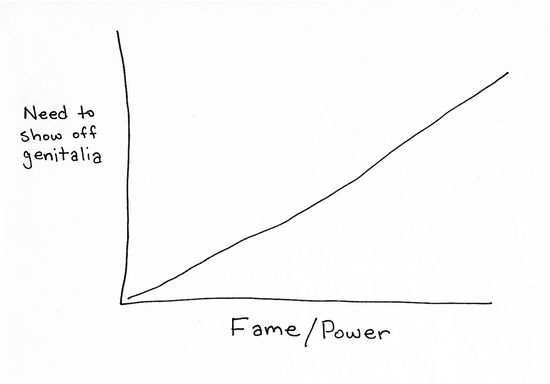
I agree about the lack of discretion. But what ended his career was the fact that he had been humiliated by the demands of his own considerable cock. That "too big to fail" organ beat the other one in his cranium. In men, that happens sometimes, in case you haven't noticed. In men fueled by testosterone and power – and just look at him, he's a strutting rooster of hormones – the combination can be overwhelming. I feel pity not disgust. Another:

If these exchanges had been completely separate from his service as a Congressman, the grounds for pushing him to resign would be weak. But the reality is that these interactions were far too close to his work and responsibilities as an elected official. Would it be appropriate for a Congressman to respond to a question at a town hall meeting by passing a questioner any of the pictures he sent online? It might sound like an unfair comparison given the privacy of the Internet, but a Congressman’s Twitter and Facebook accounts serve a purpose similar to that of a town hall. It’s not unreasonable to say that those people are entitled to responses that don’t involve the Congressman’s penis.

Er, yes. But these are new arenas and we haven't quite adjusted to them yet. Post-Weiner, a lot of online mores in DC will shift. Another:

Weiner is not simply the representative of a liberal district in New York City. He is Obama's most visible leftward policy pull. During the healthcare debate he was a regular on Meet the Press. The administration couldn't risk campaigning for the public option, so Weiner turned out every Sunday to tell Americans about its advantages. My parents are conservative farmers in Iowa, but they listened to and considered Weiner's arguments via their local NBC affiliate. To my father, Weiner is a Democrat the same as Obama, no daylight between. And yesterday, a porn star held a press conference in which she said Anthony Weiner instructed her to lie about their relationship. Obama is a consciously post Clinton, post scandal Democrat. And Weiner is out.

Meanwhile, David Vitter remains one of the many politicians my father has never heard of.

For a look back, Matt Stopera created "The Official Weinergate Headline Timeline". Cartoon by Ted McCagg.

Santorumism Of The Day

A reader points to a passage on the candidate's website:

[Being part of the "Gang of Seven"] did not make Rick Santorum a popular man in an old boy’s club like the House of Representatives, but Rick knew that the only way to make a positive difference in the lives of his constituents was to challenge the corrupt norms that had seeped into the People’s Body.

The GOP And Signing Statements

Better late than never I suppose:

Tucked into a summary of a GOP-sponsored House appropriations bill is an unexpected line about restricting presidential power:

In addition, the bill eliminates the “Youth Media Campaign,” prohibits funds for the [Executive Office of the President] to prepare “signing statements,” which has been used in the past to undermine or circumvent laws passed by Congress, and requires reports on the costs and regulatory burdens caused by the flawed Dodd-Frank financial legislation.

The GOP is, of course, right that signing statements have been used to circumvent laws passed by Congress. President George W. Bush used signing statements to claim the power to flout a legal ban on permanent military based in Iraq, to undermine congressional attempts to fight genocide, and to thumb his nose at his legal obligation to hire competent people at FEMA.

And, of course, torture. This is a good sign that conservatism as a belief in divided, and limited government may be making a comeback, after its nadir during the Cheney de facto protectorate.