A New Splint!

So I'm trapped in DC while Aaron and the girls settle into Ptown. My shattered pinkie – why are my ailments always a combination of extremely tender and completely laughable? – needs more scrutiny from the orthopedist before I am released.

And since I cannot ride a bike, walk two dogs, or use my left hand much at all, there wouldn't be much point getting it full of sand on the cape anyway. In two weeks, I leave for England, for three weeks. Ptown will have to wait. Tant pis.

Minor point about healthcare. I have had to fill out three separae swathes of forms each time I go to a new doctor. You don't notice it as much until it's cumbersome to write. But seriously: this industry is, in some ways, a relic, like the book publishing industry. There's inefficiency here that would never survive in the private sector – oh, wait, they are in the private sector – just one that has no real competition.

Another Big Lie Debunked

Obama “bullied” Israel? If only:

The Washington Post’s left and right columnists are having a grand old time mixing it up over a call that Steve Simon, the White House go-to guy on Israel, had last Friday with the Jewish leadership. I heard the call. To put it gently, Greg Sargent, the Plum Line, or “left” columnist, has it right. And I don’t know where Jennifer Rubin, the “Right Turn” columnist, is getting her info.

Rationing Isn’t A Dirty Word

National Review editorializes against the Independent Payment Advisory Board and urges its repeal. Josh Barro dissents:

The Editors are right to note that IPAB, despite all the Democrats’ denials, is a rationing measure. But rationing should not be a dirty word. The alternative to rationing is uncontrolled expenditure. Ryan himself described the situation correctly: “Rationing happens today! The question is who will do it?” If you moved to a premium-support model, the answer would be “consumers and private insurers.” But since single-payer Medicare is going to be around for decades to come (if not forever) some of that rationing will have to be done by the government.

Equality Coming To New York?

On a day when the third largest state in the Union is on the cusp of enacting marriage equality, which would double the number of Americans able to wed someone of their own gender, a reader writes:

Though I don't agree with you all the time, I enjoy reading your blog (when it was at The Atlantic and now at the Beast). I'm taking a moment to thank you though for one specific thing: your continued push for marriage equality. I am not as mature as you, so I can only imagine what it was like when you first started fighting for this equality. I am 26 and just married my husband. We are an inter-racial, inter-height relationship and had much support from our parents and families. My father performed the ceremony in Vermont (temporary officiant, he and my mom live in SF) and my husband's 83-year-old grandmother blessed the union. In addition to that, we jumped the broom, which is a traditional African-American (and apparently gypsy) tradition.

I write all this to simply say: "Know hope." As my father said about my husband's grandmother (and now my grandmother-in-law): "She's doing pretty well. She is from a generation where she didn't expect her grandson to grow up to marry a black person. And she certainly did not expect this black person to be a man."

The latest news from Albany suggests that a vote on marriage equality will occur over the weekend or even early next week, into an extended legislative session. Passage may come down to a certain GOP senator.

Are Tomatoes The New Blood Diamonds?

Tomatoes

In his new book, Barry Estabrook exposes the system of "modern-day slavery" that feeds the tomato industry in the US: 

In the last 15 years, Florida law enforcement officials have freed more than 1,000 men and women who had been held and forced to work against their will in the fields of Florida, and that represents only the tip of the iceberg. Most instances of slavery go unreported. Workers were "sold" to crew bosses to pay off bogus debts, beaten if they didn't work, held in chains, pistol whipped, locked at night into shacks in chain-link enclosures patrolled by armed guards. Escapees who got caught were beaten or worse.

(Photo by Flickr user Joost J. Bakker IJmuiden)

What A Badge Can’t Do

The blogger at A Girl And Her Bike, who happens to be a cop, describes an off-duty assault and arrest:

[L]et me explain something to you about a police badge. It doesn't grant you super powers. It's simply a piece of tin embedded with a number. It's not magical. It will not stop bullets. It will not make people do what you want. It will not make you win a fight. I have plenty of friends that always seem to think that because I'm a police officer, I am impervious to assault, robbery & bullets and that I never, ever have to worry about these things. This is not true. If anything, I am more vulnerable. Because instead of just being your average girl, I'm a threat. I live in the fear that should I ever be the victim of a robbery, the criminals will discover my badge and decide they can't risk me living and kill me. This actually happened to a friend of mine who was shot during a robbery when they saw his badge. He lived to talk about it, thankfully–but its a very real and very possible fear.

The Fear Of Failure

Seth Godin tells us to work hard. Ben Casnocha wonders why many people don't:

Here's a non-obvious reason: working hard is risky. If you work hard and fail, you don't enjoy the self-protection that less than 100% effort affords. If you get a C on a test in school, and you didn't study much, then it's no big deal — you just didn't study enough. If you get a C on a test in school, and you studied really hard for it, then you must just be dumb.

Solar Beats Steel?

Solarchart

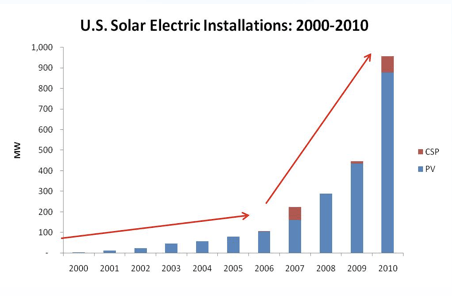
Stephen Lacey welcomes growth in U.S. solar jobs:

With roughly 93,500 direct and indirect jobs, the American solar industry now employs about 20,000 more workers than the U.S. steel production sector. The American steel industry has historically been a symbol of the country’s industrial might and economic prosperity. But today, the solar industry has the potential to overtake that image as we build a new, clean-energy economy.

Germany is also pulling ahead with more than 100,000 workers employed in the solar PV industry alone. A reader at Clean Technica points out:

The US has about 312 million people while Germany has 82 million, about 25% as many people…. That makes the German solar industry more than four times as large an employer than US steel based on country size.

the US has about 312 million people while Germany has 82 million, about 25% as many people…. That makes the German solar industry more than four times as large an employer than US steel based on country size.”

Source: Clean Technica (http://s.tt/12Daw)

the US has about 312 million people while Germany has 82 million, about 25% as many people…. That makes the German solar industry more than four times as large an employer than US steel based on country size.”

Source: Clean Technica (http://s.tt/12Daw)

Sarah Laskow has more on Google's $280 million investment in SolarCity, a company that installs and takes on the risk of residential-scale solar panels.

“It Worked In Texas” Ctd

Another data point in the debate over the Lone Star State's economy:

Texas has by far the largest number of employees working at or below the federal minimum wage ($7.25 per hour in 2010) compared to any state, according to a BLS report. In 2010, about 550,000 Texans were working at or below minimum wage, or about 9.5 percent of all workers paid by the hour in the state. Texas tied with Mississippi for the greatest percentage of minimum wage workers, while California had among the fewest (less than 2 percent).

Pat Garofalo piles on Perry:

In addition to these facts that Perry would surely prefer stay under the radar, he relied more on the 2009 Recovery Act than any other governor and faced a $27 billion budget deficit for the 2012-2013 budget, after assuring everyone for months that Texas had its fiscal house in order.

The Paradox Of Fiction

Brandon Watson defines it:

We human beings read, watch, and listen to a lot of fiction. We know that it is fiction. But we have emotional responses and attachments to the characters. So, according to Colin Radford, who first put it forward, this shows that there's something incoherent in our emotional responses: we feel for things we know don't exist.

J.L. Wall complicates this thought:

Fiction doesn’t present the unreal; it presents the possibly real, something balancing precariously between the real and the non.  (This holds, it should be said, for fantasy, science fiction, and other “genres” as well as in realistic or literary fiction; they just go about it, as is the case in variation between individual works, in different ways.) We empathize with fictional beings not despite their unreality, but because of their possible reality.

Kyle Cupp is in related territory when discussing "narrative theory."