
Riot police walk in the street as a couple kiss on June 15, 2011 in Vancouver, Canada. The city broke out in riots after the Vancouver Canucks lost in Game Seven of the Stanley Cup Finals. By Rich Lam/Getty Images.
Riot police walk in the street as a couple kiss on June 15, 2011 in Vancouver, Canada. The city broke out in riots after the Vancouver Canucks lost in Game Seven of the Stanley Cup Finals. By Rich Lam/Getty Images.
A reader writes:
In comparing Massachusetts and Texas, what do you think would happen to the poverty rate in MA if it shared a border with Mexico? Furthermore, if MA is such a success story, why, according to Pew, did the state experience a net loss of 128,000 people from 2005-2007 while TX experienced a gain of 430,000?
More broadly, comparing states with much different sizes, geography and demographics is pretty problematic. This is why comparing TX with CA makes more sense than MA. Interestingly, if you compare MA with neighboring NH, one finds that MA has an unemployment rate of 7.8% versus 4.9% for NH. Coincidentally – or not - the Mercatus Center ranks NH as the most economically free state in the country, while MA checks in at #46.
Another writes:
As a Texan, I thought I'd point out one of the main reasons Texas is doing better than many other states: we have far tougher real estate regulations than most states do.
In Texas, per Texas Law 50 (a)(6), you can't refinance for more than your original mortgage amount. Why is that important? Because while the rest of the country was using their homes as ATMs and over-leveraging themselves, Texans couldn't do that. Therefore homes in Texas weren't as overvalued as homes in other states, so when the crash came it didn't hurt us as much. Not only that, but because our lifestyles weren't dependent upon the value of our homes, we didn't have the same pinch in consumption.
Isn't it ironic that one of the reddest states has some of the bluest real estate laws? This is yet another example of how Republicans have abandoned conservatism. Today's GOP considers regulating pretty much anything to be a bad move, but it didn't use to be that way.
Update from another reader:
I thought that Mercatus "study" your reader cited looked familiar; turns out I read about it earlier today in an article on Salon that basically tore it apart. A Koch Brother-founded thinktank using dubious and laughable criteria of what "freedom" is? Gee, what a surprise that every major blue state ranks at the bottom of the list.
Ezra Klein suspects that Huntsman's anti-war message will draw support:
Is he likely to win? Nope. But he’s even less likely to win if he tries to run the same candidacy that everyone else is running. By staking out foreign-policy territory when no one else seems particularly interested in the topic, he sets himself up to capitalize on a black-swan crisis that unexpectedly makes foreign policy issue #1 in the presidential campaign, and he also makes himself strong on a set of issues where the other candidates understand themselves to be weak, which increases his value as a potential vice-presidential candidate.
Al Gore embraces Mitt Romney on climate change. I'm sure Mitt is thrilled to all goshness.
Chicks with longboards cruise through the Madrid Mountains:
A reader writes:
I would really like someone to begin exploring the actual number of Facebook members, because many people have multiple accounts, and I am pretty sure the company reports each of these as separate, individual members. The company would have no way of knowing how many Facebook accounts a person has. I have four, which I use for four sets of friends that I don't want to mix into one big mess. And I know I'm not the only one. If that's true, then the actual number of Facebook users is far less than the reported number. The press shouldn't uncritically accept Facebook's claims. They need to be challenged to use terminology that makes it clear that the numbers they report are separate accounts, not individuals.
Another writes:
I think Libby Copeland's recent article in Slate about how Facebook can make us miserable is relevant to the decline in Facebook. Here is the key passage:
The human habit of overestimating other people's happiness is nothing new, of course. Jordan points to a quote by Montesquieu: "If we only wanted to be happy it would be easy; but we want to be happier than other people, which is almost always difficult, since we think them happier than they are."
But social networking may be making this tendency worse. Jordan's research doesn't look at Facebook explicitly, but if his conclusions are correct, it follows that the site would have a special power to make us sadder and lonelier. By showcasing the most witty, joyful, bullet-pointed versions of people's lives, and inviting constant comparisons in which we tend to see ourselves as the losers, Facebook appears to exploit an Achilles' heel of human nature. And women—an especially unhappy bunch of late—may be especially vulnerable to keeping up with what they imagine is the happiness of the Joneses.
Many readers are echoing this one:
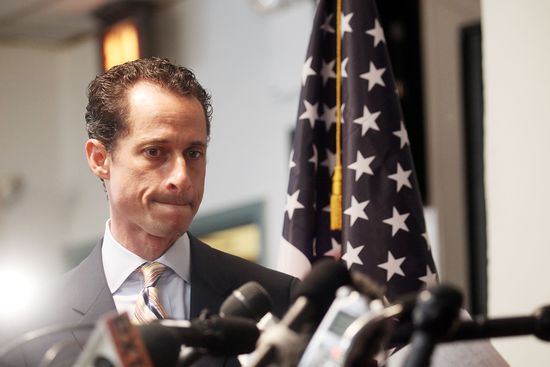
How can you call Weiner's resignation unprecedented? Christopher Lee did nothing more than send a shirtless picture of himself to a woman who had posted to the "women seeking men" section of Craigslist. He didn't have sex, he didn't solicit prostitution, he didn't break any laws. So what is unprecedented about Weiner resigning?
Good point. I guess he fled my consciousness – and that of many others – because he resigned so quickly there was no extended discussion of the issue, and his pic was nowhere near as graphic as some of Weiner's. But I stand by my point. Lee had long had an adultery question, it appears from this report, and he had a hypocrisy issue. His pet cause had been Internet security for kids:
"Private information and images can so easily be transmitted to friends and strangers alike," he warned in an op-ed in 2009, two years before his shirtless self-portrait was splashed everywhere.
Weiner didn't commit adultery, and wasn't a hypocrite. He was targeted for purely partisan reasons.
(Photo: U.S. Rep. Anthony Weiner (D-NY) enters to announce his resignation on June 16, 2011 in Brooklyn, New York. The resignation comes ten days after the congressman admitted to sending lewd photos of himself on Twitter to multiple women. By Mario Tama/Getty Images)
Douthat goes another round:
[Assisted suicide] turns medical professionals into soul-readers, asking them to examine a tormented person and decide whether the death wish they’re feeling is temporary or permanent, whether it emanates from their demons or from their authentic (under the inevitably-uncertain definition of “authentic”) selves.
This is why I think a legal and cultural presumption against suicide is actually more modest, in a sense, than the alternative of allowing physicians to assist in voluntary euthanasia. Absent a totalitarian police state (and not really even then), a presumption against suicide doesn’t usually prevent people who really, really want to kill themselves from finding a way to do it. But neither does it empower any authority, whether public or private, to claim that they know the last word about any human heart.
Obama claimed that automation is hurting job prospects. Wilkinson notes that there are more bank tellers now than there were before the advent of the ATM, but agrees that technological change is part of the story:
I think it's plausible that as demand began to pick up after the recession hit bottom, many firms chose to invest in updated technology that further increased the productivity of skilled workers they did not dismiss rather than re-hiring workers whose skills are less augmented by better tech. I wouldn't blame ATMs on our jobless recovery, but surely the general skill-bias of technological change is an important part of the issue. I suspect Tyler Cowen may be right that the recession created an occasion for firms to shed "zero-marginal-product workers". In that case, the ranks of the unemployed are filled with wannabe workers whose labour is at present worth less to employers than the cost of employing them.
 The Dish