Tort Reform ≠ Cost Control

Tort_Reform_Savings

Aaron Carroll supports medical malpractice reform. But he thinks it has been majorly over-sold as a cost-control measure:

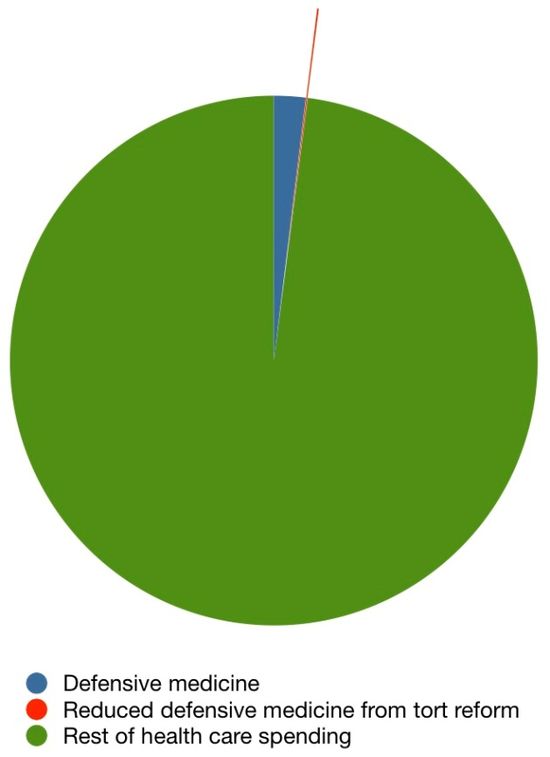
If the pie represents our total health-care spending, then the blue wedge is defensive medicine. Not as big as you thought, likely. But the red sliver, which I pulled out for easier viewing, is what we could expect to see in savings from tort reform.

I’m not going to disagree that the malpractice system needs fixing. Likely, too many claims are filed that have no merit. In addition, many more are never brought to trial that absolutely do. I completely support efforts at malpractice reform.

But it’s not the solution to our high health-care spending. Tort reform does not equal cost control.

When All You Have Is A Hammer …

… every sinner looks like a nail. Here's Ross on Weiner:

The fact that he used the Internet’s freedoms to violate his marriage vows isn’t particularly noteworthy. That’s just the usual Spitzer-Schwarzenegger routine performed on a virtual plane.

We do not know his marriage vows. No one has charged that he had sex with anyone other than his wife. He did not break the law, as Spitzer did. He was not engaged in hypocrisy as Spitzer was. And he didn't secretly father a child, as Schwarzenegger did. Apart from that, they're all the same.

What Can We Do In Syria?

Not much, according to Larison:

Despite the obvious lack of practical options for the U.S. to influence events in Syria, there have still been the predictable calls to bring about regime change somehow. Critics of the administration’s reaction to the Syrian crackdown in Congress and the media have relied on a very dubious argument.

They argue that the fall of Assad serves both American values and interests: The Syrian people will be empowered, and a reliable ally of Iran and patron of Hezbollah will be overthrown. According to this view, it is therefore worth the risk of regional chaos, chaos that would engulf a number of U.S. allies surrounding Syria, for the chance to deprive Iran of its client. This view takes for granted optimal political changes that include the improbable separation of Syria from Iran, and it irresponsibly minimizes the possibility of sectarian violence.

Vacation Calculations

Travel-blog480

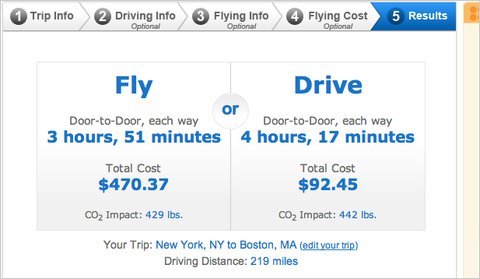
Joanna Foster welcomes a new travel calculator, which determines costs in time, money and carbon dioxide emissions of driving versus flying:

If nothing else, the calculator will give you a sense of what importance you assign to saving dollars and cents, versus saving time or reining in your greenhouse gas emissions. How many hours are you willing to sacrifice sitting in a car to reduce your carbon footprint by 100 pounds?

Fighting For Light Bulbs

Virginia Postrel makes the case against the incandescent ban:

What matters, from a public policy perspective, isn’t any given choice but the total amount of electricity I use (which is itself only a proxy for the total emissions caused by generating that electricity). If they’re really interested in environmental quality, policy makers shouldn’t care how households get to that total. They should just raise the price of electricity, through taxes or higher rates, to discourage using it.

Reihan, Friedersdorf, and Sullum agree.

Watching It Live

Chuck Klosterman is bored by DVR'd sports:

When you watch an event in real time, anything is possible. Someone could die. Something that has never before happened could spontaneously happen twice. When there are three seconds on the clock, not one person in the world can precisely predict how those seconds will unspool. But if something happens within those three seconds that is authentically astonishing and truly transcendent — well, I’m sure I’ll find out about three minutes after it happens. I’m sure someone will tell me, possibly by accident. You can avoid the news, but you can’t avoid The News. Living in a cave isn’t enough. We’ve beaten the caves. The caves have Wi-Fi.

(Hat tip: MR)

How To Grow The Economy

Bruce Bartlett has a prescription for long-term economic growth:

The bottom line is that neither taxes nor spending by themselves are the most important government contribution to the investment climate; it’s the budget deficit. Consequently, a reduction in tax revenue which raises the deficit is unlikely to stimulate domestic investment because more money will have to be borrowed from abroad. Conversely, a tax increase dedicated to deficit reduction could well be stimulative, as was the case with the 1982 and 1993 tax increases. Contrary to Republican dogma, rapid growth followed on both occasions.

A “Gay” “Girl” In “Damascus” Ctd

The Guardian interviews hoaxer Tom MacMaster:

Amy Davidson finds fault with his apologies. Meanwhile, MacMaster's actions are causing real damage in the propaganda war:

Syrian state TV aired a report on MacMaster's "lies." … "MacMaster's hoax aimed at enhancing continuous fabrications and lies against Syria in term (sic) of kidnapping bloggers and activists," a report on state-run news agency SANA said.

And the whole story is getting weirder:

[T]he editor of the lesbian news site Lez Get Real, with the tag­line “A Gay Girl’s View on the World,” acknowledged that he is also a man. “Paula Brooks,” editor of Lez Get Real since its founding in 2008, is actually Bill Graber, 58, a retired Ohio military man and construction worker who said he had adopted his wife’s identity online. …

In the guise of Paula Brooks, Graber corresponded online with Tom MacMaster, thinking he was writing to Amina Arraf. Amina often flirted with Brooks, neither of the men realizing the other was pretending to be a lesbian.

The Daily Wrap

Today on the Dish, we live-blogged the first GOP debate, with the full web reax here. Andrew scrutinized the super-relaxed emails Palin sent on the day Trig was born, and decoded the divine prescience of Sarah Palin, who wrote in the voice of God. A Palin loyalist abandoned ship, a reader nominated her as the defining moment our politics became decadent, and Michelle Bachmann schooled her in political maneuvering. Herman Cain appeased white tea partiers on race, Pawlenty's (economics) and jokes bombed, the GOP excluded Gary Johnson from the debate, and Romney as the frontrunner still lagged behind.

Readers reacted to the bearded man behind the "gay" "girl" in "Damascus," and we parsed the implications for real gay bloggers in the Middle East. Libyan revolutionaries just wanted bureaucracy, Egypt didn't want elections, and as troops come home, the number of contractors will likely increase.

Laura Kipnis psychoanalyzed Weiner, we loved to kick the powerful when they're down, and Andrew chalked it up to "texting while male." We crossed our fingers for marriage equality in New York, Virginia Postrel tackled the lightbulb ban, and Ezra Klein asked what it would take to end the war on drugs. We pondered how keeping bodies alive has become the default mode of end of life care in America, and assessed the power of preschool. David Sirota popped the Groupon bubble, over-fishing messed with the oceans beyond repair, and old people hijacked jobs from young people. We took a bad trip down memory lane, and a star was born.

Chart of the day here, hathos alert here, email of the day here, Matt and Trey bait here, Malkin award here, Yglesias award here, quotes for the day here, here and here, VFYW here, MHB here, and FOTD here.

–Z.P.

Debate Reax

The moment everyone is talking about:

Josh Marshall:

Romney seems like the only serious candidate on the stage. In a sense that's not surprising because he's almost the only serious candidate in the race. Santorum struck me as particularly scattered. The key though is Pawlenty. He's the only other really serious candidate in the race, at least on paper. But he struck me as weak — and not just in his unwillingness to repeat his criticism of Romney to Romney's face. And that's a win for Romney, since again, no one else up there is a serious candidate for the nomination. And yet Romney's answer on health care reform simply didn't hold up — a lot of sensible points that didn't at all address the fact that his bill is fundamentally the same as President Obama's. That's still the albatross around his neck. But what if there's no other credible candidate to oppose him?

Dave Weigel:

Pawlenty failed to break out, again. Even his hockey reference was less of an easy applause line than Romney's. Bachmann, who's always underrated, was as poised and quick as she's ever been. Herman Cain suffered from the presence of buzzy candidates and from a lack of new things to say. Gingrich didn't live up to his promise as the guy with the out-of-the-box ideas everyone else has to ponder. And Romney won.

DiA:

Overall, I thought Bachmann and Santorum most improved on their pre-debate standing. Herman Cain, reputed to be a fiery orator, was a disappointment. Gingrich and Paul remain amusing un-electable cranks. Pawlenty is still boring. Romney is clearly still winning.

Stanley Kurtz:

I think Romney has come across well. He knows how to handle himself, the format makes it tough to go after rivals, and the candidates clearly prefer to hammer Obama rather than each other. Is that good strategy? Maybe staying positive is best in the short term, but eventually the leader will have to be taken down a peg.

Ron Fournier:

The mitts were off Mitt. Romney received a pass from a strikingly timid field of rivals in Monday night's debate. … There's a rule of thumb in political debates: When a front-runner leaves the stage unscathed, he's still the front-runner. And, thus, regardless of the sound and fury of the debate itself, he wins.

Stephen Green:

Here’s T-Paw’s problem. He’s not charismatic, so he has to be the guy with the specifics. Can you name one of his tonight?

Jonathan Tobin:

In the end, it really doesn’t matter whether it was because [Pawlenty] was too nice or not courageous enough to call out Romney to his face. Either way he failed. It was a key moment in this race and one that Pawlenty will rue in the months to come. He walks away from the debate clearly weakened by this astonishing failure of either nerve or imagination. Instead of winning the competition between the two mainstream candidates, Pawlenty is now in danger of slipping back into the second tier.

Philip Klein:

During the 2008 campaign, one of the biggest problems Romney had was that he built up resentment among his rivals by not only reversing himself on a host of issues, but then attacking all his opponents for being insufficiently conservative on the issues he had just converted on. This came back to haunt him down the stretch, particularly as Mike Huckabee and John McCain effectively teamed up against Romney in Iowa and New Hampshire. But tonight, Romney was affable, and complimentary to all of his rivals, and specifically to Pawlenty. This had a disarming effect, and it also allowed him to concentrate his fire on the real opponent, President Obama.

Jonathan Chait:

Boy, did [Pawlenty] look weak, especially when he refused to defend his "Obamneycare" line. There's going to be a wimp narrative, and Republicans like their men manly.