"I think she dresses a lot like my mom. But a lot, a lot of women have done that the last few years. I do think it's odd, you know, seeing people with red blazers with their hair up with glasses. I don't know if she's wearing glasses but you want to be hummmm, do you think that people don't notice you're dressing like my mom?" – Bristol Palin.
Month: June 2011
My First Gay Bar
June Thomas begins a six-part series on the history and decline of the gay bar:
In 2007, Entrepreneur magazine put gay bars on its list of businesses facing extinction, along with record stores and pay phones. And it's not just that gays are hanging out in straight bars; some are eschewing bars altogether and finding partners online or via location-based smartphone apps like Grindr, Qrushr, and Scruff. Between 2005 and 2011, the number of gay and lesbian bars and clubs in gay-travel-guide publisher Damron's database decreased by 12.5 percent, from 1,605 to 1,405. Could the double whammy of mainstreaming and technology mean that gay bars are doomed?
In her second installment, Thomas asks a variety of writers about their first experience in a gay bar. I missed the deadline. So here's my recollection, for what it's worth.
The first gay bar I entered was actually a mixed bar. It was called Campus-Man-Ray in Cambridge. One part of it was 1980s straight hipsters getting down to Depeche Mode, and it was with my straight friends that I went. But it was attached to another part, a more conventional gay disco called Campus. You got to Campus by a downstairs hallway where the toilets were. One night, after taking a piss, I decided not to return to my straight friends, but to venture through the swinging doors into the gay one. (One of the few straight guys who eventually came with me through those doors ended up as a high-level Opus Dei functionary in Rome. That in itself makes me wonder how straight he really was.)
If it were a movie, it would shift from black-and-white into 3D color as I entered the bar. I was staggered and more than a little thrilled at how normal everyone looked, how attractive, diverse and mellow. I edged up to the bar and managed to blurt out, "A gin and tonic please." The bartender picked up my vibe. "Get that stick out of your ass, honey. This is a gay bar." And so my first impression of gayness was actually removing something from my butthole rather than violating its tightly-puckered virginity.
23 years of repression unwound in that bar. I am grateful for the kind condescension that must have greeted my spirited spinning to "You Turn Me Round (Like A Record, Baby)" or the latest Whitney. It was there that a man pulled his shirt off in front of me on the dance floor for the first time and I nearly fainted with desire. It was there that I returned Friday night after Friday night to discover who I really was.
One more thing. It reminded me of church. The colored lights; the smoke; the synthesizers; and the legions of men. And I distinctly recall as I watched the scene a premonition that one of my tasks in life would be, in whatever way I could, to convey this benign hidden world to the wider universe beyond it. I believe it was God speaking to me. He appears where Jesus would have. And it is a scene of revelry and hope.
Here's Dan Savage:
[The Bushes] was dark, it was dirty. But it was a public place—the first public place where I ever kissed a guy, my first boyfriend, who was wrong for me in more ways than I could possibly cover in this space. But I was glad to be there and glad to be with him that summer. …
The Bushes was named for the infamous bushes in nearby Lincoln Park where gay men—and straight-identified closet cases—had anonymous sex. This was a time when all gay bars had names that winked—Nobody's Business, the Hideaway, the Closet—so that gay men could spot them in the phone book. There's still a gay bar on the site of the old Bushes, but I'm not sure what it's called. I'm pretty sure there are no high-school juniors making out with their 29-year-old boyfriends in whatever that bar is called now.
Face Of The Day
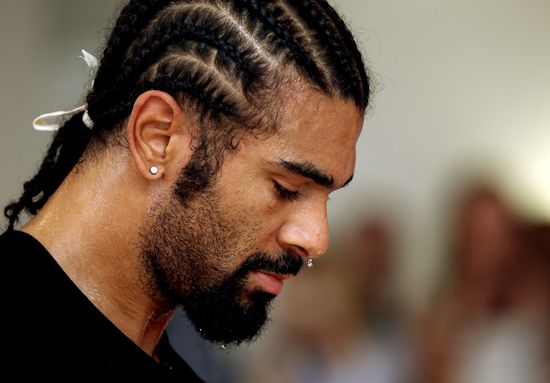
David Haye works out during a public training day to preview his heavy weight title fight with Wladimir Klitschko at a Mercedes Benz showroom on June 29, 2011 in Hamburg, Germany. By Scott Heavey/Getty Images.
Niebuhr And God
Alan Wolfe reviews Why Niebuhr Now? by John Patrick Diggins:
Had he lived long enough to witness the American response to September 11, 2001, Niebuhr would have recoiled in shock. Unlike George W. Bush, who was capable of finding God on his side no matter which side he was on, Niebuhr, as Diggins rightly points out, “was a realist because he was religious.” If we need Niebuhr now, it is because that particular combination is no longer with us. Our realists are too cynical and focused on power in this world to acknowledge any higher authority. And all too many of our believers evoke God only to secure more power for the United States.
A President, Not A Governor Ctd
A reader writes (before my post on Obama this morning):
It seems everyone who believes in marriage equality wants to bash Obama for not supporting their issue. Just imagine if Obama had said New York should pass the marriage equality bill, discussions would have been shut down immediately. Please name me one Republican who wants to be known as someone who takes orders from Barack Hussein Obama. The president has moved gay rights closer to the finish line much quicker by keeping his distance and not forcing the issue. He should be given props, but all I hear is sneers from the gay community. When are you guys going to learn he is four steps ahead of you on every issue?
By the way, my daughter is gay. She is only 18 years old, but I know how important the New York law is to her future. We also are African American and live in South Carolina. So we know a little bit about discrimination.
My thoughts on his presidential style here.
Bachmann And Originalism
A reader writes:
So if Bachmann really wants to go back to the vision of 1789, by all means let her. She unfortunately would not be able to vote for herself in the election due to the fact that the 19th amendment didn't pass until 1920.
Another writes:
This isn't so much about whether Bachmann is improving or not (I don't think she is, nor do I think it matters when it comes to the nomination this time around). This is more about the Founders and the notion of them as some hive-minded group of supermen.
The real problem that Originalists have is that even in 1789, the Constitution was a series of compromises. From the counting of slaves in the census to the makeup of the House and Senate to the overlapping powers in foreign policy (president's negotiate and sign treaties, but they are ratified by the Senate, the power to make war, sending and receiving ambassadors) to advice and consent to the entire Bill of Rights. And it was always open to interpretation – that's what Marbury v Madison (a case involving to varying degrees four Founders) stands for more than anything.
This is the major problem any time someone tries to rely on the Founders. Because for every Jefferson quote you can come up with, I can find a quote by Hamilton or Adams that stands for something different. I can probably find two from Madison that contradict themselves. Not to mention Washington's opinion on not getting involved in foreign entanglements. This is especially difficult for Originalists to accept – they want some School House Rock version of history where everybody agreed about everything, and that's just not the way it went.
Originalists have to overlook the fact that Jefferson vehemently opposed the ratification of the Constitution in 1789. They have to overlook that Madison's views changed. They have to overlook that in order to get the Constitution out of the Convention, the abolitionists (and there were some, Franklin and Hamilton among them) had to agree that the issue of the trans-Atlantic slave trade couldn't be touched for twenty some years.
Yes, there were some Founders who wanted to end slavery, but they were the types that the Originalists wouldn't like today because they also happened to be Federalists who believed in the necessity of a strong central government. Really, calling these folks Originalists or Federalists is a sham. And I can say this as a former member of the Federalist Society who spent years talking with a lot of the legal minds (folks who believe repealing the 17th Amendment makes a great deal of sense), and really, they aren't Federalists, and they aren't Originalists – they are Anti-Federalists.
Another:
One thing I don't understand about "Originalists", as you called them, is their complete ignorance (or convenient forgetfulness) of the anti-corporate side of colonial America. One of the major shackles the colonial Americans where throwing off was the corporate power in England that dominated trade with the colonies.
Where are the constitutional fundamentalists calling for a return to limited corporate charters that had to be shown to be for the public good? Where are the calls for corporations to not be able to own shares of other corporations, for corporations to be strictly forbidden from political influence or policy, and for corporations to be strictly held to only the expressed public good function of their charter?
I think many of us would be glad to see much of the power of corporations stripped back to more originalist ideas of corporate purpose (especially after seeing the documentary "Hot Coffee" on HBO and seeing how the US Chamber of Commerce has been spending bags of money on judicial elections across the US to install more business friendly judges).
Another:
Your observation on Rep. Bachmann and her contextualization of slavery reminded me of an experience some thirty years ago that still makes me laugh. It happened in late 1979. I was working on an archeological dig in a very, very Republican (i.e., Catholic) area of Northern Ireland. When I showed up, the Beeb had just started showing Roots, and the entire village was aghast. You couldn't walk into a pub without seeing it. The Troubles were still seething, several of the locals were incarcerated, and the connection the remaining populace felt to the oppressed Africans was palpable. Everyone was caught up in the drama.
The dig was made up almost entirely of non-local university students. About three days into my tour, one girl from Dublin caught me scraping away by myself, and, out of earshot of the Protestants on the dig, hissed, "No Catholic could ever own slaves!" I remember rocking back on my heels and looking up at her, wondering where to begin. As my mind swirled over the thought "But your last name is Carroll!" – the same famously Catholic family that owned more than 350 slaves here in Maryland – I decided it was better not to start to say anything at all. Sometimes, explanation seems futile.
Another:
I wonder if Michele Bachman knows that her hero of the American Revolution, John Quincy Adams, took his presidential oath of office on a book of laws, not a Bible – because he wanted to protect the separation of church and state. Me and Wikipedia, we're just sayin' …
It appears a Bachmann fan got a hold of the JQA Wiki page as well.
Peace In The Middle East After 2008
David Shulman repeats that the Goldstone retraction doesn't change much:
[T]he absence of a policy to kill civilians deliberately is not enough; actions that inevitably result in high civilian casualties, and that follow from premeditated decisions on the part of the army command, remain crimes of war. In my view, the extensive use of white phosphorus and the heavy artillery bombardments in densely populated areas of Gaza—both amply documented during Operation Cast Lead—clearly fall into this category.
What is worse, none of the above can be isolated from the current wave of nationalist hysteria, racist legislation, self-righteous posturing, and self-destructive policies that has engulfed the State of Israel and now informs much of its public discourse—including official statements by government spokesmen, the Foreign Ministry, and many members of the Knesset. Such statements and the actions they seek to justify or defend are the true cause of the present “poisonous atmosphere inhospitable to peace negotiations."
Cutting Medicare (But Not Abolishing It)
Chait hails Lieberman-Coburn:
The irony here is that comparing this to Ryancare plays into Ryan's intellectual sleight of hand. Ryan argues that Medicare as it's currently structured can't continue. The only alternatives are to do nothing and watch it disappear, impose draconian bureaucratic rationing, or try his proposal. The truth is that Medicare is in trouble, and the cost-saving measures in the Affordable Care Act are an important step toward controlling health care cost inflation but probably not enough to solve the problem on their own. Over the very long run we need to build on its cost-control devices. In the medium-run, we probably need to impose some straightforward cost saving. Coburn/Lieberman is a way to do that while preserving the traditional Medicare system. It's proof that Ryan is wrong.
Seconded. And Coburn's sane position in getting revenues out of tax reform is getting majority support even among the readers of National Review. Norquist's absolutism will destroy the possibility of a governing conservatism. It's theology, not politics.
Kramer vs Sullivan?
In their premier weekly dialogue at New York, Adam Moss and Frank Rich discuss their surprisingly emotional reaction to New York’s legalization of marriage equality. It’s well worth a read. I recall Adam’s skepticism in the early days. Then this:
Adam: Larry Kramer’s enormous role in this movement cannot be denied. I was thinking this weekend about the yin and yang of Kramer and Andrew Sullivan, whose writings were also essential to Friday’s vote. I imagine Sullivan and Kramer can’t stand each other.
Frank: I would not want to be an arbiter between the two of them, and God knows I’ve had my innings with Larry Kramer too. There are many heroes in this story, and certainly Sullivan (and others, like Evan Wolfson, the legal mind behind Freedom to Marry) played a big role in marriage.
The truth is: although Larry and I have tried immensely hard to not stand each other, we have long been good friends. We interviewed each other twice in Poz magazine; we share the same core ideal – simple, radical equality; we believe in a gay culture that will one day do justice to the great gay Americans in the past, from Lincoln to Whitman; we have little but contempt for the Human Rights Campaign; we were both forged in the crucible of AIDS, although I was too young to experience the early horrors that Larry did. We have also both acted as lightning rods within the gay community and are happy to be Jeremiads if necessary.
Larry is more traditional than many appreciate; and I am at times more radical. The fight for marriage was and is both conservative and radical. The truth is: we are more alike than either of us would care to admit. Except on religion.
Obama’s Libya Dodge
Greg Sisk, a conservative Catholic who to date had largely supported Obama's foreign policy, is starting to have doubts:
There were two principled paths that Obama could have taken on Libya, but he chose neither. First, he could have shown real leadership by making the moral case to the American people for continued participation in the NATO action in Libya, rather than leaving that task to his former opponent, Senator John McCain. On this path, Obama would have forthrightly sought congressional approval (as have Obama’s predecessors, including President George W. Bush, in every similar past case). Second, Obama could have argued that the War Powers Resolution is an unconstitutional intrusion on presidential powers and forthrightly said he would not comply with its requirements (again, a position taken by Obama’s predecessors of both parties). Right or wrong on the substance, either position had the merit of integrity. Instead, Obama appears to want to avoid any responsibility by pretending nothing really is happening (just move along, nothing to see here).
 The Dish