Month: June 2011
The Never-Ending Cycle Of History
Hillary Chute interviews journalist and comic book author Joe Sacco, whose recent book, Footnotes in Gaza, examines two Palestinian massacres in 1956:
It’s almost as if history bleeds. In people’s minds, one bit of history bleeds into another bit of history. Some people have a very hard time keeping straight what happened in ’67, what happened in ’56. And it gives you this idea, especially in the particular case of the Palestinians, that history hasn’t really stopped. They’ve never had the luxury of looking back and isolating things, and thinking about it and coming to terms with it. … Every generation is somehow brutalized, and their parents are transmitting bitterness and frustration.
The View From Your Window
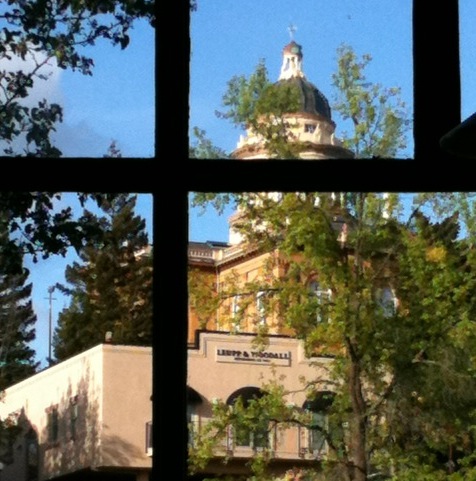
Auburn, California, 6.03 pm
The Failed Greenhouse Ark
Christopher Turner remembers the real Bio-Dome. The situation quickly deteriorated, with the bionauts desperate for more food than their meager organic plots could produce. Money quote:
[T]heir memoirs of the two-year project are full of references to their recurring dreams of McDonald’s hamburgers, lobster, sushi, Snickers-bar cheesecake, lox and bagels, croissants, and whiskey.
Although the biosphere was deemed a failure overall, there was one redeeming discovery, thanks to the medic overseeing the team's health:
[Dr. Roy Walford]'s experiments with diet, reported in the Proceedings of the National Academy of Sciences in December 1992, were judged a success. The bionauts not only showed dramatic weight loss (stabilizing at an average of fourteen percent overall), but also lower blood pressure and cholesterol, more efficient metabolisms, and enhanced immune systems.
Searching For The Past
The above footage was shot in Chile's Atacama desert, which is the subject of Patricio Guzmán's beautiful documentary "Nostalgia for the Light," reviewed by Andrew O'Hehir:
Astronomers come there from all nations because the humidity-free skies render celestial bodies brilliantly clear; archaeologists come there because human remains and artifacts from thousands of years ago are perfectly preserved; and bereaved mothers, wives and sisters come there because Pinochet's regime apparently buried the bodies of hundreds of kidnapped and executed dissidents there in the '70s and '80s.
All these people, Guzmán observes, are concerned with the past, and at least indirectly with the most profound and unanswerable questions about the nature and meaning of human existence. (Remember that the starlight we see from Earth has been traveling through space for many years; astronomers viewing the most distant galaxies are literally looking billions of years back in time.) As one astronomer explains, there is almost no such thing as the present — a fact observed by St. Augustine 1,600 years ago — and another observes that the atoms of calcium in the bones of Indians and dissidents interred in the Atacama were forged long ago by the stars, perhaps in the Big Bang itself.
Charles Mudede shares some equally high praise.
What Man On The Cross?
Tom Rees summarizes a recent study that measured religion, politics and approval of torture:
What [the study] found was consistent with a set up where religion makes people conservative, and that in turn makes them support torture. In other words, religion has a direct and an
indirect effect. Basic religion (in their model) opposes torture, but it also increases support for conservative politics. As a result, it indirectly increases support for torture.
What's more, this indirect effect was much stronger in in educated people. In educated people, religion is more likely to be linked to conservative views, and conservative views are more likely to be linked to support for torture.
Fighting Over Free Will
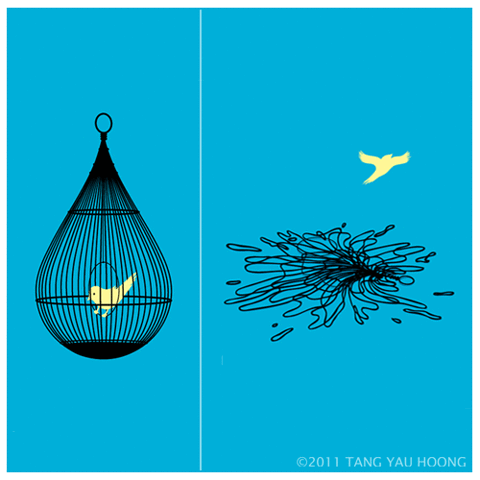
Sam Harris dismisses his critics:
For them, freedom of will is synonymous with the idea that, with respect to any specific thought or action, one could have thought or acted differently. But to say that I could have done otherwise is merely to think the thought, "I could have done otherwise" after doing whatever I, in fact, did. Rather than indicate my freedom, this thought is just an epitaph erected to moments past. What I will do next, and why, remains, at bottom, inscrutable to me.
Each of us has many organs in addition to a brain that make unconscious "decisions" — but these are not events for which anyone feels responsible. Are you producing red blood cells and digestive enzymes at this moment? Your body is, of course, but if it "decided" to do otherwise, you would be the victim of these changes, rather than their autonomous cause. To say that I am "responsible" for everything that goes on inside my skin because it's all "me," is to make a claim that bears no relationship to the feelings of agency and moral responsibility that make the idea of free will an enduring problem for philosophy.
(Image by Tang Yau Hoong via the Behance Network)
Forever Jung
Mark Vernon honors Carl Jung's work, 50 years after his death, by reminding us how little has changed:
Towards the end of his life, Jung reflected that many – perhaps most – of the people who came to see him were not, fundamentally, mentally ill. They were, rather, searching for meaning. It is a hard task. "There is no birth of consciousness without pain," he wrote. But it is vital. Without it, human beings lose their way.
Cinema As Prayer
James Martin, S.J. expounds on the religion implicit in two recent films, Terence Malick's "Tree Of Life" and “Of Gods and Men," which is based on the true story of martyred monks in Algeria in the 1990s:
[B]oth “Of Gods and Men” and “Tree of Life” turn our gaze to small things of great and overlooked beauty: in one film, the waving grass, a reaching tree, a squalling baby; in the other, a monk tending a sick child; another monk pouring wine for his brothers; the communal singing of the psalms. … “Of Gods and Men” may require some in-depth knowledge of Christianity—the notion of sacrifice, of contemplative prayer and the monastic life itself. (It may be hard to understand why the monks stay if you know nothing about the vow of obedience.) “Tree of Life,” on the other hand, can be seen by anyone who wonders about God.
A Subjective Experience Of God?
Paula Kirby justifies converting from a devout Christian to an atheist:
What happened was four little words: “How do I know?”
One of the things that had struck me during my Christian years was just how many different Christianities there are. Not just the vast number of different sects and denominations (over 38,000 by one reckoning), but the huge amount of difference between individual Christians of the same sect or denomination, too. The beliefs and attitudes of an evangelical, biblical, literalist Christian compared with a liberal Christian are so wildly different that we might almost be dealing with two completely different religions …
Some of us knew that God wanted us to respond to other people’s shortcomings with tolerance and forbearance and humility; others knew that he wanted sin to be made an example of, to be held up and publicly rebuked. … This is why subjective experience cannot tell us anything about God. Knowing what kind of god someone believes in tells us a great deal about that person – but nothing whatsoever about the truth or otherwise of the existence of any god at all.
 The Dish