by Patrick Appel
Max Boot – surprise! – argues that it should:
If you want yet another example of how costly our aversion to nation-building has been, look no further than Iraq. The Bush administration associated nation-building with the hated policies of the Clinton administration and refused to prepare for it. The result was that Iraq fell apart after U.S. troops had toppled its existing regime. Iraq is more stable now, but only because the Bush administration overcame its early reluctance to nation-build.
He follows up here. Larison fumes:
One lesson we ought to have learned from the last twenty years of experience is that the U.S. is not particularly good at “nation-building,” and Americans understandably fail to see the point in such open-ended, quasi-imperial missions. That doesn’t mean that we should heed Boot’s advice that the U.S. needs to become better at doing it.
Larison uses the American experience with nation-building in Bosnia and Kosovo as evidence for his argument, citing David Bosco's reporting. Bosco recently met with various Balkins experts who all believed that "the expensive and prolonged international involvement in the region had failed." It should be noted that Bosco himself disagrees:
My assessment is that while serious problems remain, the international stabilization efforts in the Balkans have been broadly successful. … What seemed mostly absent in the discussion was a recognition of how vastly different today's problems are from those of the mid-1990s. Then, the problems weren't corruption or economic stagnation–they were massacres, rape, and ethnic cleansing. Tens of thousands of Bosnian refugees had flooded into western Europe, and there was deep concern that violence might soon extend to Macedonia and Albania.
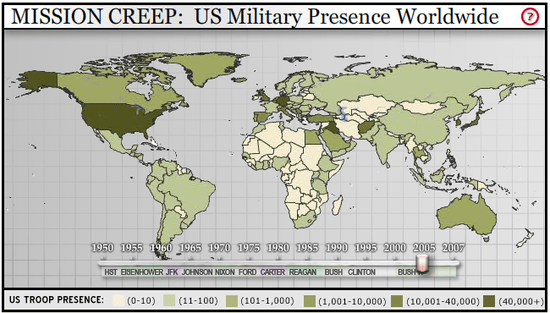
(Image: A still of an interactive map of U.S. military deployments from Eisenhower to Bush II created by Mother Jones.)
 The Dish