by Chris Bodenner
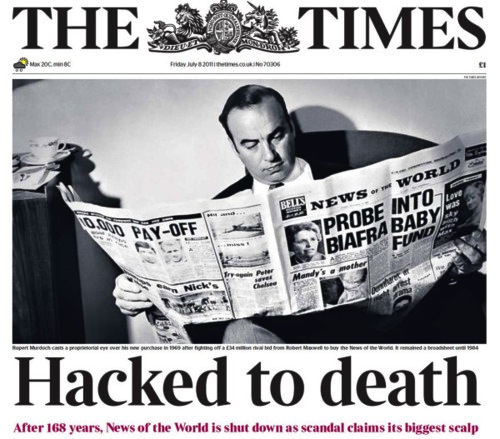
Alex Klein is worried about what the collapse of the lucrative News of the World will mean for the financial viability of News Corp.’s more respectable UK papers:
The Times and Sunday Times lost £87.7 million in 2009 and £50.2 million in 2008. Murdoch bought the Times as a prestige paper in 1981 for tens of millions, and as he puts it, “[My] only paper that’s in loss is the London Times. And that’s always been the case.” To his credit, the paper might have failed otherwise. The Times is still a loss leader with half a million or so readers, propped up by the gangbuster revenues of other News Corps outlets like the Sun and News of the World, which boast about 2 and a half million readers apiece. News of the World alone makes over £150 million a year in sales and ads. With that revenue stream gone, News Corps papers are going to come under a lot of pressure.
But Sam Gustin reports that because NotW’s profits actually have little to no impact on News Corp.’s bottom line, the decision to fold was something of a no-brainer:
“News of the World is pretty immaterial to News Corp.‘s earnings, in the one percent range, so whatever happens there is a flea on the back of an elephant,” Barton Crockett, an analyst at Lazard Capital Markets, told Bloomberg. “News Corp (NSDQ: NWS). is a company that’s really driven by their TV networks in the U.S. and internationally, and that part of the story is very strong right now.”
Under the circumstances, News Corp. executives clearly felt they had no choice but to amputate News of the World, which has become toxic, lest it infect the rest of the company or tarnish James Murdoch’s prospects of succeeding his father as overall News Corp. chieftain.
Along those lines, Gustin invokes the company’s $19 billion bid to take control of the British Sky Broadcast network, a deal that government regulators are currently weighing.
 The Dish