by Chris Bodenner
Contrary to the supposed masochism of Cubs fans, Bill Savage argues (paywalled) that the appeal of being a Cubs fan isn't confined to the actual game:
The most germane comparison to the Cubs is their cross-town rival White Sox. If romanticized losing could by itself bring in fans, the White Sox, with their World Series victory drought from 1917 to 2005, should give Cubs fans plenty of competition. And at many periods during the 20th Century, the White Sox outdrew the Cubs. But differences between their media strategies, their ballparks, and their neighborhoods show how the broadly drawn boundaries of Cubs baseball create its fan base.
Both Wrigley Field and Comiskey Park (the original and its replacement, now U.S. Cellular Field) were built in densely populated neighborhoods. But the 1980s seem to be the turning point. While Wrigleyville flourished, the White Sox’ “reconstruction” of Comiskey changed its relationship to Armour Square and Bridgeport. Like too many modern ballparks, U.S. Cellular Field sits in the middle of a sea of parking lots, offering fans little to do before or after games; McCuddy’s, a family-owned tavern where Babe Ruth was renowned to have beers during Yankees games, was demolished and never rebuilt. The park is clearly designed to ensure that every dollar spent by fans coming to the game is spent inside the ballpark.
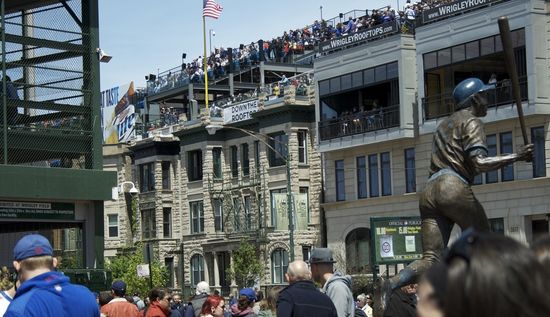
Wrigleyville, on the other hand, was transformed since the early 1980s from a working-class neighborhood into a year-round music and night-life district. Scores of bars allow tens of thousands of fans to participate in the Cubs experience without ever having to buy a ticket. Local businesses of all sorts get into the act: besides the inevitable souvenir stands and ticket brokers, a pet supply shop on Clark Street offers discounts with that day’s ticket stub, and at least one local tattoo parlor runs specials on Cubs logo tattoos. […]
The neighborhood really is Wrigleyville; everyone can take part in the broadly defined game.
A reader writes:
Why root for a team that disappoints you year after year? Because they're your guys, that's why. They represent your city, they represent you, and there isn't a fan in those stadiums that doesn't recognize this on some level. I don't know about other sports, but being a baseball fan is very similar to a religious experience. You're part of something that goes back centuries, you grow up hearing stories of the greatest ballplayers to ever live, from Ruth to Aaron to Gibson to Mays. And especially for Cubs fans, who go to Wrigley Field, one of the great cathedrals of the sport, this religion is intrinsic to growing up in the North Side of Chicago. You can't be anything but a Cubs fan if you're from there, just like you can only be a Phillies fan if you're from Philly, or a Red Sox fan if you're from Boston, or a Cardinals fan if you're from St. Louis.
It's who you are. It's part of your identity as a denizen of the city. You literally can't root for someone else, not without losinga connection to your home. The only way this connection is avoided is if you aren't a fan of the sport in the first place. No matter where I go or what I do, I have been and always shall be a Phillies fan. I knew exactly what Cubs fans were going through. And I know what they're waiting for, because for me it all changed in October 2008.
Because in one moment, one pitch, all that heartache I'd built up during my life, all the dismay, the futility, the doubt, all of it vanished in one glorious moment when the Phils finally won it all. I had literally waited my whole life for this. I was at the championship parade on Halloween that year. So were 2 million other people. And it was The Greatest Day In My Life (so far). Finally, my guys were giving the victory speeches. It was my guys parading down the street. My guys were hoisting the trophy. And it's a feeling I wouldn't trade for anything in the world.
That's what Cubs fans are waiting for. That's why they keep coming back. That one time where they get to wake up in the morning and feel like a winner. Because on that day it will all, finally, be worth it.
(Photo by Niklas Hellerstedt)
 The Dish