by Patrick Appel
Felix Salmon debates it:
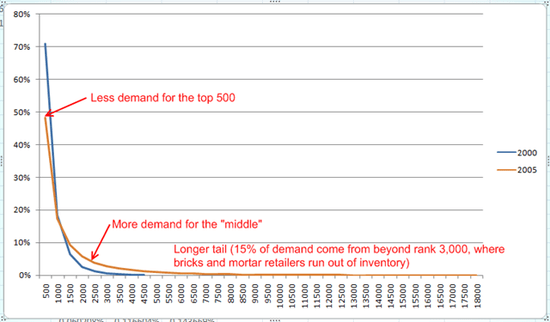
Back in 2009, Chris Anderson posted this chart, showing how Netflix’s consumers were embracing the long tail of its offerings. As the number of movies in Netflix’s library grew from 4,500 to 18,000, the top 500 movies in the library went from constituting more than 70% of demand to less than 50% of demand.
Salmon expects a reversal:
In shoving people out of their DVDs-by-mail schemes and into the streaming-only option, Netflix is reversing the trend seen in Anderson’s chart: the proportion of demand accounted for by its top 500 titles is almost certainly going to reach new all-time highs.
Felix has more general thoughts on Netflix's business model here. Adrian Covert tries to understand Netflix's strategy:
Instapaper founder Marco Arment took to Twitter and ventured a guess about the effect the streaming-only plan will have on Netflix, and thinks that if a large number of people go streaming-only, it's possible Netflix will have more firepower to negotiate with going forward. He also thinks it's possible Netflix was caught off guard by the costs involved in scaling up their streaming operation, and needed more financial resources to do so. And Arment is onto something. Netflix needs to find a way to strong arm studios into giving up more streaming content. Right now, the studios have the power.
E.D. Kain defends the company:
Even at the higher Netflix rates, subscribing to the streaming + 2 DVD plan and Hulu Plus is cheaper than subscribing to basic cable plus DVD rentals. With the online and mail plans you get to dictate what you watch and when, and there are fewer commercials.
 The Dish