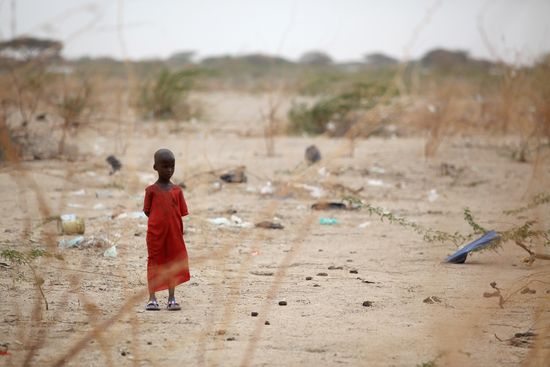
It's the worst drought in over a century and the U.N. has officially called it a famine – a rarely used label. The BBC explains what differentiates a famine from regular old horrific starvation:
Most major aid agencies – the FAO, the WFP, the UN's Famine Early Warning Systems Network, Save the Children UK, CARE International, the European Commission Joint Research Centre and Oxfam – only describe a crisis as a famine when the situation on the ground reaches level five on the Integrated Phase Classification (IPC) system. This means:
- at least 20% of the population has access to fewer than 2,100 kilocalories of food a day
- acute malnutrition in more than 30% of children
- two deaths per 10,000 people, or four child deaths per 10,000 children every day
It is usually up to governments to declare a famine. But in the case of Somalia, the UN stepped in because of the lack of central government.
Joshua Goldstein explains the famine's causes and how you can help.
(Photo: A refugee child stands on the outskirts of the Dagahaley refugee camp, which makes up part of the giant Dadaab refugee settlement, on July 20, 2011 in Dadaab, Kenya. The refugee camp at Dadaab, located close to the Kenyan border with Somalia, was originally designed in the early 1990s to accommodate 90,000 people, but the UN estimates over four times as many reside there. The ongoing civil war in Somalia and the worst drought to affect the Horn of Africa in six decades has resulted in an estimated 12 million people whose lives are threatened. By Oli Scarff/Getty Images.)
 The Dish