A June report from Pew on social networking focused on trust:
A Facebook user who uses the site multiple times per day is 43% more likely than other Internet users and more than three times as likely as non-Internet users to feel that most people can be trusted.
This has economic implications, according to neuroeconomist Paul J. Zak:
Zak and a co-researcher found that nations with higher levels of trust (Sweden, Germany, the U.S.) have stronger economies than those on the other end of the spectrum (the Congo, Sudan, Colombia). "Where there is more trustworthiness, there is more prosperity," Zak says.
Along the same lines, Sarah Leonard traveled the world using CouchSurfing.com:
It may seem odd to put your life in the hands of a total stranger in a foreign country. My mother certainly thinks so, but long use of Facebook, AIM, MySpace, and LinkedIn has shaped my confidence in Internet interactions. I, like many others, act as if some truth does filter down through the interwebs. I would never hitchhike, but I’ll sleep in a stranger’s living room. Why? … Familiarity has been globalized, and trust crystallizes over enormous distances. On Facebook I see abbreviated versions of my friends, but here I used abbreviated portraits of strangers to judge if they might become friends. The transition isn’t so hard.
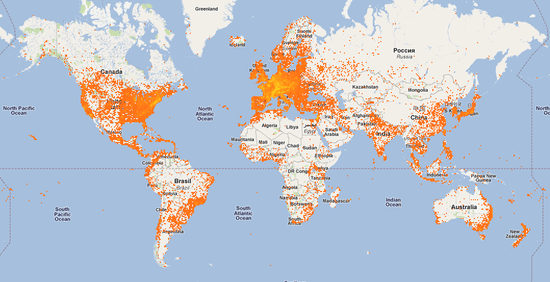
Couchsurfing map from Couchsurfing.com.
 The Dish