Harold James argues that the Murdochs' downfall demonstrates the failings of family-run corporations:
In the first half of the 1990’s, many observers of the alleged Asian economic miracle emphasized trust and families’ capacity to cooperate with political authorities in order to realize long-term growth plans. After the 1997-1998 Asia crisis, and as authoritarian regimes in South Korea and Indonesia disintegrated, these relationships were suddenly interpreted as corrupt, and the counter-view – that “crony capitalism” had become entrenched in these countries – soon prevailed. The Arab Spring has been in large part a movement against corrupt family capitalism, embodied not only in ruling families like the Ben Alis, the Mubaraks, and the Assads, but also in the large family business empires that depended on and supported them.
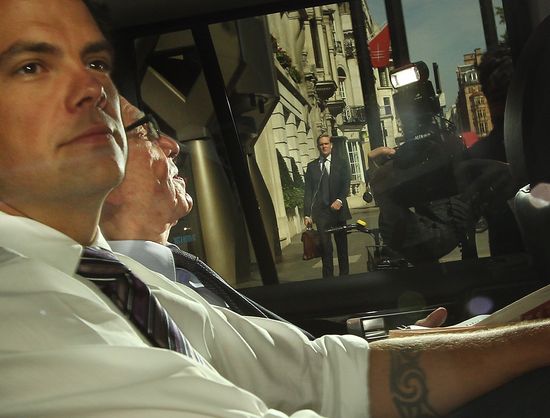
The above photo, by Getty's Peter Macdiarmid, shows Rupert and his eldest son, Lachlan. The Wiki description of the latter's rise and fall:
At the age of 22, Murdoch was appointed general manager of Queensland Newspapers, which publishes The Courier-Mail in Brisbane. One year later, he became publisher of Australia’s first national paper, The Australian. In 1995, he was appointed Deputy CEO of News Limited, Executive Director of News Corporation since 1996, Deputy Chief Operating Officer since 2000, Senior Executive Vice President from 1999 to 2000, and Chairman of STAR since 1995.
Murdoch has been criticized as a "rich brat" for his "poor handling" of Murdoch interests in One.Tel,[1] which lost the empire millions of dollars. For the year 2001, Murdoch earned a salary of A$2.59 million.[3]
After Lachlan resigned from his executive positions at News Corporation in 2005, Roger Ailes, the chairman of Fox News Channel, was named chairman of News Corp's group of television stations. The abrupt and unexplained departure of the 33-year-old Murdoch apparently dashed Rupert Murdoch's hopes that his son would one day take over as CEO of the global media empire.
 The Dish