"Ridiculously heavy currency." That was my comment on one of the things that Orwell observed that I felt was still true in my essay on how Britain has changed since I left it. A reader is having none of my criticism:
Lovely piece. But as a frequent visitor to England, I must disagree with your Orwellian critique of “the ridiculously heavy currency.” The pound coin has heft. It has weight. This, I recall thinking the first time I held a few of the new one-pound coins (after the pound note was eliminated in 1988), THIS IS MONEY.
But more than that, I love (in comparison to the boring regularity of American specie, the state quarters series notwithstanding) the many commemorative coins produced by the Royal Mint.
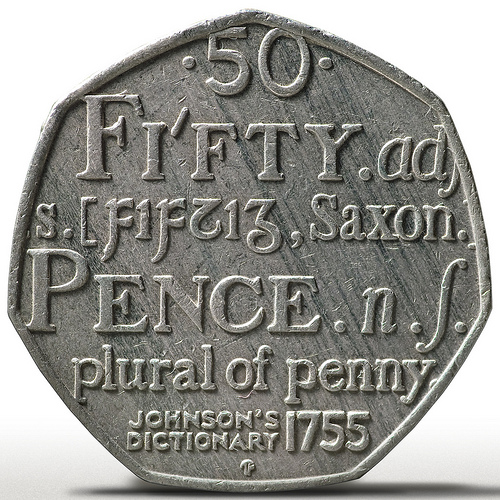
A few years back, I was visiting my friends in London (and if you have friends in no other place, do strive to have friends in London, especially if they have a spare bedroom) and we went to visit the small Museum at Samuel Johnson’s home. There was news that a 50-pence piece was going to be issued commemorating the 250th anniversary of the publication of Johnson’s Dictionary. I came back to England as soon as this coin was available just to get some, and brought them back to the States as gifts for all my friends who are 18th Century Lit scholars. Its simple elegance—with the definition of “fifty” and “pence” on the reverse—is sheer genius.
Coins are art and history we carry in our pockets and exchange with our fellow citizens
(or the citizens of the country we are visiting). The best are miniature bas-relief sculptures, like the heavy statuary of so many London parks and monuments, reminders of historical events that matter (D-Day, Roger Bannister’s Four-Minute Mile, Women’s Suffrage, just to mention some other 50 p coins I have collected, or the Royal Shield Reverse designs).
I love poring over my pocketsful of coins accumulated in a day wandering around London or Oxford. Finding a coin from the Isle of Man or the Bailiwick of Jersey—or a pre-decimalisation penny or twopence–mixed in with the usual English or Scottish coins connects with so much rich history. And I am so impressed by the fact that while Elizabeth II is on all of the money, she’s also been allowed to age: the coins depicting her currently depict her as the older woman she is, not some mythic youth.
So, as you analyze how England has changed, do spare its change from your critiques. Britain has the greatest coinage I know.
 The Dish