A reader writes:
Your Wisconsin reader apparently misses the point that roofs are white with snow anyway (unless a house has very poor attic insulation). So they are really never getting the benefit of having a dark roof. Since the winter is a wash because of the snow anyway, gaining the energy savings in the summer really adds up. Also, as pointed out here:
The same steps that make buildings easier to cool in the summer also can make them more difficult (and expensive) to heat in winter. It turns out, however, that in hot climates the summertime benefit greatly outweighs the wintertime penalty. That's because in summer the sun is high overhead, and shines mainly on the roof of a home; in winter the low sun shines on the walls and through the windows. So if we want a home to stay cool in the summer, we want it to have a light-colored roof. But to capture solar heat in the winter, the roof plays less of a role; it is more important to have large south-facing windows.
Another writes:
It seems to me the Wisconsin letter writer has two arguments:
1) Dark shingles will help absorb the sun, and help keep your house warm in our frigid winters. 2) The dark, sun-absorbing shingles will somehow prevent snow from building up and then creating ice dams as the snow melts.
I live in Wisconsin too, and let me tell you, when you have more than about three inches of snow, it doesn't matter *what* color your shingles are. In a snowstorm there *is* no sun to warm the roof and keep the snow off (especially if your snowstorm is at night). So the snow builds up anyway. And once a few inches of snow fall and your dark shingles are covered, any insulating value of the dark color disappears. (Snow, however, does make a very good insulator.)
Yes, you could probably make an argument that dark tiles will help absorb what little sun we get in the winter, and thereby help you heat your house, but that only works if there isn't much snow. Oh, and ice dams aren't caused by lack of reflection; they're caused by bad insulation, and by the heat leaking out of your roof and melting the snow that's built up there. Don't want ice dams? Seal up leaks in the roof/ceiling, insulate the hell out of your house, and if all else fails, get a roof rake and get the snow off of there.
Another:
One factoid in the favor of white roofs: supermarkets were early adopters, even in the Northeast. A supermarket in Vernon, CT has had a white rubbery roof surface for at least 20 years. In 1991 I was up on that roof, doing maintenance on a king-size dehumidifier, installed by the company I was doing a six month college co-op with.
I was informed back then by my employers that supermarkets have pretty low profit margins, only a few percent. So anything that helps cut costs is a potential win. One of their major costs is air conditioning. Some of it is simply to keep customers comfortable, but it's also done to dehumidify the air and reduce frost and fogging in the freezer section, which is why that section is often really cold. (The idea behind the dehumidifer we sold was that it would be cheaper to run than A/C, would dry the air in the freezer section, and would avoid freezing the customers. Not sure it worked well enough; the company seems to be gone.)
If a supermarket with a huge roof up in Vernon, northeastern Connecticut, can handle a white roof, I have to assume the snow issues have been worked out. Perhaps they have heat-generating cables strung underneath the rubber. They'd only have to be turned on once in a while, so they probably wouldn't eat into the energy savings too much. Might even be possible to run them off a smallish solar panel.
Another adds a new color to the discussion:
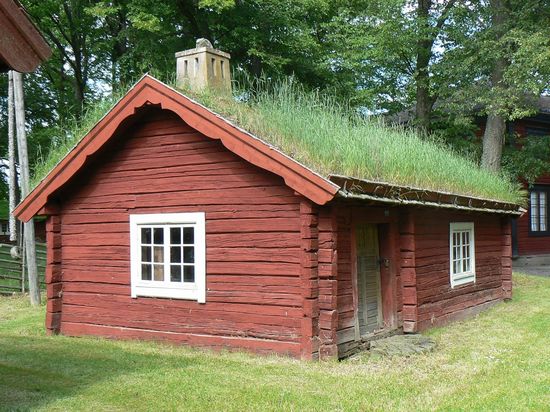
What you really want, if you can afford it and your local climate can support it, is a green roof. I work in outreach for NASA Earth observation. Because some green roof research used NASA data, I wound up writing a brief article about this in 2006. Green roofs not only alleviate the urban heat island, but also the "urban runoff island."
(Photo of "Swedish Eco house old style" by Flickr user phototouring)
 The Dish