Sami Moubayed provides a primer on the two largest, Damascus and Aleppo, and their role in the current crisis:
To date, [both cities] have tried to look the other way vis-à-vis the uprising that has broken out in every town and city across the country since mid-March. In these two cities, the markets are still open, banks are still in operation, merchants are still trading, entire families are dining at restaurants, young couples are getting married and, in many cases, enjoying the summer in complete denial of what is happening throughout the rest of Syria. So long as Damascus and Aleppo remain quiet, or neutral at best, the Syrian authorities believe the situation will be under control.
A closer look, however, shows that this argument — although applicable four months ago — is now nothing more than wishful thinking.
First, it is wrong to compare Damascus to Aleppo because sympathy with the Syrian uprising is high in the Syrian capital, but low and close to non-existent in Aleppo because of the city’s distance, its relative immunity from the economic crisis (thanks to flourishing business relations with Turkey), and the unique relationship the city has had with President Bashar Al Assad, who has paid it plenty of attention since coming to power in 2000. Additionally, Aleppo paid a terrible price for its support of the Muslim Brotherhood uprising of 1982, and sees how the state is retaliating in other cities today, like Hama and Deir Ezzor. It does not want to suffer a similar fate.
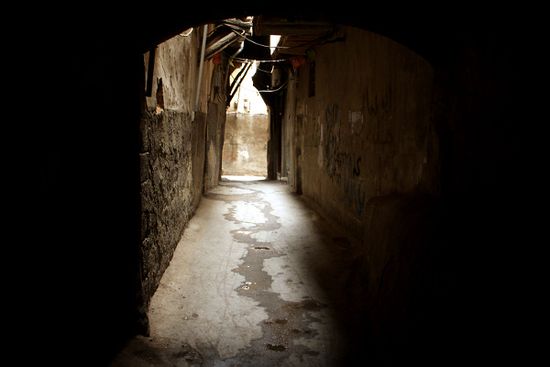
(Photo of a street in old Damascus by Flickr user hern42).
 The Dish