Yasmine El Rashidi is covering the Mubarak trial:
What’s happening in Egypt these days is much more complex than the now-familiar narrative about Islamists versus revolutionaries, pro-democracy versus pro-Mubarak, protesters versus SCAF. By the time the military did eventually disperse the remaining Tahrir occupants on August 1, even the square itself was divided: the English-speaking “activists” had packed up the day before and returned to the luxury of their homes and to Western-style coffee shops. Many young working class men remained in the square, as did families of martyrs. The upper-middle-class activists tried to convince them to pack up and go, to re-open the square. “Why should we,” several of them told me much later that night as we walked through Tahrir. “We have nothing to go home to.” …
Outside the trial this week, that sense of fragmentation was clear again in the very different responses to Mubarak’s arrival in the courtroom.
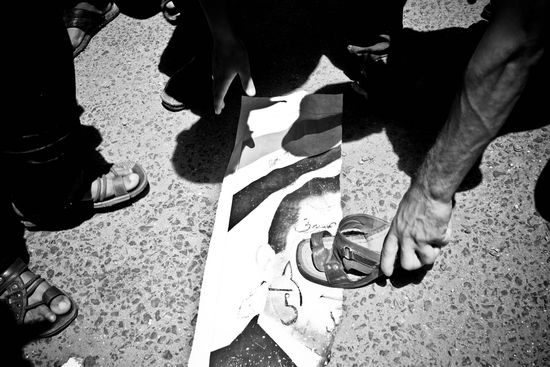
At 9:59 AM, following his two sons, an ashen looking ex-president was wheeled into the small barred dock on an ambulance stretcher. Inside the courtroom and outside the academy, people gasped. The scuffles and rock-throwing by anti-Mubarak crowds outside the academy—who tried to pelt the massive screen in protest against what they called “media lies” and pro-Mubarak banners beneath it—suddenly subsided. Shock washed over people’s faces. A few shed tears. A man kneeled down to the hot tarmac floor and kissed it, thanking God.
(Photo from outside Mubarak's trial by Flickr user Maggie Osama)
 The Dish