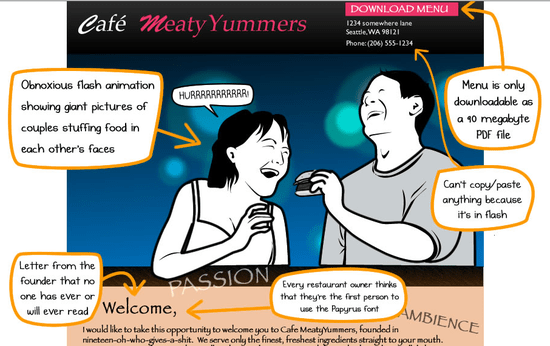
Many readers are sending us this link:
A wonderful internet comic strip, The Oatmeal, covered this topic and nailed it.
The page seems to be down temporarily, but a partial screenshot is seen above. In the meantime, check out the tumblr "Things Never Said About Restaurant Websites". Another reader:
I believe the reason they suck is very simple: they're cheap. As someone who's worked in and around the restaurant industry for many years, I know the ridiculously tight margins they operate on and the under-the-table, corner-cutting way of doing business that is essential if you want to survive. Restaurant managers usually have a friend, or friend of a friend, who designs websites – or even worse, they take a web design class at the Apple store and just do it themselves. Managers have bigger concerns to worry about.
Who needs a restaurant website anyway? We're all going there for the same info: menu, hours, phone number, address. Menupages.com. Done and done.
Another has a different perspective:
As a web programmer, I tend to think that restaurant websites are generally pretty good. It was typically the case a number of years ago that many of them wanted all the annoying accoutrements, when Flash was all the rage, but those kinds of requests have tapered off.
In fact, the last few bars/restaurants I did sites for specifically didn't want any of the clanging bells and whistles. Some of that has to do with wanting to save money (Flash work is expensive), but it has more to do with the fact that they wish to make sure their website shows up correctly on visitors' phones, which means, in practical terms, using only a minimal amount of graphics and a nice, clean design.
This is increasingly the norm. If you google "Chicago Restaurants" (I work in Chicago) and start clicking on the results, you'll see that, for the most part the music, animation (save for an image slideshow), the buttons with bad Photoshop effects, etc., have gotten scarce.
Another expert writes:
"Why this bizarre preference for menus in PDF format?" As someone who has built websites for restaurant chains before, this has a very simple answer. Chains usually get their nice-looking printed out menus designed by the same company that does their print advertising. This is supplied to the chain as a PDF file for proofing purposes. When faced with putting a menu on their website, making changes to HTML is intimidating. They cannot generally do it themselves and a programmer would charge several hours of work at $50 to $100 per hour to make a nice looking HTML version. Any future changes to the menu would also have to go to a programmer, though little tweaks wouldn't take much time. On the other hand, being shown once how to upload the latest menu.pdf sitting in their email inbox is easy and a one time expense.
It makes even more sense with big chains that allow individual restaurants to modify their menu with slightly different prices, selection, or layout (all within the approved guidelines of the corporate offices of course). Imagine trying to get a thousand individual IHOP owners to input slightly different menus. But since the menus are all created by the nationally retained advertising firm, it's easy for them to just upload the proofed PDFs to each individual location's website automatically when they are changed.
There's also the issue of end user printing. There's nothing big chains hate more than non-professional looking things with their logos. But what do people do with their favorite restaurants that they repeatedly order from? They print out the menu and tack it onto a bulletin board. HTML is difficult to get a consistent look from, whereas the PDF file format will print the same on any computer. Sound silly? One of the first thing computer illiterate CEOs like to do when looking at a test version of a new website is print it out. Then they throw a hissy fit when the text wraps slightly differently on paper than on the screen.
This is why I left the business world to get a PhD in the social sciences.
 The Dish