A reader responds:
My comment last week on your post "The Derbyshire-Bartlett Alliance" drew a number of furious dissents from Southern Dish readers, who – between calling me an "asshole" and recommending that I get fucked, characterized my words as "sanctimonious tripe," "mean-spirited childish ranting," "smug narrow-minded jingoism," and myself as "beneath contempt." In other words, I hit a button – apparently, a very hot button.
Fortunately, some other less volatile Southern readers wrote in to defend my perspective, and I can do no better than to quote one of them, when s/he wrote: "The reader was not describing the entire South. [With the phrase "the rump South" the reader] was referring to [the dictionary definition of "rump" as] the last and definitely the inferior part, which [is], as [the dictionary] phrases it, "a small part of the original" and "therefore unrepresentative."
That is precisely correct. The phrase "rump South" refers not to the South or the people of the South as a whole, but to the rump Confederacy and its bastard offspring Jim Crow, and to its political, social, economic, philosophical and spiritual grandchildren (which are by no means confined to the geographical South, as any child of the Midwest, like me, knows all too well).
This neo-Confederate influence, though waning, still manages to constantly rear its ugly head in our national discourse and politics. Consider Rick Perry's 2009 suggestion that Texas had the right to secede from the Union, or the recent debt ceiling crisis, when the Southern Tea Party/Republicans threatened to drive the nation into default unless their demands were met. In fact it was this last crisis that prompted Michael Lind to write the piece in Salon you called a "must-read" (it is) and profiled on August 2 in your post "The Southern Coup: An Update."
Lind's piece and the subsequent related discussion on the Dish, was the background against which I wrote my own comments. They were by no means meant to be a condemnation of the South in general, or the people of the South, any more than were Lind's. But neither do I retract a word of them.
Let me clarify a couple specific points brought up by dissenters, and I'll retire peacefully into the far West, where I now live:
To the dissenter who accused me of "conveniently ignoring facts of history like the wholesale lynching of emancipated slaves during the New York City Draft Riots of 1863, etc.," please take into account I was writing a short comment to Andrew, not a book. As a native of Indiana, I'm more than aware of the sins of the North, Midwest and West:
"The Indiana Klan was a branch of the Ku Klux Klan, a secret society in the United States that practiced racism and terrorism against minority ethnic and religious groups. The Indiana Klan rose to prominence beginning in the years after World War I… The organization reached its highest point of power during the years that followed, and by 1925 over half the members of the Indiana General Assembly, the Governor of Indiana, and many other high ranking members of the government were all members of the Klan."
This was a mere 25 years before I was born. My. Home. State. Just as much "rump South" as anything below the Mason-Dixon line. These are the good Christian people I grew up with — and I know them well, both the good and the bad. At least they had the good sense to eventually throw the Klan out — but only after a horrific scandal.
To the dissenter who felt "sick to [his] stomach" on reading that I thought he "viewed the [2008] election as 'a nigger up against a son of the South'," I would ask that you re-read my comment, and ask yourself: Do you consider yourself part of the "rump South," and all that that connotes? If not, the words do not apply to you. If so, they do.
In any case, picture this, if you will:
some other major world power, once a colonial state in which blacks were enslaved by whites, and now, eight generations later, a black man runs against the great-great-great-grandson of one of the largest slave-holders of the colonial ("planter mentality") era — do you think the world would just ignore that biblical drama? Or should? And yet, did we hear a word, a single word, about McCain's background? I didn't. I didn't know a thing about it until the election was over. No one else I know did either. Yet, that's ALL we heard about Obama. Not one word about McCain's background. Or the plantation that's still in the family. Or the black McCain's still living down there in Mississippi. Apparently none of that is of the slightest interest or importance. But would we have felt that way if it had been happening anywhere else? An historical human drama of that depth and scope?
John McCain is not responsible for what his great-great-grandfathers did. We are not responsible for what Jefferson or Washington or a thousand other founding fathers did. But we all live with it. And to ignore the fact is a form of insanity. "The past," a famous Southern writer once wrote, "is never dead. It's not even past." Faulkner was right. The darkness of the past has not gone away. It will never go away. It cannot be denied. It can be redeemed. And part of that redemption is to call it out, loud and clear, whenever its dark rump spirit rises in the present, whatever new disguise it uses to obscure itself. That's what Lind was doing, that's what Andrew is doing, and that's what I was doing. America has not yet redeemed its past. Not even close. You'll know it has, when the denial stops.
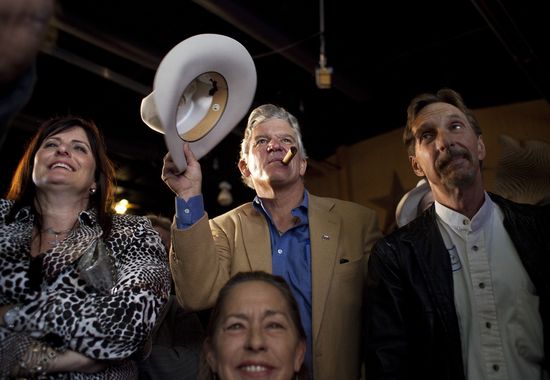
(Photo: Conservative supporters including Chris Scharbauer (C), of Amarillo, gather at the Victory Texas and Republican Party of Texas election night watch party at the Texas Disposal Systems Exotic Game Ranch on November 2, 2010 in Buda, Texas. Gov. Rick Perry has been elected to his third term by defeating Democratic challenger Bill White. By Ben Sklar/Getty Images.)
 The Dish