A reader writes:
It's more complicated than saying that Adam and Eve didn't literally exist. It appears that the population of humans at one point diminished to a point where all humans now living are in fact descended from just one woman in the population, dubbed "mitochondrial Eve." This does not mean that we are all descended from the "first woman," just that we are all descended from the "same woman." Some Jews and Christians who are not literalists will nonetheless take this as a comforting affirmation of the reality of our common humanity, as will some secular humanists. At any rate, it is what it is, an emerging scientific fact.
Another writes:
What gets me is that, according to Genesis, there were humans outside of Eden awaiting Adam and Eve. And, thus, it is completely unnecessary for Christians to ever argue that the entire human race was spawned from Adam and Eve. As a Christian myself, I've become interested in a theory I heard within the last couple of years: that God created Eden as a beachhead on an already fallen Earth.
The angelic fall preceded the fall from Eden and so the Earth and its inhabitants were already evolving (yes, evolving) in a spiritually-fallen universe. The opening Genesis narrative is specifically the view from within Eden – a plot of land freshly created (or carved out) to launch God's spiritual plan and battle for redemption. And the plan, on a spiritual level, required the creation of two, unfallen human beings. The creation of Adam and Eve within this Eden requires no more of a leap of faith than any other Biblical miracle (think the Immaculate Conception).
This is the Cliff's notes version of the theory, of course. But it starts us down the road of reconciling science with Christian theology and the actual Biblical narrative.
Another:
The Council of Trent did not state that Original Sin is passed genetically. It is implied because Adam is assumed to be the first man, and his sin is passed to all other people, but it is never stated explicitly. It's kinda strange Mr. Farrell simultaneously describes the teaching as "quite explicit" and "ultimately mysterious".
Papal encylicals are not dogmatic. Pius XII did not explicitly invoke papal infallibility and was not speaking "ex cathedra", or from the chair of Peter. The last case of infallibility is universally believed to be the Doctrine on the Assumption of Mary, in 1950. The views stated may be found interesting to believers but are ultimately not dogmatic.
The current Vatican is not denying anything. They are silent on the issue of Pius XII's view of evolution while maintaining the theological aspects of it. When they are silent on something, that usually means it is being reconsidered or it has already been abandoned.
The Roman Catholic Church is a 2,000-year-old institution. Please, for God's sake, cut them some slack on at least this issue. Institutions don't survive for 2,000 years by willy-nilly changing doctrine on a dime. They'll get there. The human genome wasn't mapped 300 years ago and the Vatican is just dragging its feet. This science is relatively new.
I just want the debate to begin. Because one reason that Christianity is in crisis is that it has failed to engage the modern intellectual world, except to spurn it. But we cannot spurn truth. And if faith is not related to truth, or widely seen to be hostile to it, it suffers.
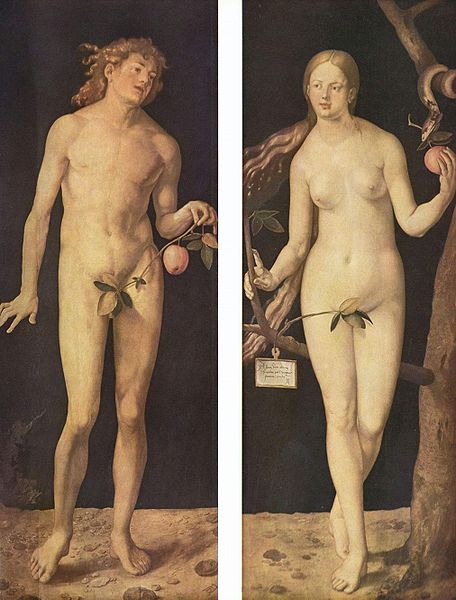
(Painting: Albrecht Durer, 1507.)
 The Dish