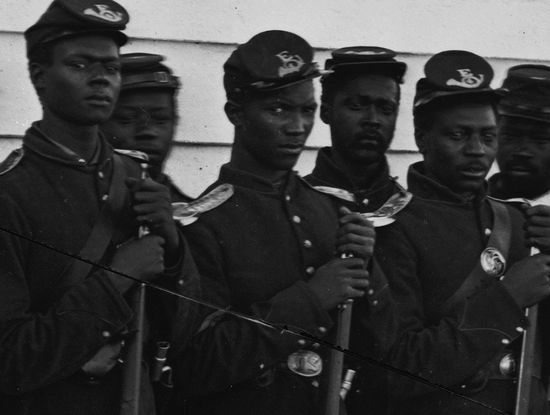
Ta-Nehisi continues to argue no:
[T]he Civil War as avoidable tragedy didn't materialize out of thin air; it comes not just out of American popular memory, but right out of American historiography. The origins of the American Tragedy are rooted in the Civil War denialism of historians who held that the war wasn't about slavery but, in the words of Charles Beard, "a sectional struggle" between two powers divided by "accidents of climate, soil and geography." Attendant to that view was the Fitzhughesque notion that "wage slavery" was as bad as "chattel slavery." When you reduce the Civil War to a fight between two equivalent systems of labor, it becomes much easier to believe that 600,000 Americans died in vain.
… It is a privilege to view the Civil War merely as four violent years, as opposed to the final liberating act in a two and half century-long saga of horrific violence, a privilege that black people have never enjoyed, and truthfully that no one in this country should indulge.
Calling the war "kind of tragic," Yglesias crunches some numbers:
[T]he Union spent $2.3 billion fighting the war and the South spent $1 billion fighting back. That right there is approximately the monetary cost of just buying all the slaves and freeing them.
Except the war option was not only equally costly in narrowly fiscal terms, it also led to the deaths of 625,000 people and all kinds of other physical devastation. Which is just to say that the war, like most wars, was a monumentally negative sum use of human capabilities and economic resources. Expending vast resources in pursuit of human freedom was eminently justifiable, but it’s still the case that relative to other conceivable ways of wrenching slaves from the grips of their masters "fight a giant war" is a tragically wasteful way to do it.
Freddie deBoer isolates the classic definition of tragedy – "that the tragic is the downfall that springs from character, that tragedy occurs because there is some failing within the tragic character (here the United States) which makes that tragedy inevitable":
In this sense I would say that the Civil War is precisely tragic: given the character of the early United States, it was both inevitable and necessary. That equality was codified in so many of our foundational texts while simultaneously denied to many millions of the country's people isn't merely an ugly contradiction but one which made violent correction inevitable. And it is the same elementary truth that constantly plays out in our conduct today: the United States pays lip service to a set of righteous values while acting in a way totally contrary to those values, and expects the world to judge it by the values and not the action.
 The Dish