This debate continues to blur lines and fascinate:
You quote a reader's self-described "Cliffs Notes" version of a theory that Adam and Eve weren't the only people originally created. It's a testament to how far we've come that the reader had first heard this theory only recently. It's actually a centuries-old doctrine called "polygenesis," which had a considerable vogue in the nineteenth century and was closely linked to the "scientific racism" of that era. It was thought that the simplest way to explain the differences among human groups was to assume that they arose from separate creations. Race differences were therefore innate and unbridgeable, like the differences between humans and apes.
Against this, the traditional "monogenesis" of the biblical Creation account was helpful, at least some of the time, as a progressive reminder that we're all finally part of the same big family and all equal in God's eyes, regardless of differences in skin color and the like.
Fortunately, the further advances of science have been as destructive of polygenism as of biblical literalism. There is no good reason to revive either one. All evidence now suggests that (a) there was no literal, instant "Adamic" Creation as described in the Bible, but (b) nonetheless, at least since the last Neanderthal died, there has been one and only kind of homo sapiens, and the variations crudely referred to as "races" are superficial and invidious if taken as reasons to favor some groups over others.
If polygenesis made a comeback, our debates on a range of issues would be even coarser than they already are. For instance, as maddening as it is to hear gays described as disordered and in need of "cure," or that "marriage is only between a man and a woman," at least these backward views concede that gay and straight are part of the same human creation. Imagine how much further we'd still have to go if there were people seriously arguing that gays and straights aren't really even the same species and that marriage is only for human beings. But that's exactly the depth to which racist claims once descended.
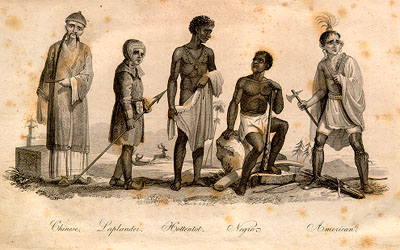
From the text accompanying the above image:
Early anthropological studies were used to support both [monogenesis and polygenesis]. Goldsmith's illustrated races (above) include "Chinese," "Laplander," "Hottentot," "Negro," and "American." Variations in human physiognomy (seven-foot Masai tribesmen, three-foot pygmies, Asiatic North Americans, albinos of all "races") led to far-fetched theories about the origins and possible relationships among human beings. Darker races were sometimes described as the descendants of Cain. Lighter races were linked to the iconography of Jesus, even after it became clear that a first-century Palestinian would have looked nothing like a "white" European.
The proximity of humans to higher apes caused additional confusion; the orang-utan was referred to as homo silvestris (man of the woods) until well into the nineteenth century. The problem resolved itself into a simple opposition that had staggering consequences for the two centuries after 1800: if humans (much less races) were separately created, then the laws and moral values that applied to one group need not apply to another; if all humans (much less animals) were biologically related, then their shared destinies might depend on respect and cooperation, not blind dominion.
 The Dish