by Maisie Allison
Defending Rick Perry against an egregiously weak charge of racism, Reihan Salam makes a larger observation:
One thing that is undeniably true is that American conservatives are overwhelmingly white in a country that is increasingly less so. As the number of Latinos and Asian-Americans has increased in coastal states like California, New York and New Jersey, many white Americans from these regions have moved inland or to the South…These white voters are looking for champions, for people who are unafraid to fight for the America they remember and love. It’s unfair to call this sentiment racist. But it does help explain at least some of our political divide.
Yglesias pounces, recalling John Boehner's assertion last year that Obama and the 111th Congress were "snuffing out the America that I grew up in." Isaac Chotiner goes further:
My question for Salam is this: how racially insensitive does one have to be to prefer an America with segregation because he or she saw other advantages to 1950s society? What possibly could outweigh the disgusting racial status quo of the 1950s (I am leaving out the status of women and gays)? To wish for a return to that America, I would argue, one has to be so racially insensitive that bigoted seems like an apt descriptor. The alternative answer, of course, is complete solipsism.
Friedersdorf disputes the notion that culturally conservative nostalgia is inherently bigoted and instead attributes it to the tendency to romanticize childhood or the past. My question for Salam: Are "white voters" looking for "champions" or are the demagogic champions (Fox News, Bachmann, Perry, Palin, etc.) looking for white voters?
The more important question is the latter. The "my country is fading away" sentiment that Salam detects in sections of the electorate is a pretty unexceptional phenomenon, which occurs across generations and geography. In this sense, it is insignificant. Indeed, cultural conservatism naturally lends itself to some sort of "political divide," but as a source of antagonism, it has been needlessly aggravated and even exploited by elements of the Republican Party. In a cynical way, the GOP often caters to this emotional impulse, and even serves to validate and reinforce it. As a party it has lacked the vocabulary and vision that would broaden and elevate the worldview of these voters.
As Salam notes:
This bias against efforts to speed up social change has led to a number of horrible misjudgments, including the opposition of conservatives like Arizona Senator Barry Goldwater to the Civil Rights Act of 1964 and, more recently, the almost universal opposition among national conservative politicians to letting the states decide whether or not to grant same-sex couples the right to marry.
As the political theorist Peter Berkowitz argued in 2005, “the American constitutional order speaks the language of freedom,” and causes that run counter to the spirit of freedom are, in the long run, doomed to defeat. That could explain why the idea of economic freedom retains such a powerful appeal for Americans, and it also explains why a certain kind of cultural conservatism — the kind that fuels opposition to same-sex marriage — is dying out among the young.
The healthy conservative bias against manufactured "efforts to speed up social change" is not a mandate to ignore or suppress or fear reality. This leads to the GOP's strategic problem: the nostalgic white voters are becoming irrelevant (by Salam's account, they are old and in retreat). And the GOP is neglecting everyone else. For instance, Michael Barone warns of the demographic disaster facing a GOP that refuses to "evolve" with the electorate on gay marriage:
The Republicans’ problem is young voters. Huge majorities of them favor same-sex marriage, and for most of them it’s simply a no-brainer. They must have been turned off if they were watching the Republican presidential candidates vie with each other in opposing it in the Fox News/Washington Examiner debate in Iowa.
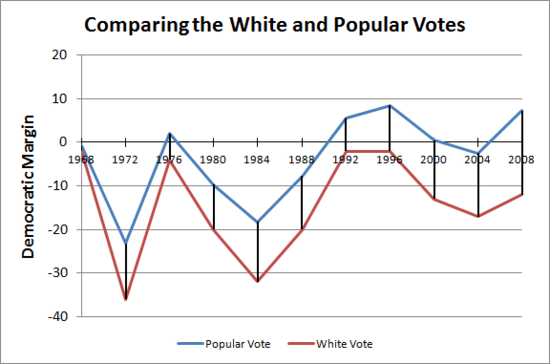
Here, it's the regrettable solipsism of the Republican Party that matters. Chart from FireDogLake.
 The Dish