by Zoë Pollock
Philippe Sands has an extensive report on Saif Qaddafi's involvement in Libya's crackdown. Saif's mentor, Mohammed al-Hawni, recounts the main points of the speech Saif could have given, supporting the protesters:
“He had the chance to destroy his father, and he did not take it,” al-Hawni said. And why was that? “He wants to show that he’s strong, to prove to his father that he is up to the problem.” He did not know what passed between father and son that day, but believed that it had “changed everything.” From Khamis Qaddafi, al-Hawni learned later that Saif had met with his father and then gone straight to the television studio. It was not politics but family, “between father and son.” Saif chose “family . . . the father and the leader.”
Sands' interview with Luis Moreno-Ocampo, the I.C.C.’s chief prosecutor, complicates that version of events:
Did Moreno-Ocampo buy the notion that Saif was at a personal crossroads, that the speech could have gone a different way? “No, that is not what my evidence is saying. The information shows that he was involved well before that, that he was involved from the beginning, in the planning before the 15th of February.”
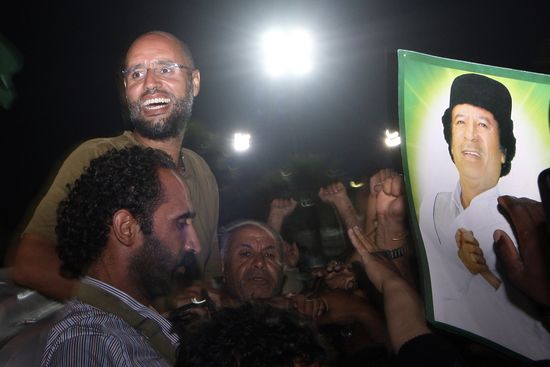
(Photo: Saif al-Islam Qaddafi, son of Libyan leader Moamer Qaddafi, is surrounded by supporters and journalists at his father's residential complex in the capital Tripoli in the early hours of August 23, 2011. Seif al-Islam, wanted by the International Criminal Court for crimes against humanity, claimed the insurgents had suffered 'heavy casualties' when they stormed Qaddafi's Bab al-Azizya compound in Tripoli. By Imed Lamloum/AFP/Getty Images.)
 The Dish