by Maisie Allison
Lewis McCrary counters Drew Faust, who warned in her Jefferson Lecture in the Humanities (pdf) that reenactments perpetuate false narratives about war, and are "less about remembrance than forgetting":
For Faust, the reenactments are a simulacrum, an image that bears no relation to what it purports to represent. Whatever meaning it gives must be false. But for the reenactors, replaying these battles provides a reminder that conflict is always with us, and that some instinct, perhaps original sin, always leads men to do violence to one another. In Faust’s interpretation, the Civil War was a tragic but necessary component of national progress. But the more provincial reenactors intuitively understand a more fundamental story, that war is a result of the fallen human condition. Their reenactment, like the carnivals of old, is liturgical; it restrains rather than rekindles violence.
Andy Hall reflected on a reenactment of the "last slave sale" this year for TNC's blog. In May, Glenn LaFantasie echoed Faust and debunked the notion of "living history" in the context of the Civil War's sesquicentennial. Previous discussion on whether the Civil War was tragic here.
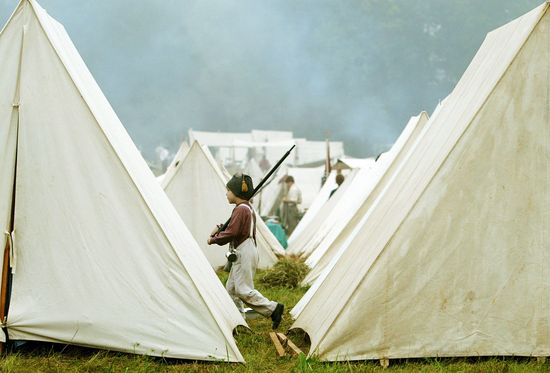
(Photo: A young Civil War reenactor walks though the camp of the Army of Nothern Virginia in Gettysburg, Pennsylvania. Photo by Mark Wilson/Getty Images)
 The Dish