by Zoë Pollock
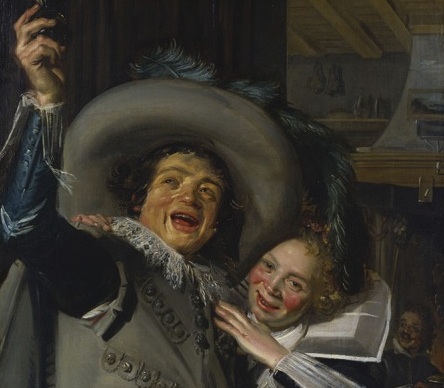
Many argue that a painting by Frans Hals, often referred to as "Yonker Ramp and his Sweetheart" (seen partially above), depicts the prodigal son cavorting before his eventual return to his father. Morgan Meis extends the theory, which suggests "that we don't need to depict the prodigal son of the Bible since we can go out and see the prodigal son right there in our local pub":
And that matches up nicely with a bit of Protestant theology — namely, the idea that we do not need much mediation between ourselves and the truths of the Bible. … "God," taught Martin Luther, "writes the gospel not in the Bible alone, but on trees and flowers and clouds and stars." Marrying that thought with the iconoclastic impulses of Dutch Protestantism led to an almost inexorable conclusion for Frans Hals: He would paint the stories, morals, and lessons of religion into the immediacy of the world as it was presenting itself right there in front of him.
 The Dish