by Patrick Appel
A reader writes:
The problem we see in manufacturing and elsewhere is that technology is constantly allowing us to do more with less. From a resource perspective this is vital if we're to continue to maintain economic growth in a world of finite resources. However, this same innovation is also allowing us to be more productive with less employees. We have factories full of robots to build our cars and computers. Who needs a secretarial pool when you have e-mail, copy machines, and printers?
Up through roughly the 1980s, if you had a minimal education, you could still find gainful employment that could provide a middle class income. That is less and less the case now, and it will only get worse in the future. So how do we, in a capitalist democracy, address the fact that some people will be incapable of a meaningful contribution to productive output? People who do not have the skills and are not capable of learning those skills will be unable to make a living, much less rise up from poverty. So we will find ourselves with an ever increasing under class that has no economic opportunity available to them.
This disparity of opportunity is one of the main reasons we have such a polarization in US politics today is because this issue has continued to go unaddressed. The tea party is not angry at government as such, but rather angry about getting screwed by the system. But their right leaning politics assumes that the target of their ire should be the government. The left, similarly angry, blames large corporations. While the object of their derision may differ, both left and right are fundamentally reacting to the same sense that the future is looking ever bleaker.
Of course as poverty rises, wages stagnate, and unemployment remains high for less educated workers, politicians are all too happy to demagogue, blame the other side, and make the situation even worse. So we wind up with a self-reinforcing problem where greater inequality leads to greater polarity and makes real solutions more difficult to achieve. In the end, this is unsustainable.
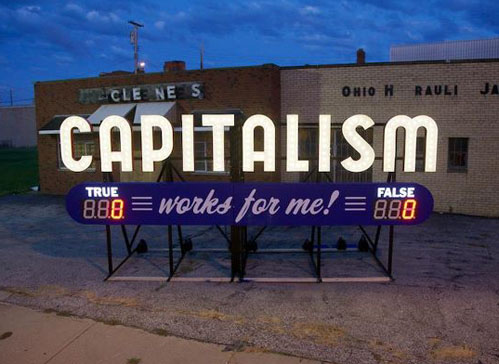
(Photo: Image of Steve Lambert's traveling art project, which is being funded through Kickstarter. Hat tip: This Isn't Happiness)
 The Dish