An Epidemic Of Not Watching, Ctd

Jonathan Litz reports on a new draft law – supported by the coalition and opposition – that legally subordinates Israel's democratic character to its Jewish one:

According to [MK] Elkin, the law is intended to give the courts reasoning that supports "the state as the Jewish nation state in ruling in situations in which the Jewish character of the state clashes with its democratic character."

Elkin said: "The courts deal with this issue quite a lot, such as with the Law of Return as a discriminatory law." The bill redefines basic consensus regarding the character of the state. For example, it also proposes that Hebrew would be the only official language in Israel, as opposed to the present situation – based on current mandatory law, Arabic and English are also recognized as official languages.

Goldblog has a more specific worry:

I fear that [Glenn] Beck's August 24 rally in Jerusalem might mark the moment when the cause of Israel itself jumps the shark.

Really? An Israeli prime minister dictating future policy to an American president in public was not enough?

The Best Conservative President Since Bill Clinton

Bruce Bartlett picks up the meme. And he reminds us how many conservatives, in moments of rare candor, have agreed with that thesis over the past few years. Obama reminds me of a one-nation Tory, refitted for the austerity era. David Cameron would fit very easily into his cabinet, and vice-versa. But then I've always insisted on that from the get-go. Yes, he is a liberal redistributionist in theory (if not in practice). But when the country is careening toward Chile-like social inequality, that too is understandable as a Tory instinct.

Sex As Bargaining Tool

Women in Barbacoas, Colombia have resorted to a "crossed legs" strike after all other efforts to lobby their government for basic infrastructure failed:

[T]he lack of a paved road means that even the cost of food is five or six times that of other regions of the country. But this isn't just about the price of goods or convenience: there have been many deaths linked to the lack of adequate infrastructure, as ambulances get stuck in the mud trying to reach town.

Nona Willis Aronowitz admires the desperate move:

At face value, this political tactic is as old-fashioned as it gets. It paints men as horny brutes and women as sacrificial gatekeepers. … But context is everything. The women in Colombia aren't simply playing the sex card; they're connecting their life-or-death struggle to their future children. "We are being deprived of our most human rights and as women we can't allow that to happen," Ruby Quinones, one of the organizers, told a local newspaper. "Why bring children into this world when they can just die without medical attention and we can't even offer them the most basic rights?"

Of course, in a country where birth control is accessible (and now free!) and abortion is legal, this defense rings hollow. But in a place like Barbacoas, where access to even basic medical care is strained and ending a pregnancy could get you three years in prison, a strike like this suddenly becomes meaningful.

The Ghosts Of ’92

120247840

Alexis Okeowo puts horrifying new reports from Somalia in historical context:

Three hundred thousand Somalis starved to death just nineteen years ago. In 1992, when the American government sent U.S. soldiers into Somalia to facilitate the delivery of food, the mission was infamously aborted when two Black Hawk helicopters were shot down, and eighteen soldiers killed, by Somali militants. The memories of those horrors still cloud the decision-making of foreign donors reluctant to engage in the country.

But because of the perils of the arduous journey to refugee camps, the best way to feed people would be through centers based in southern Somalia out of reach of the [Al Qaeda-linked] Shabaab, an effort the Kenyan government is advocating. (The United Nations has limited feeding operations in Somalia). Meanwhile, the famine is expected to extend through the end of the year, as the rains still refuse to pour.

More than 29,000 children under the age of five have perished over the past 90 days in southern Somalia alone.

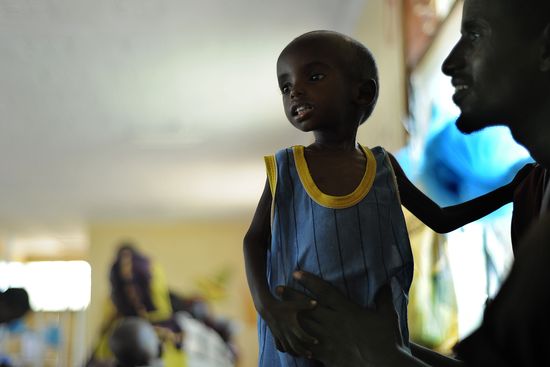
(Photo: Aden, a three-year-old Somali refugee with his father Abdille, recovers at the stabilisation centre at Hagadere refugee area on August 02, 2011 after arriving a week earlier on the verge of death from severe malnutrition. Aden lost his mother to starvation during the journey from southern Somalia and is now recovering remarkably at the centre, run by the International Rescue Committee [IRC] supported by UNICEF, after his father, grandmother and two siblings managed to get at the Dadaab refugee complex in Kenya's north-easterly province. An estimated 3.7 million people in Somalia – around a third of the population – are on the brink of starvation and aid agencies are stretched in trying to cope with a daily influx of Somali's escaping not only drought but the al-Shabab extremists who have turned taken advantage of the famine to forcefully arrest and recruit men trying to escape the famine. By Tony Karumba/AFP/Getty Images)

The Cycle Of Escalation

Eric Martin rounds up arguments against increasing US involvement in Syria and discovers a pattern that escalation advocates use to go from condemnation to war:

Step 1: How can the President not at least condemn [Regime X] publicly for its abhorrent actions?  A public condemnation is the very least the President can do.  It wouldn't cost much, but it would be an important show of our resolve and support for freedom!

Step 2 (with Regime X still in place): So what, the President condemned the regime publicly with some harsh words and called it "illegitimate."  Words are cheap and inconsequential.  We need sanctions and coordinated efforts to isolate the regime. That will do the trick!

Evangelicals And Democracy

GT_COPTIC-EGYPT-110804

Syrian Christians are afraid of being persecuted (as Egypt's were) if Assad is toppled. Molly Worthen tracks the evangelical response in America:

Evangelical concern for persecution overseas is completely genuine — though too often lumped together with more dubious causes. "Religious freedom" has become a kind of shorthand in American political rhetoric, useful for prescribing some domestic policies (prayer meetings in public schools, intelligent design in the curriculum), decrying others (same-sex marriage, the repeal of "don't ask, don't tell"), and contributing to an ambivalent view of democracy — whether in the United States, or in the Muslim world — if the principle of "one voice, one vote" happens to threaten evangelical priorities. 

Every time evangelicals indulge in hysterics about the persecution of American evangelicals and "how liberals are waging war against Christians," they weaken their own case against the tyranny of the majority in the Middle East and insult those congregations huddling behind drawn curtains in Egypt and Libya. But then, scholars of evangelicalism have long observed that cultivating a persecution complex — even one that is mostly a self-perpetuating fiction — is not a bad way to maintain authority and stoke followers' sense of divine purpose. The trouble is that this mindset may make evangelicals look less like their oppressed brethren and more like the very despots they hate.

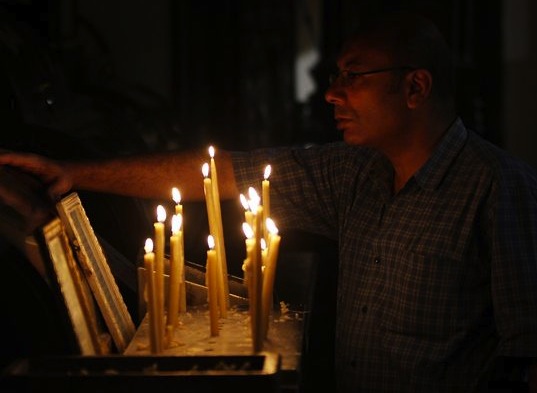
(Photo: A Coptic Christian stands near candles in The Hanging Church on May 27, 2011 in Coptic Cairo, Egypt. By Peter Macdiarmid/Getty Images.)

Where Your Troops Are

Nick Turse reports on the vast global reach of US Special Forces:

Last year, as an analysis of SOCOM documents, open-source Pentagon information, and a database of Special Operations missions compiled by investigative journalist Tara McKelvey (for the Medill School of Journalism's National Security Journalism Initiative) reveals, America's most elite troops carried out joint-training exercises in Belize, Brazil, Bulgaria, Burkina Faso, Germany, Indonesia, Mali, Norway, Panama, and Poland. So far in 2011, similar training missions have been conducted in the Dominican Republic, Jordan, Romania, Senegal, South Korea, and Thailand, among other nations. In reality, Nye told me, training actually went on in almost every nation where Special Operations forces are deployed. "Of the 120 countries we visit by the end of the year, I would say the vast majority are training exercises in one fashion or another. They would be classified as training exercises."

A Federal Crack-up, Ctd

Chris Cillizza contextualizes a new poll showing the lowest approval rating for Congress ever – 14%. Ezra Klein thinks it's "time to admit this system is broken:"

For the political system to do something as difficult as deficit reduction requires a consequence as unthinkable as default. So this, then, is another example of what happens when Congress can’t agree to act: Those in Congress who want action — and they are of both parties — manufacture crises in order to force it. It’s not that things don’t get done so much as that they get done in the most dangerous, insane and reckless way. And if that fails and they don’t get done, they trigger awful, unimaginable crises.

Raghuram Rajan blames the electorate. Greg Sargent looks at how our political dysfunction is sinking the super-committee. Earlier hand-wringing here.