The Daily Wrap

08-Washington-Rip
Today on the Dish, Andrew squared up to the new American reality that we've hit an economic wall, but he wasn't concerned about other countries gaining world domination. Frum refuted the right's ridiculous claim that Obama has made the economy worse, Chait pwned McArdle on Bush tax cuts and the American people agreed, and Andrew would prefer a return to Clinton-era tax rates instead of cutting important programs. Frum gave credit to Krugman for knowing this crisis was coming, Krugman requited, and Andrew praised Don Peck's foresight. We mapped the dissolution of our functioning democracy as the GOP took radical steps and took on serious risks, and Obama came out on top. Andrew defended the existence of independents and Obama's appeal to them, Freddie de Boer rooted for the left, Jonathan Cohn begged politicians to focus on unemployment, and McConnell was a party pooper.

Romney pledged to break up Andrew's marriage and Andrew recalled how real Christians would treat politics if they were following Jesus' lead. Santorum believed early start programs wanted to indoctrinate children, constitutional lawyers defended Obama's healthcare reform on the basis of the Commerce Clause, and you can examine all Romney's flip-flops side by side. 

Andrew wondered when the last time there was a left-wing secular mass murder or assassination, Nikki Stern contemplated being a symbol of 9/11, and Goldberg skewered Pamela Geller's most recent Islamophobic venture. Donald Rumsfeld may be actually tried as a war criminal, Michael Joseph Gross sounded the alarm about Operation Shady rat, and we questioned the reporting in the New Yorker's Abbottabad piece. Syria's uprising could reinvigorate the Green movement in Iran, Mubarak's trial could vindicate the struggles of Arab Spring, and Steve Cook remained cautious about Erdogan's power in Turkey. Egypt tried and convicted its bloggers and activists, Qaddafi's son compared Libya to a delicious piece of cake, the world's tallest building was brought to you by the Bin Laden group, and the Likudnik beat goes on.

A new documentary remembers the purge of gay people from government in the 1950s, and complex HBO programs may be making us smarter. We don't need horses in our cities like we used to, bioart raised new ethical issues for how it gets disposed, and bees can respond to stress. Dish readers marveled at each others faces on our Facebook page, and the Dish app was around the corner!

Hathos alert here, chart of the day here, FOTD here, MHB here, VFYW here, and the view from your airplane window here.

–Z.P.

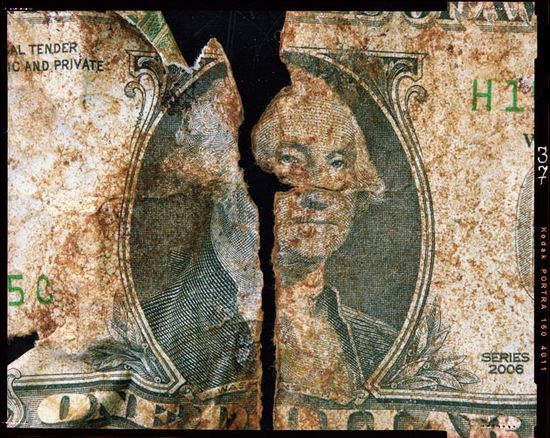
(Photo: "Washington, Rip" by Will Steacy, who photographed decrepit money before it's destroyed by the Federal Reserve.)

Sugar Daddies And Student Debt

Amanda Fairbanks investigates SeekingArrangement.com, one of many sites to connect college students in debt to "sugar daddies" that offer financial aid in exchange for sex or companionship:

Debt-strapped college graduates weren't included in [founder Brandon Wade's] original business plan. But once the recession hit and more and more students were among the growing list of new site users, Wade began to target them. The company, which is headquartered in Las Vegas, now places strategic pop-up ads that appear whenever someone types "tuition help" or "financial aid" into a search engine. And over the past five years, Wade says he's seen a 350 percent increase in college sugar baby membership — from 38,303 college sugar babies in 2007 to 179,906 college sugar babies by July of this year.

Walter Russell Mead says the education bubble has to pop soon. Kay Steiger has mixed feelings about how the transactions are portrayed:

[P]erhaps framing “arrangements” in strictly transitional terms to pay off tuition isn’t a great way to present women who choose them. Talking about it this way takes away the agency some of the women enjoy feeling when they enter into an arrangement like this. Most of the arrangements discussed in this article are consensual relationships between adults. The stigma women may face for wanting to enter into an agreement like this—rather than presenting it as part of one’s sexuality—may be so great that women cite financial reasons instead.

Tracy Clark-Flory hones in on whether the women are prostitutes and the men, johns:

Rich men who want to buy sex can afford euphemisms. "Sugar daddy" can be one of those euphemisms, but not always. Yes, some men look for a "sugar baby" when they really just want sex, and the companionship thing is a front. But some really just want the companionship and sex never happens, and if it does, they may or may not see it as something they've directly purchased. … Most of us don't like to acknowledge the complex relationship between sex and money. Sex workers, however, claim these gray areas — sometimes to protect themselves from the law, and sometimes because it is just that complicated.

The Left vs The World?

Freddie deBoer doesn't appreciate the beating the left has been taking:

The Tea Parties don't get exactly what they want, usually. But they steadily and consistently push the conservative movement to the right, and in doing so drag the center with them. That's the salient lesson of the last several years: extremes define the center. Yet liberal bloggers delight in kneecapping the man to their left, while conservatives race to be the man to the right. How could anyone wonder why this results in a steady march rightward? What bothers me is never that liberal bloggers fail to adopt the ideas of the left but always that they don't understand that true left wing voices give them cover and help to establish a middle ground that is conducive to their interests.

Yglesias Award Nominee

"To put the burden of proof on Muslims to prove their loyalty to America, simply because they are Muslim, is the antithesis of the spirit of the American founding. And to target people simply because of their religious faith – to assume that (in Michael Gerson’s words) every Muslim is a recruit for sedition – is a direct assault on the very Constitution conservatives say we revere," – Pete Wehner, commending Chris Christie for smacking down the far right.

Egypt’s Trials

GT_EGYPT-TRIALS-110804

While the Mubarak proceedings continue, albeit chaotically, Joshua Hammer looks at another sort of court case:

Since February 11, when President Hosni Mubarak ceded power to the Supreme Council of the Armed Forces, between seven and ten thousand civilians have been brought before closed military tribunals inside this fortresslike building. The civilian courts that normally would have tried them were not functioning in the first weeks after the revolution, but now, according to human rights officials, that’s no longer the case. Those arrested have been charged with a variety of offenses, including “thuggery,” assault, and threatening the security of the Egyptian state—a catch-all phrase once employed by Mubarak’s despised ancien regime.

Those accused include pro-democracy demonstrators, bloggers, and other prominent activists swept up in the chaos that preceded and followed Mubarak’s fall, as well as common criminals and bystanders. Thousands have been convicted and sentenced to terms of between several months and five years in prison. The procedures tend to be swift and are conducted before single judges in military uniform who are not known for scrupulous attention to the evidence. In late June, Amnesty International said that trying civilians in military courts violates “fundamental requirements of due process and fair trials.”

Michael Totten dispatches from a recent protest demanding more democratic rule from the SCAF. Reza Aslan thinks the promise of democracy is already taming Islamist groups, but Courtney Messerschmidt worries the lack of a strong government in Egypt might increase the chances of another Gaza war.

(Photo: Egyptian riot police follow the trial of former interior minister Habib al-Adly on a screen erected outside the Cairo Criminal Court at the Police Academy on August 4, 2011 during his trial along with six senior police officers over deaths in the uprising that unseated Hosni Mubarak. By Marwan Naamani/AFP/Getty Images)

Supercommittee Shenanigans

Chait thinks the members will "succeed by failing:"

Republicans needed a way to approve the debt ceiling without backing down from their avowed goal of reducing the deficit by a dollar for every dollar they hiked the debt ceiling. The supercommittee was supposed to lock in the lion's share of that deficit reduction. Now, suppose the parties can't agree on a fiscal adjustment — that is, Democrats insist on a balanced deal and Republicans insist on a cuts-only deal. Then we trigger some painful cuts neither party wants, and Congress then goes ahead and cancels them out. End result: we increased the debt ceiling by $2.4 trillion, and only cut half as much from the budget. By the time this is clear, conservatives have long since turned their attention to other matters, and Boehner gets to keep his Speakership.

Chart Of The Day

Big-Mac-Index-Economist

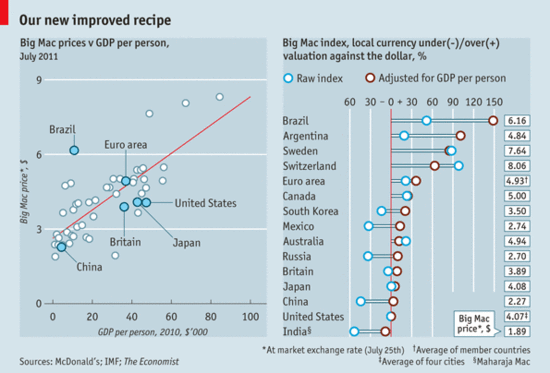
The Economist updates its Big Mac index:

The difference between the price predicted for each country, given its average income, and its actual price offers a better guide to currency under- and overvaluation than the “raw” index. The beefed-up index suggests that the Brazilian real is the most overvalued currency in the world; the euro is also significantly overvalued. But the yuan now appears to be close to its fair value against the dollar—something for American politicians to chew over.

Sorry, Megan

44 percent of the public blames the Bush administration for our current economic mess, with only 15 percent blaming Obama (double what it was at the begiining of 2010 but stable since this spring). The blame on Bush, in contrast, is the highest it's been in two years. The American people are not stupid. And if the GOP thinks they can pin all our woes on the incumbent president, they will seem out of touch and excessively partisan.

Meepage Update

After his alleged humiliation, the latest poll from the NYT/CBS sees the silver lining for Obama. He doesn't come out smelling like roses, but the GOP has tainted itself badly by its tactics in the eyes of Americans. Obama's handling comes out a wash, 46-47 approve-disapprove; Boehner does worse: 30 – 57. His 57 percent disapproval is up from 41 percent in April, with all the undecideds headed into the disapprove column. On who is trusted the most on the economy, Obama beats the GOP 47 – 33. And on the core question of whether this is a time to compromise or to stick to principles, compromise wins 85 – 12.

Ask yourself: between Obama and the GOP, who has landed on the right side of that equation? Meep, meep.

Debating HCR’s Constitutionality

SCOTUSblog is running a series of essays from constitutional lawyers on both sides of the healthcare question.  From Dawn Johnsen's "simple case" for the upholding the Affordable Care Act:

The Constitution expressly confers on Congress the authority to regulate commerce among the several states.  The Supreme Court long has held that this power is “plenary” – a word that means full, unqualified, absolute – and gives Congress wide discretion to choose how to address national economic problems. The Court set forth the basics of how to interpret congressional powers almost two centuries ago, in landmark cases every law student studies: McCulloch v. Maryland and Gibbons v. Ogden.  In Gibbons, the Court said of the commerce power: “This power . . . is complete in itself, may be exercised to its utmost extent, and acknowledges no limitations, other than are prescribed in the constitution.”

Applying these bedrock principles to the Affordable Care Act:  Congress quite simply is regulating interstate commerce, just as the Constitution authorizes.  Congress is regulating the interstate insurance market and addressing critical problems of health care – a very large and troubled segment of the national economy.

Oregon Attorney General John Kroger is on the same page:

The first argument raised by opponents of the Act is that the Commerce Clause, by its own terms, only regulates commerce. Declining to get health insurance, they argue, is not commerce but rather refusing to engage in commerce. Therefore, they conclude, it falls outside the power of Congress to regulate. This argument is exceptionally weak. It was explicitly rejected in Gonzalez v. Raich, a 2005 case in which the Supreme Court held: “Congress can regulate purely intrastate activity that is not in itself commercial.” That holding was stated not just in the majority opinion, which Justice Kennedy joined, but also in Justice Scalia’s concurrence.