Face Of The Day

120280059

A woman on the shore photographs 'Die Badende' ('The Bather'), a giant sculpture showing a woman's head and knees as if she were resting in the Binnenalster Lake on August 3, 2011 in Hamburg, Germany. The sculpture, which is made of styrofoam and steel and measures 4 meters high and 30 meters long, is a project by artist Oliver Voss and will be on display for the next ten days. By Sean Gallup/Getty Images)

The Truth About Abbottabad, Ctd

After it emerged in a WaPo interview that Nick Schmidle, author of the blockbuster bin Laden piece, never spoke to any members of SEAL Team 6, a controversy erupted about the report's veracity. C. Christine Fair summarizes the prosecution's case:

Surely a journalist or an editor with a commitment to informing – rather than amusing – a public would understand that disclosing this simple fact is critical to allowing readers to determine how much credibility they should put into this account.  In the absence of such disclosure, we are left asking whether this was second or third-hand information? Who are the people that he spoke to and how credible is their information? Such an egregious exercise of incaution raises a number of questions about the entire report.

Exum sides with Schmidle. Schmidle's editor says he knows who Schmidle's sources are and is satisfied with them.

The Newest Tallest Building

Screen shot 2011-08-03 at 2.29.24 AM

The Freedom Tower is getting dwarfed:

At a kilometer high — that’s 3,280 feet — The Kingdom Tower will top the current tallest building, Dubai’s Burj Khalifa, by 568 feet. Its 5.7 million sq. ft. interior will house a Four Seasons hotel, apartments, and the world’s highest observation deck. …

Oh, and the building is a collaboration between Saudi Prince Alwaleed bin Talal’s Kingdom Holdings and … the Bin Laden Group. Awkwaaaaard.

More details at Gizmodo.

Were Republicans Acting Like Extortionists?

Eugene Volokh argues no:

[W]hen we design institutions we might want to constrain some groups’ ability to get what they want by threatening to withhold their cooperation. Some might argue, for instance, that unions shouldn’t have various legal rights that make it easier for them to threaten strikes, and that employers should be freer to refuse to employ union members. Some might argue that various supermajority rules — whether the Senate filibuster, or even the possibility of divided government that stems from the separation of the executive and the legislative — give too many groups the ability to get too many concessions through threatening to withhold their cooperation. … But when people are exercising whatever existing legal and constitutional rights they have to withhold their cooperation, and to threaten to withhold their cooperation, I don’t think that labeling them “extortionists” or “hostage-takers” is a useful analogy. If you want people to work with you, to give you their votes, or to promise to pay for more debts, you may have to make concessions that you shouldn’t have to make when all you want is for people to leave you and your property alone.

So perhaps the troll vs hobbit debate is more appropriate? But the underlying point is that threatening the full faith and credit of the Treasury – something never done before – to maximize your own position, was indeed a new level of risk. Maybe a $14 trillion debt justifies it. But this was not business as usual or the conventional checks and balances. It was far more radical; and in the long run, impossible to say what consequences will follow: more fiscal responsibility or more political brinksmanship.

A Federal Crack-up

08-Washington-Rip

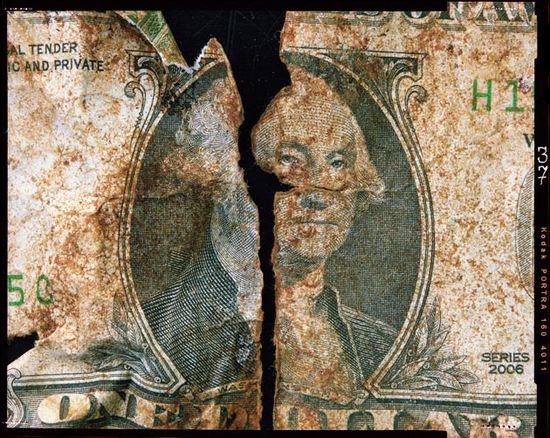
A while back Andrew Sprung detailed the dismal state of the US government:

[T]he GOP, led first by Gingrich and then by Bush Jr., blew through norms and broke taboos that had greased our democratic machinery for decades prior to the early 90s. These include, "you shall not filibuster every pending bill or block every opposition appointment" as well as "you shall not torture detainees or politicize Justice Department hiring."

Fallows can't believe what Congress, led by Congressman John Mica, has done to the FAA – essentially forcing airport safety inspectors to work unpaid and run up expenses on their personal credit cards:

Governments exist precisely because it doesn't make sense to pass the hat for airport safety  — or border protection or the public-health service etc. You can argue about a lot of government responsibilities, but transportation safety is pretty close to everyone's idea of a core public function. But — to hell with it! And to those 70,000 families with no paycheck. Let them cut back. This will help the recovery in so many ways, just as the the $1 billion or so in foregone FAA revenues will help cut the deficit.

Doug Mataconis nods:

It is, perhaps, understandable, when partisan rhetoric gets heated when dealing with big issues like the national debt, the size and scope of government, or the use of military force in a foreign country. In fact, that’s to be expected and even encouraged because these are important issues. An FAA funding bill is not one of those important issues, and the disputes between the House and the Senate are of a nature that, in ordinary times, ought to be capable of some kind of resolution. The fact that this issue has remained in limbo since 2007 demonstrates how it’s apparently become impossible for our legislators to resolve even minor disputes, and it leads me to think that, in some fundamental way, the system is indeed broken.

Frum echoes Sprung's original point:

The debt ceiling debate feels like one of those tragic episodes out of the history of the fall of republics. To gain their point on a budget matter, Republicans did something unprecedented in the annals of American government. They made a bargaining chip out of the public credit of the United States. In a well-functioning democracy, certain threats are just not used, and the threat to force the country into default should rank high on the list of unacceptable threats. …[S]omething that was once unthinkable has become thinkable.

(Photo: "Washington, Rip" by Will Steacy, who photographed decrepit money before it's destroyed by the Federal Reserve.)

The Reality We Face, Ctd

McArdle rejects Obama's claim that Bush was responsible for our debt troubles. Chait's riposte is, well, devastating:

What changed about the Bush policies that made them more expensive when Obama  took office? What changed is that the economy underwent its deepest crisis since the Great Depression.

Bush inherited a budget that was structurally balanced, which became  a large surplus at the peak of the business cycle. His policies turned it into a budget that was structurally in deficit even at the peak of the business cycle. And then when the economy collapsed, those structural deficits became massive. McArdle is implying, without quite openly arguing, that presidents should be judged on the deficits that occur under their watch, not on whether their policies increase or decrease the deficit. This ignores the reality that the business cycle plays a huge role in year-to-year deficits.

This is particularly smart:

Take George H.W. Bush. His policies significantly reduced the deficit. But the deficit ran at extraordinarily high levels under his presidency, and McArdle's data would suggest he was a massively irresponsible president. In reality, what happened is that he presided over a recession and the necessary bailout from the Savings and Loan crisis, which bloated the deficit despite his (eventually successful) efforts to tame it.

It took Megan a couple of years to pursue this meme. Glenn Reynolds was doing it from Day One.

The Hackers No One Is Talking About

Forget Anonymous and LulzSec, says Michael Joseph Gross; what we really need to worry about is whoever (or whatever state) is behind Operation Shady rat:

[It] ranks with Operation Aurora (the attack on Google and many other companies in 2010) as among the most significant and potentially damaging acts of cyber-espionage yet made public.

Operation Shady rat has been stealing valuable intellectual property (including government secrets, e-mail archives, legal contracts, negotiation plans for business activities, and design schematics) from more than 70 public- and private-sector organizations in 14 countries. The list of victims, which ranges from national governments to global corporations to tiny nonprofits, demonstrates with unprecedented clarity the universal scope of cyber-espionage and the vulnerability of organizations in almost every category imaginable. In Washington, where policymakers are struggling to chart a strategy for combating cyber-espionage, Operation Shady rat is already drawing attention at high levels.

Evangelicals Against Christianism

David Sehat argues that evangelical involvement in politics has been counterproductive:

That evangelicals have been so disappointed with the presidents they elect suggests that politics might not be the best avenue to achieve their aims. Politics demands compromise and conciliation that counter evangelical calls for purity. When Michele Bachmann insists that “social conservatism is fiscal conservatism,” does she understand that conservative Christians want to do more than cut taxes? When Tim Pawlenty names his “political heroes” — “I love Winston Churchill, Ronald Reagan, Abraham Lincoln, Jesus Christ” — does he know that making war wasn’t part of the carpenter from Judea’s program?

No he doesn't. He sees Jesus as a signal of cultural identity and nationalism, both of which are pretty much anathema to Christianity. Imagine a libertarian Christianity, which urged individuals to give away as much of their property as possible to the poor, to forget about the sex lives of their neighbors and focus on their own, to pray more than politic and to forgive more than to judge. Imagine, in other words, Christianity, and remind yourself how alien Christianism is to it.

Quote For The Day III

"The court finds no convincing reason that United States citizens in Iraq should or must lose previously-declared substantive due process protections during prolonged detention in a conflict zone abroad. The stakes in holding detainees at Camp Cropper may have been high, but one purpose of the constitutional limitations on interrogation techniques and conditions of confinement even domestically is to strike a balance between government objectives and individual rights even when the stakes are high," – U.S. District Judge James Gwin, allowing a torture suit against the war criminal, Donald Rumsfeld, to proceed.