Infinity Hurts Your Brain, Ctd

SandmanInfinity_

by Chris Bodenner

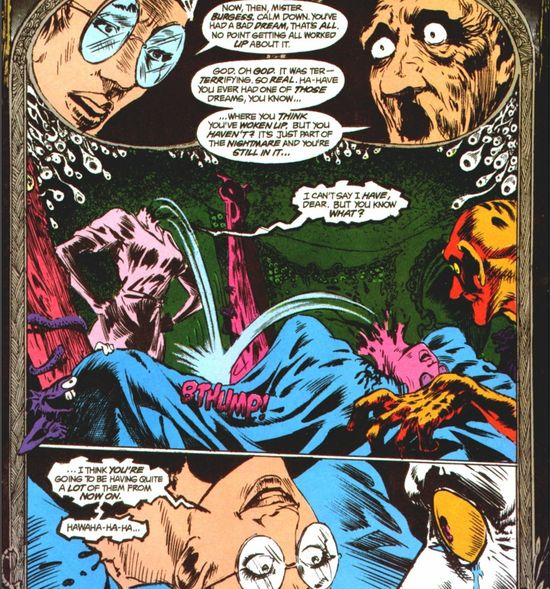
A reader sends the above image and writes:

Now you're incorporating a) comics and b) dreams into this thread on infinity, which means you are now obligated to include the final scene of Neil Gaiman's Sandman Issue #1, in which the hero's revenge is infinity itself: Endless Waking. Gaiman makes the bad guy have nightmares that he keeps "waking up" from … into a new nightmare. Forever. Now that's rough.

Another points to a famous Mad cover illustrating infinity. Another writes:

Though I hesitate at all to connect torture and humor, given the recent discussion on infinity and this blog's many discussions of torture, I just want to note that Douglas Adams conceived of the Total Perspective Vortex, a device that gives just one momentary glimpse of the entire unimaginable infinity of creation, and somewhere in it a tiny little mark, a microscopic dot on a microscopic dot that says, "You are here".  It is reputed to be the most horrible torture device ever created.

Another:

I've always liked James Joyce's description of eternity in A Portrait Of The Artist As A Young Man:

For ever! For all eternity! Not for a year or for an age but for ever. Try to imagine the awful meaning of this. You have often seen the sand on the seashore. How fine are its tiny grains! And how many of those tiny little grains go to make up the small handful which a child grasps in its play. Now imagine a mountain of that sand, a million miles high, reaching from the earth to the farthest heavens, and a million miles broad, extending to remotest space, and a million miles in thickness; and imagine such an enormous mass of countless particles of sand multiplied as often as there are leaves in the forest, drops of water in the mighty ocean, feathers on birds, scales on fish, hairs on animals, atoms in the vast expanse of the air: and imagine that at the end of every million years a little bird came to that mountain and carried away in its beak a tiny grain of that sand. How many millions upon millions of centuries would pass before that bird had carried away even a square foot of that mountain, how many eons upon eons of ages before it had carried away all? Yet at the end of that immense stretch of time not even one instant of eternity could be said to have ended. At the end of all those billions and trillions of years eternity would have scarcely begun. And if that mountain rose again after it had been all carried away, and if the bird came again and carried it all away again grain by grain, and if it so rose and sank as many times as there are stars in the sky, atoms in the air, drops of water in the sea, leaves on the trees, feathers upon birds, scales upon fish, hairs upon animals, at the end of all those innumerable risings and sinkings of that immeasurably vast mountain not one single instant of eternity could be said to have ended; even then, at the end of such a period, after that eon of time the mere thought of which makes our very brain reel dizzily, eternity would scarcely have begun.

Another:

Like your reader, I too have become overwhelmed with absolute terror when contemplating infinity. When I first started college, I thought I'd be a physics major. But as the physics (and required math) for that major started increasingly delving into the topic of infinity, I simply started to freak out. It invaded my dreams and my conscious thoughts in a way that filled me with a terror I can't describe. It forced me to switch majors just to save my own sanity.

But more than that, it made me feel so helplessly small and meaningless. I hear that some find meaning in religion, but the myths and tales I heard on that subject paled at the power of infinity. Contemplating infinity made the ideas in religious texts seem quaint and small by comparison. Plus, whenever I started thinking about an everlasting afterlife, I'd just get freaked out about the endless nature of it! Oddly, what finally gave me comfort was the knowledge that I was mortal and that I'd one day die – that there was a finite end to it all. Whereas most people probably find peace in the concept of an infinite afterlife to get over their fear of death, for me, it was finding a peace in the concept of death that got me over my fear of infinity.

A more optimistic view:

I've never really had any problem with infinity. Why? Because if the universe is infinite, then I am by definition the center of the universe. Any direction I point, you can travel an infinite distance. I might be small and insignificant compared to the rest of the universe, but knowing I'm the center makes everything OK.

P.S.  This also means you are also the center of the universe ;)

The Cameron-Blair Administration?

by Zack Beauchamp

Pete Redford and Matt Beech think that Cameron's enthusiasm for the Libya intervention places his foreign policy views closer to Tony Blair's than the traditional Tory position:

By subscribing to more idealist liberal foreign policy themes and placing them next to traditional realist and pragmatic conservative foreign policy Cameron and his party are indicating that their view of the UK’s global role is different to that of their predecessors. In the aftermath of 9/11 New Labour maintained that the attacks fundamentally altered British foreign and defence policy. The rise of international terrorism and the emergence of a home grown terrorist threat have further cemented this with the fear of terrorist attacks cemented in the British consciousness as the biggest threat facing the UK.

This view is also taken by Cameron’s Conservatives who believe that the 9/11 attacks have indeed altered Britain’s foreign policy. However, Cameron’s view is in contrast to that of the three foreign secretaries in the article that served under Thatcher. To them 9/11 isn’t the decisive shift in foreign policy that New Labour and Cameron’s Conservatives see it as. They take an “archetypal Tory” view in that they are unsurprised by new events and that terrorism is ever present, just that throughout history it takes different forms.

Rick Perry’s Foreign Policy Agenda

by Patrick Appel

Erica Grieder expects it to mostly track public opinion:

[Perry] defers to the will of the people on those occasions when they coalesce to express it. This, combined with his pro-business bent, may mitigate Perry's hawkish tendencies. One of his critiques about entitlement spending, for example, is that it contributes to the deficit so much that it diminishes America's ability to maintain the world's most effective military. But having a strong military doesn't mean you have to use it. And on the campaign trail Perry has struck some pragmatic notes. "We need to be thoughtful before we ever go into an area that America's interests are truly being impacted," he said last week in South Carolina, speaking of Afghanistan. These aren't the words of a man who wants to spread democracy from Kyrgyzstan to Syria; they are the words of a politician who doesn't like losing causes.

Where Does Islamophobia Come From?

by Maisie Allison

The Center for American Progress investigates (pdf). The report exposes a small, powerful collaboration at work, with a focus on familiar "misinformation experts" and several foundations, which have devoted more than $42 million to the cause since 2001. Stephen Walt is miffed:

The irony in all this that the extremists examined in this report have gone to great lengths to convince Americans that there is a vast Islamic conspiracy to subvert American democracy, impose sharia law, and destroy the American way of life. Instead, what we are really facing is a well-funded right-wing collaboration to scare the American people with a bogeyman of their own creation, largely to justify more ill-advised policies in the Middle East.

Justin Elliott interviews two of the report's authors. Adam Serwer sighs at the GOP's lazy malevolence:

Until Republican leaders try to appeal to the better angels of their constituents’ nature — rather than feeding on and profiting from their paranoia — things are unlikely to change.

Did Global Warming Cause Irene?

by Patrick Appel

Maybe, maybe not. Elizabeth Kolbert rephrases the question:

Are more events like Irene what you would expect in a warming world? Here the answer is a straightforward “yes.” In fact, experts have been warning for years that New York will become increasingly vulnerable to storm surges and flooding as the planet heats up. In 2009, the New York City Panel on Climate Change, appointed by Mayor Bloomberg, concluded that, as a result of global warming, “more frequent and enhanced coastal flooding” was “very likely” and that “shortened 100-year flood recurrence period” was also “very likely.” Much of the problem simply has to do with sea levels—as these rise, any storm or storm surge becomes more dangerous.

The Giant Gambian Rats Of Hurricane Irene

by Chris Bodenner

A reader actualizes my unspoken fears:

I was rather shocked to read your piece about the Giant Gambian Rat that was killed in some project housing here in New York. Imagine my surprise when I drove, not an hour ago, down my street and witnessed a huge mother rat cross the street with two baby rats hanging on her side. It looked just like the one in that photo – huge long tail and everything. This is an affluent neighborhood of Queens. The power is out in our local area and I'm guessing Hurricane Irene forced many rats out of their hiding places.

Then again, I've never been out at 2am in our neighborhood. Maybe this is a normal occurrence here :/

At least the sighting wasn't near the Gowanus Canal, or we could be talking toxic giant rats.

Update: Let's hope this reader is right:

The reader almost certainly describes an opossum, not a giant rat.  I believe rats carry babies with their teeth, not clinging to their sides. You can see why one might think rat, though:

Image001 (1)

An Independent Bid From The Right?

GT_PALINHUNTSMAN_110828
by Maisie Allison

Matthew Dowd plays the parlor game:

If Republicans nominate an extremely polarizing figure who has a difficult time getting independent votes (especially in the crucial Midwest states) or one who instills no passion at all in the conservative base, and if Obama’s approval numbers stay low, then we basically would have two unelectable candidates facing each other in the general election.

Ed Morrissey is skeptical. Erick Erickson can only interpret Huntsman's impertinence as the rumblings of a third-party candidate: 

He is slamming the other Republicans. He is smearing Iowans. He’s burning every bridge within the GOP. The only other place to go is to endorse Obama or claim to be a third party “middle way” candidate.

PPP runs the numbers, complicating Dowd's scenario:

[W]e took a look at seven possible independent candidates against Obama and his strongest GOP challenger, Mitt Romney, and found that the chances of defection by GOP-inclined voters are stronger than are cracks in the Democrats’ armor. Despite their grumbling, Democrats remain pretty united behind Obama, and six of the seven possible independent candidates would hurt Romney more than the president.

A third-party Palin run would hurt Romney most:

Palin would split general-electorate Republicans, with Romney at 46% to her 41%. As she usually does when the two are pitted head-to-head, she would give Obama his biggest lead among independents, 51-26, with Palin at 15%. Overall, Obama would run away with the election, 47-26-21 over Romney and Palin. 

(Photo: Alaska Governor Sarah Palin and Utah Governor Jon Huntsman listen as Governor Ed Rendell speaks to the media at the meeting of the National Governor's Association after the governors spoke with President-Elect Barack Obama and Vice-President -Elect Joe Biden at Independence Hall December 2, 2008 in Philadelphia. By William Thomas Cain/Getty Images)

Christianism Watch

by Chris Bodenner

"I don't know how much God has to do to get the attention of the politicians. We've had an earthquake; we've had a hurricane. He said, 'Are you going to start listening to me here?' Listen to the American people because the American people are roaring right now. They know government is on a morbid obesity diet and we've got to rein in the spending," – Michele Bachmann.

Alex Seitz-Wald notes the obvious irony: "[T]he damage [Irene] causes it likely going to increase government spending." The Bachmann camp is calling her comments a joke. I'll say.