Obama’s Pyrrhic Defeat, Ctd

A reader writes:

Chait’s argument is incoherent.  Tax hikes and default would have been very bad for Republican constituencies, but if you believe that all they care about is the zero-sum politics, then it makes sense to assume that the costs would mostly be borne by Obama.  But if you believe that, then there is no reason to think that the next round won’t have the same ending.  Defense cuts will hurt Republican priorities, but if they see these cuts as a way to defeat Obama—“He would rather put our nation at risk than give up his dream of higher taxes”—then they will be no more flexible in the upcoming super-committee than they have been to date.  If they think they can win the presidency and reverse the defense cuts, then the trigger doesn’t actually hurt them.  I see another big cave in Obama’s future.

The question is whether the defense debate has shifted. I suspect many Americans are sympathetic to the notion that we have spent too much time nation-building abroad rather than at home, and if Demcrats can make that strong case well, they should be in good shape. Of course, Democrats seem unable to make even the strongest case well, which is why the other lesson of this is that Obama does need to articulate his goals more clearly in advance. He can seize the Bowles Simpson banner now, or cede the initiative again to the far right.

Why Obama Might Lose, Ctd

Adam Serwer echoes Seth Masket:

Grim forecasts aside, Obama has two important advantages: He retains levels of base approval higher than presidents facing bad economies usually do, and many Americans still blame Bush for the recession. Come election time, though, voters may simply decide that even if the recession isn’t Obama’s fault, he still failed to get us out of it. The presidency is not graded on a curve. Even assuming Republican intransigence and obstruction have given Obama the most challenging political landscape ever for a Democratic president, what matters is whether voters feel like he did what he was elected to do: Bring the American economy back from the brink.

Dissent Of The Day

A reader writes:

You wrote: "While all the liberals are bemoaning their purportedly weak president…" I know we don't agree about this. But at least give me and all the others like me the benefit of the doubt – our opinions on this aren't pure nonsense. This is not about losing some dick measuring contest. Here's a Pro-Publica article that's mostly a summary of economic stats.

The economy is bad. It is, by now, Obama's economy. I understand what Bush and Co. did, and I know the role that Greenspan played, and all of that. But Obama can't say "I inherited this from Bush" if he's not making the requisite policy changes to prevent it from happening again. And he hasn't been willing to take on the people who would lose under genuine reform. He hasn't done what's necessary. He hasn't tried. This is where I'm coming from.

The numbers on that Pro-Publica page – they're real people, with real lives that pretty much suck. Millions of them. And I believe that the agreement just made is going to make their lives suck more. It doesn't take an econometric model running on a super computer to tell you that if you slash unemployment benefits it's going to hurt people who are out of work. Sometimes these fights get wrapped up in ideology and power struggles. We just had Democratic and Republican plans to raise the debt ceiling that were pretty similar, and they had a lot of trouble making a deal. That says to me that a lot of this is about power.

You believe in austerity and it's just sort of this common sense thing to you – of course debt is bad, and having less of it is better. But you don't have any kind of economic model that measures the pain caused by reducing the debt and compares it to the benefits that accrue. I'm not throwing stones – neither do I.

This is so much like the Iraq debate it scares me. A bunch of people playing power games, backing their side with pseudo-rational arguments that fall apart under rigorous scrutiny by people who really know the field, completely ignoring the effect that all of this jostling has on real flesh and blood people on the ground. If Obama gets unemployment down to 8.2%, I'll get back in line. Let him deliver 1% of relief, and I'll start drinking the Kool-Aid again. If you want to tell me to blame the Republicans, tell me what the President wanted to do that they blocked. Tell me the policies he fought for that would have made a difference.

I do not believe in austerity as such. I was very happy in the go-go 1990s. But I do believe in math; and can read the projections of future debt; and don't want to see hyper-inflation; and want to see a balanced responsible path toward a sustainable fiscal situation. We are not in one, and it saddened me that the president couldn't lead from the front on this one, as it has become completely clear the parties are far too divided to lead from behind. Nonetheless, my judgment is that we have a slightly better chance of tackling the real issues now in the super-committee set up by this stop-gap measure than before the current kerfuffle. That's all I'm really saying.

This isn't over. It's barely begun. But nothing is going to be pleasant, because we have run out of money. At some point, those suffering Americans are going to have to be told that. If done honestly, I think they'll rally. But from now on, Obama really has to make the case for the Grand Bargain, everywhere and anywhere he can. And those of us who supported him in 2008 should support him in that balanced approach as well. Abandoning him now, when so much is still to play for, is to be out-psyched by the far right. It's time now to out-psych them, with relentless, pragmatic, reasoned reality.

It's Obama's natural cause, the Grand Bargain. Or should be.
The Damaged

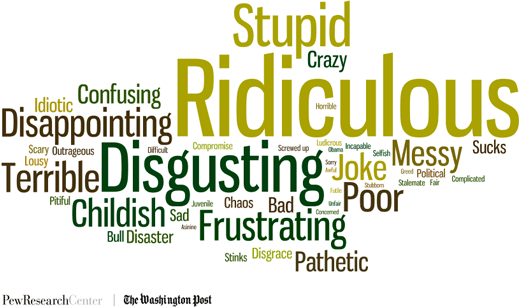
Wordle_Aug1_525px

The Pew poll shows how poorly every actor fared in the recent melodrama. But the nuances are interesting. 34 percent thought less of Boehner and 37 thought less of Obama. The Democrats – with unfavorables of only 30 percent – were the least affected, perhaps because they were by-standers. But 18 percent said their view of Obama actually improved; and 11 percent said that of Boehner.

The biggest losers? The Congressional Republicans. It will be worth keeping an eye on these polls in the coming days. The bottom line for me is: how well with the GOP fare if they obstruct the super-committee's Grand Bargain? How did this skirmish set them up for the next, more important fight?

I think it hurts them more than the Democrats (or Obama). But we'll see.

The GOP At War With Itself, Ctd

While all the liberals are bemoaning their purportedly weak president, the right isn't at all happy either. Only about half of the Tea Party caucus voted against the final deal, making them (what else) sell-outs to commies:

Rep. Allen West, seen by many as a tea party favorite, was among those who voted in favor of the compromise bill – and now he’s being targeted by tea party groups who see him as a sell-out. “One minute they’re saying I’m their Tea Party hero, and three, four days later I’m a Tea Party defector; that kind of schizophrenia I’m not going to get involved in it,” West said in consternation on Laura Ingraham’s talk radio show.

Primary challenges are already on the table, and every GOP candidate, save Huntsman, has opposed the deal. Meanwhile, we're actually going to be forced to have a debate over whether to raise taxes or slash defense or slash entitlements. Since the GOP refuses to raise taxes and is terrified of cutting Medicare, they're also set for a real dust-up over national security. Another reader notes:

The deal that was reached over the weekend seems to be Obama giving the GOP the immediate field but redeploying to higher ground. The dynamics of the super-committee certainly favor the Democrats, and it could really damage the conservatives over the next year and a half. Who would have thought that raising the debt ceiling twice would be more politically dangerous for the GOP than Obama? Each time it gets raised, the most radical of the Tea Party express get more and more dissatisfied with their current batch of conservatives. This all adds up to more and more primary challenges next year, while Obama looks more and more like the sane choice to the general public.

Meep Meep.

Always best to look at Obama decisions, even the most desperate ones, from the rearview mirror.

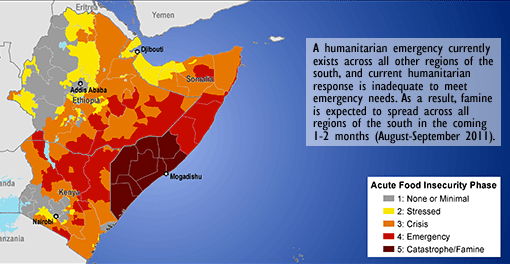
Drought Didn’t Cause The Famine

Famine

Ed Carr connects Somalia's famine to failures of government:

Famine stops at the Somali border.  I assure you this is not a political manipulation of the data – it is the data we have.  Basically, the people without a functional state and collapsing markets are being hit much harder than their counterparts in Ethiopia and Kenya, even though everyone is affected by the same bad rains, and the livelihoods of those in Somalia are not all that different than those across the borders in Ethiopia and Kenya.

Owen Barder has more along these lines. He looks at Ethiopia:

[T]he investments that have been made over the past two decades have transformed Ethiopia’s ability to deal with bad rains. Ethiopia has suffered drought and famine about every ten years.  But now a determined government, backed by foreign aid, has put in place systems which have made Ethiopia more resilient and prevented a repetition this time of past tragedies.

Super Committee To The Rescue?

Sarah Binder wonders whether the the debt ceiling bill's Joint Committee, which is tasked with finding 1.5 trillion in savings, will succeed:

Congress often kicks the can down the road to avoid blame for tough decisions.  By adding draconian spending cuts (balanced between defense and domestic accounts) should the committee, Congress, or the president fail to agree to a deal, Congress and the president have rigged the can to explode.  This suggests a more credible commitment to making the committee succeed than is usual for past delegations of authority. 

(Past delegations of course have not been made under the threat of a downgrade of the nation’s credit worthniess.)  Still, as many are beginning to speculate (Ezra Klein here, for example), it’s not clear whether one or both of the parties might prefer to watch the can explode than to craft or vote for a committee deal.

Suzy Khimm and Kevin Drum contemplate the composition of the committee. Don Taylor hopes it proposes healthcare reform:

The country needs a political deal on health reform so that we can move ahead and address health care costs. It will be a 30-40 year struggle to get a sustainable health care system. The Super Congress is the last chance for this Congress to do anything consequential policy wise. Here is hoping they will not only tinker around the edges but seek a plan that could transform health reform for a toxic partisan battle into a something that both parties can get some credit for. Most importantly, let’s hope we can come to some way forward in which both parties will share responsibility for improving the health care system. It is a long shot, but we really do need a Super Congress that thinks big.