
Wilson High School varsity baseball player Della Romano during batting practice in Washington, DC April 9, 2009. By Linda Davidson / The Washington Post via Getty Images.
Wilson High School varsity baseball player Della Romano during batting practice in Washington, DC April 9, 2009. By Linda Davidson / The Washington Post via Getty Images.
Andrew Exum has his doubts:
I understand some of you want us to have a smaller defense budget so politicians will not be so tempted to use our military power in places like Iraq and Libya. I understand that. But I do not think that trying to shackle policy-makers by having a smaller military makes a lot of sense, even if smart people sometimes argue that.
My brief experience in the U.S. military taught me that policy-makers, most of whom have no military experience, will usually throw the military into stupid situations (see: Iraq) whether or not it's prepared and that "clever" means designed to shackle policy-makers from doing stupid things don't ultimately work. So all things being equal, I would rather have a capable, effective military ready to respond to whatever damn fool idea some president from Texas (LBJ, George W., … Perry?) gets into his head.
Our brains:
As a general rule, mammal species with big bodies tend to have big brains. If you know the weight of a mammal’s body, you can make a fairly good guess about how large its brain will be. As far as scientists can tell, this rule derives from the fact that the more body there is, the more neurons needed to control it. But this body-to-brain rule isn’t perfect. Some species deviate a little from it. A few deviate a lot. We humans are particularly spectacular rule breakers. If we were an ordinary mammal species, our brains would be about one-sixth their actual size.
Carl Zimmer goes on to describe how our body has adapted to feed such a large demand.
Starting in 2013, health insurance will be required to provide birth control without co-pays. Amanda Marcotte claims this will save money:
These new contraception regulations will pay for themselves easily in the short term by reducing the insurance payouts that come along with unintended pregnancies, but insurance companies should expect long-term savings. When children are planned, children are cheaper.
As the Guttmacher noted (PDF) in its testimony on these proposed regulations, improved contraception use means women space out their pregnancies more, and putting some time in between pregnancies leads to better birth outcomes with lower medical costs. In addition, women who plan their pregnancies tend to get better prenatal care and are more likely to breast-feed, two behaviors that improve children’s health outcomes and reduce overall long-term health-care costs.
Cohn is also supportive. But Yglesias says this policy isn't ideal:
What we’re getting isn’t taxpayer-financed, government-subsidized birth control. Instead the practical impact will be higher premiums, resulting in cross-subsidy of birth control by people who don’t use birth control. I’m with Kay Steiger in thinking that this is a logistically cumbersome second-best relative to straightforward provision of birth control services.
Ed Morrissey, on the other hand, is upset:
This edict got handed down from the mountain purely for political purposes. The Obama administration wants to bolster its standing with women ahead of the next election; this mandate will probably get featured in an endless series of campaign ads. “President Obama protects women!” the copy will read. In the meantime, rational provider-patient cost sharing on non-critical products and services will be discarded, forcing the rest of us to eat the cost in higher premiums. It’s the ultimate in arbitrary exercises in authority.
On the heels of an attack in Xinjiang that China blames on Islamic extremists based in Pakistan, Brian Fishman publishes an article (pdf) examining al-Qaeda/China relations:
China’s growing economy and subsequent search for resources will increasingly tie it to regimes that al-Qaeda and its allies believe to be fundamentally corrupt, a fact that leaves jihadis conflicted about how to direct their energy today and questioning who will be their enemy tomorrow. Some jihadis enjoy the fact that the United States faces increased economic and political competition from China, but others argue that replacing the denomination of currency from dollars to yuan propping up hated Arab governments will not advance al-Qaeda’s ultimate political and ideological goals. In the wake of Osama bin Laden’s death, his successors are likely to reassess the global geopolitical picture and al-Qaeda’s role in it.
Zhu Feng looks into the possibility of China helping to clean up Afghanistan.
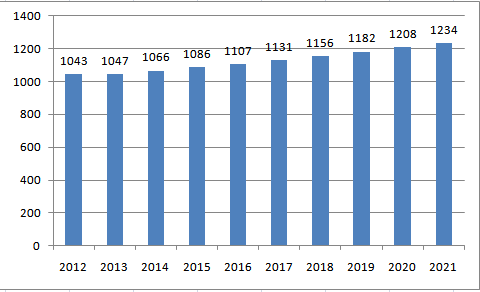
Will Wilkinson yawns at the debt ceiling deal:
Maybe Washington's game of debt-ceiling chicken went on too long for comfort, but the resolution of the game looks a lot like a pragmatic compromise to me. … [I]t looks like our democracy will have raised the debt ceiling, didn't really cut a thing, passed off responsibility for substantial deficit reduction to a "super committee", which will either come up with a plan that does not bind the future executive and legislature or will trip a "trigger" that won't go into effect until after the next election, and then, again, will go into effect only if the government of the future wants it to go into effect. If this is what "raw extortion" delivers, it's not very much.
Graph of the Descretionary Spending Cap in the Bipartisan Budget Deal Budget Authority, $ Billions, via Tyler Cowen. The bars go up because the cuts in the deal are from the CBO baseline, which predicted even higher spending increases before the debt bill.
Miley Cyrus got an equal sign tattooed on her right ring finger to celebrate New York's new marriage equality law. Alyssa Rosenberg claps:
I tend to be skeptical about the impact celebrities have on actual adults, and it’s true that the gesture is more than a little bit flip. But I think there’s a real utility to a star who is technically branded as if she’s from the heartland and whose main appeal is to tweens and teenagers taking a firm pro-equality stand in front of the 1.8 million people who follow her on Twitter.
Totally NSFW nihilist anthem, so don't click if you're squeamish. I've had moments like this but I wouldn't turn them into a video:
A reader writes:
Really enjoyed the post on whether ex-gays exist, but I was struck by one follow-up thought: where do you think bisexuals fit into this? While I think it's true that most people who try to "change" their sexuality really do end up deeply tortured and unhappy, is it possible that some of the "success" stories are really bisexuals who can manage to repress one part of their sexuality while indulging another? Obviously this would represent a relatively small portion of the "ex-gay" movement, but it seems like it might be able to account for enough "true believers" to keep this horrible process supplied with public faces.
Another writes:
Are real ex-gays out there? Sure there are. In my life, I've known three very good examples.
The first was the friend of a friend, who after being out and gay and with a couple of stable, happy relationships under his belt, fell in love with and got married to a woman. The second case is a couple in New York City. A gay man and a lesbian, both prominent activists, who one day many years ago, to the surprise of everyone, announced that they had gotten married. To each other. (I remember hearing of a similar case in Boston.)
The third is my brother. I know the most about his situation. When he met the woman who was to be his wife, he was very clear about spurning her interests, letting her know that he was gay. She responded by saying that at her age (they were well into their thirties), she was much more interested in having a good friend who was a man rather than a sexual partner, as it was obvious to both of them from the start that they shared a lot of common interests and they really enjoyed each others company. As they grew to become very important in each other's lives, a curious thing happened: my brother started to become sexually attracted to this woman. He was, and is, still sexually attracted to men, but over twenty years ago, they decided to solemnize their relationship and were married. They're still crazy about each other, and very happy, traveling the world and enjoying their life together.
In my own thinking about this issue, I've come to the conclusion that if we really were to live in a world where same-sex attraction was no more notable than being left-handed, the issue of what arrangement of genitals a person had would be much less important than the person himself or herself. It would not be especially odd for any two people to come together and decide to build a life together, one based on honesty, openness, acceptance, and love.
Neither of these three men consider themselves to be "ex-gay," as far as I know, in the sense that they deny that same sex attraction is part and parcel of who they are. However, two of them don't consider themselves to be gay at this point, for the obvious reason of their marriage, although they are both still very supportive of LGBT equality. (The third I just don't know well enough to be in a position to know his feelings, but I suspect he's in the same boat.)
Another:
I'm not sure the label ex-gay fits my experience any better than most other labels, but I know you are wrong when you say "Very, very few people who are the norm in a society where the norm is overwhelmingly celebrated, are going to be in denial that they're really straight. Maybe a few fluid lesbians in college. But that's it. I can't imagine a straight guy feeling in any way pressured to live a gay life."
While I don't doubt that there are very few ex-gays, let me tell you my story and see if it changes your mind. I've never been comfortable with labels on sexuality, and mine has been pretty fluid throughout my life.
As a teenager I had very little sexual drive. Unlike most all my peers, and really teenagers in general, I wasn't driven to be in a relationship or to constantly try to have sex. I was a bit socially awkward, but had several friends, male and female, and think I was generally well adjusted. I attended college for a while after high school, and the same general pattern emerged. I had several friends, but no relationships. After I dropped out of college I did seek companionship, someone who I could be with and depend on. Many of my friends at the time were gay and so I dated a several guys and even had sexual relationships with some of them, but none ever really felt right and they never worked out. My sense of self was in serious flux during this time, and maybe my desire to date men was simply a way to push the limits on who I was. By the time I was 21, another guy and I had developed a close friendship, more like a kinship, and moved in together, but we did not have any kind of a physical relationship. Over the next 9 years I met many of my life-long friends, most of whom are gay, but I no longer felt the desire to date or have a sexual relationship with anyone. I no longer considered myself gay, but I also wasn't looking for a straight relationship.
About the time I turned 30 I started feeling like something was missing from my life. I started dating again, only women, for I felt no desire towards men. Eventually I met the woman I'm with today. My love for her is stronger and deeper than anything I'd known before. We are now engaged and will be married next year and I couldn't be happier. What I've found especially curious is that my sexual drive is greater now than it has been at any point in my life. It seems that most men after 30 start to experience a slow decline, and I'm sure I eventually will as well, but that couldn't be further from my experience.
I'm not religious, although I did grow up Catholic. I've never felt pressured by society or my family to build a normal life. If anything can be said of my desire to find someone to settle down with, it's probably the deeply rooted desire for children and a family of my own.
Robert Krulwich explains the above video:
Because this squid was just killed, its muscle cells were still intact and operational. A live squid moves it tentacles by sending an electrical command from its brain to its muscles. The commands say "contract" or "relax." But since this animal lost its head, its brain can't send signals. Salt acts as a substitute. Extra sodium (the salt) sends ions to the cell that trigger the cell to open up, creating a cascade of chemical activities that causes the cell to fire, so the muscle twitches.
It happens with frogs' legs too. Christie Wilcox has more on the science of neurons, sodium and muscle contractions.
 The Dish