Missing George Will

Scott Galupo collects a number of passages from Will's early writings to demonstrate how far from sane conservatism he has drifted. Contrast the below excerpt from a 1981 column with Will's claim this weekend that "government and the sectors it dominates have made themselves ludicrous."

Eisenhower's conservatism ended the conservatives' pretense that the New Deal's steps toward a welfare state were steps along "the road to serfdom," and reversible. Eisenhower knew those steps reflected realities common to all developed nations—broad acceptance of the ethic of common provision, and the majority's desire to purchase things, such as certain pension and health services, collectively…The problem is not "bigness," it is unreasonable intrusiveness, which is a function of (bad) policy, not size.

Besides, inveighing against big government ignores the fact that government is about as small as it ever will be, and obscures the fact that government, though big, is often too weak.  Many conservatives insist that America's great problem is just that government is so strong it is stifling freedom. These people call themselves "libertarian conservatives"—a label a bit like "promiscuous celibates." Real conservatism requires strong government.
Why Do Americans Care About Israel’s Left?

Reacting to this Noam Sheizaf post about the coverage of the tent protests, Matt Eckel examines the question:

I think the “obsession” with the Israeli left in the U.S., particularly as expressed in outlets like the New York Times which are exemplars of this broadly American liberal Zionist orientation,* has a lot to do with the cognitive dissonance between the image ‘Rabin’s Israel’ and the actual evolution of Israeli behavior and political trends. Psychologically, it’s much easier to look for reasons that reality might still fit within one’s predetermined conceptual framework than it is to change the framework itself.

Joel Beinin finds linkages between the tent protests and the Arab Spring. Shlomo Ben-Ami looks at how the spread of democracy is remaking the Middle East's geopolitical map.

Growth Is Power

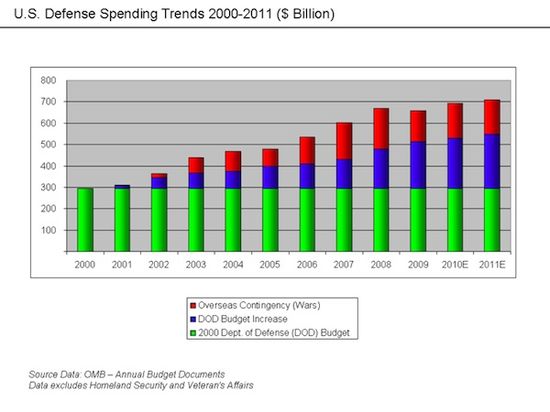
Defense_trends

Bill Kristol claims the debt bill "embodies a vision of America in decline" because of the potential defense cuts and that yesterday was "the best day the Chinese have ever had." Reihan pushes back:

If you were a Chinese military official hostile to U.S. interests, would you be more concerned about a United States that is economically stagnant due to a crushing spending and tax burden but that devotes a fairly big share of GDP to defense expenditures? Or would you be more concerned about a rich, dynamic United States that is growing pretty fast for a mature economy and that devotes a somewhat smaller share of of a much bigger GDP to defense expenditures?

I have to say, I’d be more freaked out about the latter than the former because the former United States has a great deal more latent power than it can draw upon when necessary. Granted, this “latent power” might not matter all that much in an immediate crisis, but it shouldn’t be neglected.

Douthat believes defense hawks like Kristol are out of luck. Defense spending chart from Friedersdorf.

Obama’s Pyrrhic Defeat, Ctd

Chait cheers up:

Liberals widely assume they'll just get rolled once again [in the super-committee], as Republicans will insist on zero revenue, and Democrats will cave. I'm not so sure. For one thing, the trigger really is finally balanced. Last December, inaction on taxes meant an economy-crushing tax hike at a really bad time for Democrats. This summer, inaction on the debt ceiling meant economic cataclysm at an even worse time, the cost of which would mostly be born by President Obama. But the inaction trigger in the fall will be something genuinely painful to both parties.

In some ways, this agreement is the final nail in the coffin for neoconservatism. Meep meep?

The Southern Coup: An Update

02

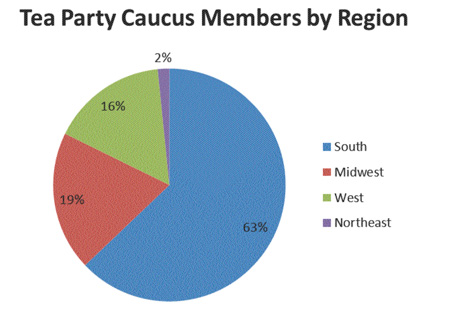
A long time ago, I was proud to run a cover essay at TNR by a then-barely known Texan writer, Michael Lind. It described the 1994 Congressional election as part of a historical pattern of Southern revolt. In a must-read, Michael updates the piece with an analysis of the Tea Party, which strips it of its national patina to reveal the forces beneath. Money quote:

From the earliest years of the American republic, white Southern conservatives when they have lost elections and found themselves in the political minority have sought to extort concession from national majorities by paralyzing or threatening to destroy the United States…

The debt ceiling crisis is the latest case in which the radical right in the South has held America hostage until its demands are met. Presidents Andrew Jackson and Abraham Lincoln refused to appease the Southern fanatics. Unfortunately, President Obama and the Democrats in Congress chose not to follow their example and instead gave in. In doing so, they have encouraged the neo-Confederate minority in Congress to find yet another opportunity in the near future to extort concessions from America's majority by sabotaging America's government.

Funny, but my memory was that, for a long time, Lincoln did all he could to appease the South without conceding the whole ball-game. I see Obama in Lincoln's position. Not for the first time.

Bibi’s “Anti-Israel” Position

He has just agreed to negotiate on 1967 lines:

It is the first time that the right-wing premier has publicly defined the borders as a starting point for talks, and brings him in line with US policy that broadly calls for talks based on ceding the West Bank to the Palestinians with agreed land swaps.

Now remember the ludicrous outcry when Obama dared to say the same banal thing. Adam Serwer pounces on the transparent hypocrisy.  The Israeli Supreme Court, in more positive news, just ordered the government to dismantle an enormous illegal settlement. Know hope. Israel is where they came up with that slogan in the first place, after all.

The First Polls

America's priorities are pretty close to the Dish's:

The poll delved deeper into specific aspects of the agreement and found support for spending cuts but opposition to the lack of tax increases for wealthy Americans. Specifically,

65 percent approve of $1 trillion in cuts in government spending over the next 10 years (30 percent opposed)

60 percent disapprove of the fact that the agreement does not include any tax increases for businesses or higher-income Americans

This is the battleground over which politics will now be fought. Advantage: Obama, balance and compromise.

Tea Party Terrorists?

Politico reports that Biden let loose a classic Biden-ism:

Vice President Joe Biden joined House Democrats in lashing tea party Republicans Monday, accusing them of having “acted like terrorists” in the fight over raising the nation’s debt limit, according to several sources in the room.  Biden was agreeing with a line of argument made by Rep. Mike Doyle (D-Pa.) at a two-hour, closed-door Democratic Caucus meeting.

But Biden denies he called Republicans terrorists. I did though with a modifier – "economic terrorism" and stand by it. The right is apoplectic, perhaps because their favorite rhetorical tool is getting borrowed by the other team. Benen recounts how the Tea-Partiers started comparing themselves to terrorists first:

Let’s also not forget the rhetoric from congressional Republicans themselves. Last year, Rep. Steve King (R-Iowa) said he could “empathize” with a terrorist who flew an airplane into a building on American soil. The year prior, shortly after President Obama’s inauguration, Rep. Pete Sessions (R-Texas) said if the Democratic majority didn’t allow Republicans to influence policy debates, the GOP would have to emulate the “insurgency” tactics of “the Taliban.” Sessions, a member of the Republican leadership, added, “[W]e need to understand that insurgency may be required,” and that if Democrats resist, Republicans “will then become an insurgency.” The Taliban, he went on to say, offer the GOP a tactical “model.”

Exum tests the comparison against the definition of terrorism as "the threat of physical coercion, primarily against noncombatants, especially civilians, to create fear in order to achieve various political objectives" and concludes it comes up short. Juan Cole sees coercion as the centerpoint of the Tea Party negotiating tactic.