The Slow Bike Movement

Celeste LeCompte praises it:

Slow riding means not arriving at work sweaty or worrying about wearing specific bike-riding shoes or any of the other wardrobe-related concerns that plague would-be commuters. Being a Slow Bike Rider may mean being left behind by the pack of spandex-wearing cyclists in the mornings, but it also means getting to know more about the rest of your community.

Felix Salmon believes it could help democratize riding:

As a general rule, the propensity of non-bicyclists to give biking a try is inversely proportional to the average velocity of the bikers they see on the street. If you live in a city where women in wedge heels are steering their old steel bikes around their daily errand route, there’s really nothing intimidating or scary about the prospect of getting on a bike yourself. If it’s all hipsters on fixies, by contrast, that just makes biking feel all the more alien and stupid.

Airing Out The Ivory Tower, Ctd

A reader writes:

As a social scientist, I have to say that Dan Cohen's essay – and especially the quote you pulled from it – has a very limited view of academia, clearly drawn from his exposure to the humanities (for some reason it's always the lit and history profs writing about the doom and gloom of academia). There's two problems with his analysis. First, there is a lot of "recursive review" going on in academic – just not in the humanities.

Many if not most economics papers that make an impact these days are working papers, and at the end of the day these things go through multiple public versions before getting published (though this has problems, as some people are pointing out). On top of that, since so much of social science is modeling, recursive review happens a lot in the process of invited talks, conferences, and comments from colleagues. Let alone the fact that peer review is recursive review.

This brings me to my second point, which is why Nate Silver is a bad example. I presume if anyone could learn from Silver, Cohen would think it would be political scientists. But, generally, he's not doing work that is "interesting" to us, at least in the academic sense. Forecasting an election in the US is important and interesting, but not as a theoretical proposition. We have a good sense of what variables matter in predicting outcomes in US elections… we have for some time. Doing it a little bit better is great, but it's hardly a breakthrough in our understanding of politics. Which is why hardly any of such stuff makes it into journals. It's not bad. Not at all. And we love reading it. But it's not advancing knowledge… it's forecasting elections. It's a whole different ballgame.

We’re Not Bankrupt, Yet

Josh Barro searches for the source of Republican anti-tax ideology:

The “we’re broke” mindset simultaneously explains what might seem like a paradox of conservative thinking today: federal deficits are alarming and unsustainable, undermining our national credit, and yet we should not think about raising taxes.

If you have a bad-but-fixable debt problem, tax increases are a logical part of the austerity package to get you on the road to health. Just look at any country in Europe that’s actually implementing an austerity plan. But if things are already too far gone to fix, if we’re really broke, why bother raising taxes? That’s just more money down the hole. Conveniently, this position allows Republicans to conclude that alarming deficits are cause for spending cuts, but not for tax increases.

Obama’s Pyrrhic Defeat, Ctd

A reader writes:

I just read your post on Obama's phyrrhic defeat and I have to say that I think that you are really overlooking just how depressed Obama's base is about this agreement.

"For both Obama and the Republicans, a win-win scenario is therefore perfectly possible from now on, unless Obama has totally depressed his base or the GOP really wants to insist on an anti-government purity that isn't shared by the public. In other words, the drama of this deal is far greater than the actual substance. It's a tactical victory for the GOP; but for Obama, it could be a strategically pyrrhic defeat."

For the first time today, I got an e-mail from my little sister who does not follow politics closely at all. She was a first time voter in 2008. She is exactly the profile of the type of voter Obama will need again in 2012.

Her e-mail to me had the subject line: "I am done."

I opened the e-mail and she had written only one line: "I cannot support a President who seems incapable of standing up to bullies."

My sister was not focused on the policy merits of the deal. All she was paying attention to were the atmospherics. For someone like her, not a member of the professional left or even the avid grassroots supporters of the President, to have embraced the meme that this President "caves" is a terrible thing, I think. The White House should be very worried that she has internalized this impression. It will be difficult (if not impossible) to overcome.

I can't help but think of the many other young people in their mid to late 20s (like my sister) who have already decided that this President is not up to the task. I talked to my sister on the phone this afternoon and she said something that should more than terrify the White House. She said something to the effect that every time she hears the President on television talking about how "broken" Washington is, all she can think about is how "broken" he is because he is after all Washington.

Between the young people who can't find jobs, the people of color who are living in the depression, and the party activists who feel as though Obama doesn't "fight" for their principles, it is truly difficult for me to see how Barack Obama is re-elected in 2012. If David Plouffe were living our here in the heartland, all of his hair would be grey. I think that this episode means the death-knell for Obama's re-election prospects. I am not prone to hyperbole or to exaggeration. But I really do not see how President Obama recovers from this beat-down by the Tea Party. He has never looked weaker to me and Americans have an allergy to weakness in their leaders.

The Daily Wrap

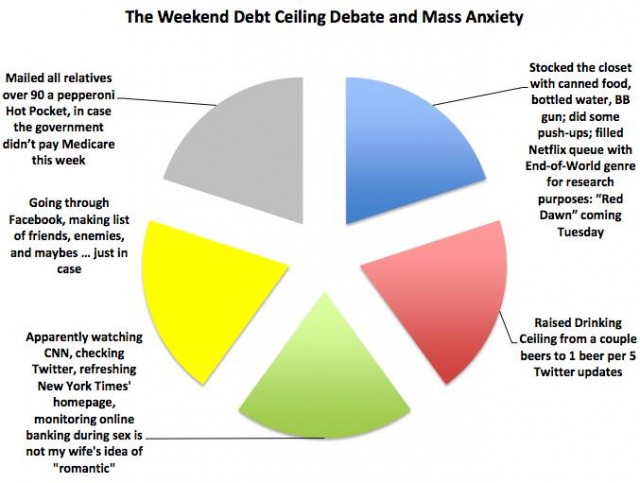
Weekend_Debt_Ceiling

Today on the Dish, Andrew welcomed the right's concession to defense cuts, and assessed Obama's pyrrhic defeat. Philip Klein predicted the end of the love affair between hawks and tax cut ideologues, and the military industrial complex could be forced to help the government raise taxes. We gathered the web's smartest debt deal reax, were shocked by Romney's ridiculous position, struggled through much of the right's reactions, and understood the debt ceiling with the help of nifty charts and jokes. Joe Klein praised Obama for not resorting to the 14th Amendment, Nate Silver looked on the bright side for the Democrats, and Bernstein calmed upset liberals. We remembered the reasoned debate of Milton Friedman, and the GOP clung to self-regulation of markets.

In international news, the Turkish president demanded a reprieve for protesters in Syria, Hugo Dixon explored the Syrians' non-violent approach, and military resignations in Turkey may have cemented Turkish Prime Minister Erdogan's power. Marat Terterov stayed skeptical about the Arab Spring because of the army's influence, we approached a drone zeitgeist, a reader confronted the paranoia about multiculturalism in England, and Nicholas Schmidle recounted Obama's reaction to the Abbottabad raid. Pamela Geller backed Breivik's distorted views and Andrew mourned the bizarre mix of pro-Israel and neo-fasicst European ideologies we're confronted with today.

In national affairs, Andrew didn't believe that real ex-gays exist but defended their right to try and live that way, while a Texan decried cowboy boots worn with shorts but not the gay pride. Peter Hitchens sounded silly trying to defend drug warriors, and readers connected the molten coffee case to tort reform. Dwight Simon wondered if children have to be taught history around war, the cubicle isn't the problem with workplace happiness, and skipping out on subway tickets pays off. Americans could stop overachieving if they only had universal healthcare, readers taught us words with no English equivalents, and more college graduates won't lower unemployment. One typographer tried to solve dyslexia with a new font, ums help humanize people, and withstanding desire may make us better people. Beagles glowed green, MTV was the internet before the internet, and dogs roll in weird shit to beef up their social status.

Chart of the day here, VFYW here, MHB here, and FOTD here.

–Z.P.

The Nonviolent Strategy In Syria

Hugo Dixon explores it:

[T]he message to the business community is that they won’t continue to prosper under Assad. The Syrian pound has fallen on the black market, tourism is dead, consumer demand has been thwacked and the economy is shrinking.  What about the secret police? This is the toughest part of the regime to crack, according to Monajed. He doesn’t have a simple message for them. Rather, he predicts that, as the revolution goes on, the regime will get tired and exhausted. The top generals may then liaise with Alawite leaders, arrest Assad and the top security chiefs, and form a transitional council with members from all parts of the community.

Bassma Kodmani goes deeper into the role of the Alawite community in engineering the regime's collapse.  Martin Jay thinks the Hama massacre has irreparably damaged Assad. Enduring America captions the above footage:

This is a GRAPHIC AND DISTURBING VIDEO. The video claims to show pro-Assad "thugs" throwing the dead bodies of protesters into a river near Hama.

What Connected The Kids Before The Internet

MTV turns 30 today. Melinda Newman reflects on the network's radical cultural impact:

I was music video editor at Billboard in the early ‘90s. Covering MTV fell under my purview and it felt like the largest, most powerful force not just in the music industry, but in pop culture. That’s because it was.  This was before the internet. This was before the dominance of video games. MTV wasn’t just king of the mountain, it was the mountain … [It] was spreading its manifest destiny across the world and it never ceased to amaze me that certain Eastern Bloc countries may have still been in political and civil turmoil back then, but, by God, they would have their MTV.

ShortFormBlog dug up the cultural artifact seen above:

Kurt Loder, circa 1995, explaining the internet to the plebes watching MTV News.

Unlike this classic clip of the Today Show anchors acting utterly confused about the Internet, Loder seems to know what he’s talking about pretty well. Fun fact: MTV.com has an interesting pre-Web history that involved former VJ Adam Curry of all people buying the domain name before MTV knew that owning this domain name was important. (Also, on a side note: Son Volt, Moby with HAIR, Better Than Ezra’s “Good,” Coolio, virtual reality, and “The Net”-era Sandra Bullock. Wow, time machine.)

Money quote from "cyber journalist" David Bennahum:

Well of course there's a lot of sex online … welcome to the human race.

The Truth About Abbottabad

Nicholas Schmidle puts together the most in-depth account of the raid's planning, execution, and aftermath to date:

The Americans hurried toward the bedroom door. The first SEAL pushed it open. Two of bin Laden’s wives had placed themselves in front of him. Amal al-Fatah, bin Laden’s fifth wife, was screaming in Arabic. She motioned as if she were going to charge; the SEAL lowered his sights and shot her once, in the calf. Fearing that one or both women were wearing suicide jackets, he stepped forward, wrapped them in a bear hug, and drove them aside. He would almost certainly have been killed had they blown themselves up, but by blanketing them he would have absorbed some of the blast and potentially saved the two SEALs behind him. In the end, neither woman was wearing an explosive vest.

A second SEAL stepped into the room and trained the infrared laser of his M4 on bin Laden’s chest.

The Al Qaeda chief, who was wearing a tan shalwar kameez and a prayer cap on his head, froze; he was unarmed. “There was never any question of detaining or capturing him—it wasn’t a split-second decision. No one wanted detainees,” the special-operations officer told me. (The Administration maintains that had bin Laden immediately surrendered he could have been taken alive.) Nine years, seven months, and twenty days after September 11th, an American was a trigger pull from ending bin Laden’s life. The first round, a 5.56-mm. bullet, struck bin Laden in the chest. As he fell backward, the SEAL fired a second round into his head, just above his left eye.

Noah Shachtman thinks the most interesting part of the piece isn't about the raid itself, but the revelation that "U.S. commandos raid Pakistan all the time."

Obama’s Pyrrhic Defeat

This embed is invalid

Visit msnbc.com for breaking news, world news, and news about the economy Zoom out a little. Think of this latest skirmish, that ended tonight, as part of an endgame to a thirty years’ fiscal war in American politics. Reagan began it, by betting that slashing taxes would spur growth; he was right and wrong. Growth really did happen in the 1980s; but he bequeathed a debt that is with us today, and that he tried only fitfully to fix on his watch. The early 1990s saw the country draw down that deficit, by continuing Reagan’s tax hikes under Bush I and then Clinton, and thanks to a peace dividend. Clinton’s eventual surplus was, alas, more mirage than reality, for it hadn’t solved the long-term entitlement problem or the healthcare cost problem, and was inflated by the tech bubble. Bush II comes in and wreaks havoc. He doubles down on Reagan on taxes and declares that deficits don’t matter, while adding one major new entitlement, two massively expensive wars and throws in a financial collapse as a goodbye present. The result of all this was a recession that helped metastasize the debt even further. This was what Obama inherited. Despite this, the new president was able to borrow even more for a stimulus to prevent a second great depression, and insisted, even in hard  economic times, on a modest bill for universal healthcare. He got both. They used up a lot of political capital. W-debt15-correction-gWhat then? I think the Grand Bargain is the final step of this thirty year debt dance, (along with serious cost controls in the healthcare sector, pencilled into Obamacare). The Grand Bargain is a big entitlement-and-defense cut package balanced by higher taxes on those who have done so well during the last thirty years. Much of this, in the view of many economists, could be done alongside tax reform to minimize the impact of more revenue on marginal rates of income tax. Last fall, we had a chance to do this, with the Simpson-Bowles commission. But the bipartisan Congressional will to act on it was weaker than the desire of both parties to play politics with entitlements and taxes. And Obama decided to lead from behind on this one, and ended up following. So where does that leave us? It leaves us with more time without a real solution to the deepest problems. That’s a huge defect in the current stop-gap deal. But it really is just a stop-gap deal. It points pretty quickly to a Grand Bargain in the super-committee, and for the first time has attached real incentives for both sides for it to work. What has just happened is, to my mind, therefore the following: 1. The Republicans used the debt ceiling as blackmail for a big cut in discretionary spending. This was a step too far, in my view, and redolent of a truly reckless attitude toward government and the American economy.  On the other hand, this was not just “another raise” in the debt ceiling as some have argued. It’s a debt ceiling of over $14 trillion. And it’s a debt ceiling that in every single poll, a majority of Americans did not want to raise, without the equivalent or more of cuts being imposed. In retrospect, it’s not a huge surprise that Obama, especially because he is actually a responsible character, surrendered. 2. But the terms of surrender are to Obama’s advantage. He has taken the nuclear weapon of the debt ceiling off the table till after the election, neutralizing his opponents’ main weapon against him. He has revealed a split in the GOP between those who are fixated on no revenue increases and those who want continued Cold War level defense spending. He has also made his preferred Grand Bargain more likely to happen with the terms for the super-committee. And he is now free – better late than never – to throw caution aside and campaign around the country for a balanced solution of tax hikes and spending cuts that can resolve our future debt decisively.
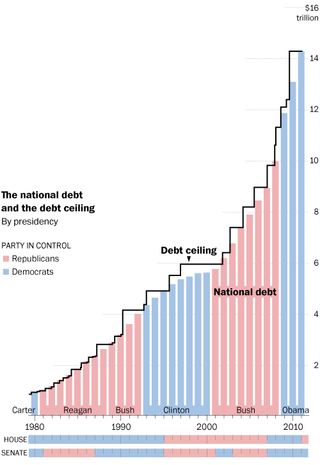
He has won his own battle: he is perceived as more likely to compromise than the GOP in a country whose independent middle wants compromise. If the battle of 2012 is between low taxes or high taxes, the GOP wins. But if it’s fought on whether we should balance the budget solely by spending cuts, often for the elderly and needy, while asking nothing from the wealthy, then Obama wins. 

For both Obama and the Republicans, a win-win scenario is therefore perfectly possible from now on, unless Obama has totally depressed his base or the GOP really wants to insist on an anti-government purity that isn’t shared by the public. In other words, the drama of this deal is far greater than the actual substance. It’s a tactical victory for the GOP; but for Obama, it could be a strategically pyrrhic defeat.

It’s still all to play for, in other words. This was just a ghastly revelation of the recklessness of the GOP’s current tacticians, not a measure of their strategic genius. Know hope.