Words With No English Equivalent, Ctd

A reader adds another word to the list:

My favorite would be staircase wit, or "L'esprit de l'escalier" in French. It means to think of a witty response to someone after the moment has passed. It happens to me all the time! I typically prefer to conduct arguments over a Facebook comment thread so that I can have ample time to come up with the best response. Perhaps other readers should send in words from other languages that they know and don't have an English equivalent. It would certainly be a better list than the one you've linked to.

I'd also like to point out that there IS an English word for that list's 2nd entry – "the phantom sensation of something crawling on your skin": formication

Another:

Turkish has a verb ending, which I will call (because of orthographical constraints) the "-mish" suffix. This isn't a word, but rather a grammatical construct with no direct equivalent in English.  When a verb ends in "mish" it indicates that the speaker/writer does not have first-hand knowledge; this is usually translated as "reportedly" or "apparently".  As soon as you hear someone say "gelmish" (he/she came), you know that the speaker doesn't know this from experience or observation; he is reporting something that someone else said or experienced. It's a tremendously useful grammatical feature.

Another:

My favorite is the Spanish-Mexican word "Tocayo." It is only used by people with the same name. So that one person named Ricardo might call another person named Ricardo "Tocayo." My sister – who knew I had an interest in such words – told me about the word after naming my nephew after me. He has been "Mi Tocayo" ever since.

However, the most interesting thing I found in the post you linked to was in the comments section:

One of my favorite foreign words is rather simple. It’s the German “doch”. It simply means yes, but to a negative question. For example, the question, “You aren’t going?” in English. If you answer “yes”, it is ambiguous (“yes, you aren’t going”, or “yes, you are going”). Doch removes that ambiguity. It always means (in this case), “Yes, you are going”.

Ever since I was young – this issue has bothered me. In 6th grade basketball one of my coaches once said, "You don't like me, do you Jernigan?" I was immediately stumped – knowing on the one had that if I said "No Sir" (which to me meant I was denying the claim, and did like him) – it would likely be misread as ""No Sir, I don't like you." But "Yes Sir" just seemed wrong. (Yes – I have very clear recollection of all this going through my head at once.). Anyway – I went with "No Sir". To which my coach said, "Good, I don't like you either." This, of course, was followed by laughter from the entire team. Then everyone had to run laps – except me of course. I certainly didn't like him after that.
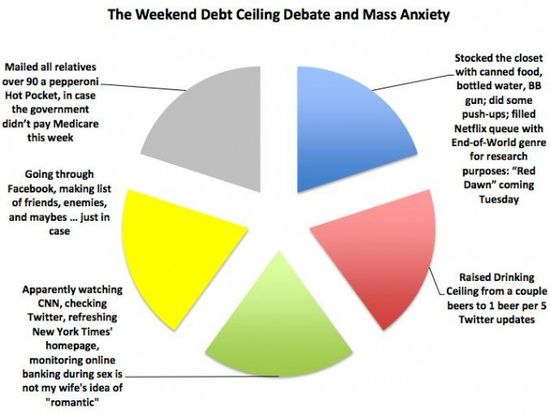
Understanding The Debt Ceiling

Jon Methven provides charts. Among them:

Weekend_Debt_Ceiling

Cartoon history of the debt ceiling here. Taiwanese TV depiction of recent events here. Ezra Klein, in a more serious post, explains what comes after the debt deal. And Bruce Bartlett continues to lobby for ending the debt ceiling altogether:

While politicians and the general public believe that the debt limit is an important constraint on national indebtedness, not one iota of evidence supports this belief. Economists have been making this point repeatedly for more than 50 years.

Notes Of A Native Son, Ctd

A reader writes:

I loved your essay on your return to Britain after so long an absence. But I found it wistfully influenced by American optimism. I have had a different experience going back to England. I should admit up front that I am American but lived there for a decade and am married to a Brit. What I think that you got completely wrong was the sense of settled, accepted multiculturalism. Sure, in London you encounter many cultures mixing like you get in other great melting pot cities like New York. However, outside of London there is paranoia and resentment over that multiculturalism.

My husband's family are almost all in Devon and Cornwall. We visited them last year, and we also visited friends in London and in the North of England. We found that outside of London our family, our friends, the locals at the pub, or the random person you have a conversation with at the grocery store are all under the impression that England is losing its identity as a result of massive numbers of immigrants. In Devon and Cornwall, I did not see a single non-white, non-English looking person the entire two weeks we were there. This is not hyperbole. Outside of London in general, I almost never saw anyone who wasn't white, yet they have the panicked impression that they are being taken over from within. 

There were many conversations among the people we encountered about the immigrant problem the country is having. It gets brought up unprompted and seems to be weighing heavily on their minds. They felt that they were all coming to England because they are "softer" than most other countries in the world and give out the most generous benefits. All immigrants were coming there to sponge off their generosity and they were taking over (despite none living anywhere near them). I pointed out that in America, immigration is what keeps the country a vibrant, innovative nation and the immigrants on the whole come there to build a better life so they are hard working and actually improve our economy. Countries with aging populations who don't have good immigration have looming economic problems as a result of not being more inclusive.

They would have none of this American nonsense. Financial benefits (which they didn't believe anyway) would be secondary to the cultural crisis being caused by immigrants who refuse to give up their old culture and become British. They believe they refuse to fit in and that they brought crime to the areas they live in. So, if they don't ever actually see any immigrants down in Devon and Cornwall, where do they get these very strong, unbending opinions about them? My only conclusion is from the tabloid newspapers

Then we spent time in London and reveled in the diversity and the sense that no matter where you were from, you could be a Londoner. London was far more diverse than Los Angeles (where I now live) and all the more vibrant and interesting for it.

I'm glad you really enjoyed your visit and I agree that the North/South divide seems to have softened and to some extent the class divide has as well. Accents aren't used against you quite as much (although an American accent will still get you down-graded in standing). I love so many of the same things that you do about the gentleness and world-weary wisdom of the place. Now that you can go back whenever you like, perhaps the rose-tinted glasses will come off a little more or subsequent trips, although that would be a shame.

Getting Lobbyists To Cut Government

Michael Scherer says that Washington is "pointing a gun to the knee caps of corporate lobbyists for the defense contracting and medical provider communities and saying, 'Help us, or else'":

[T]o save their own skin, military contractors, who spent $146 million lobbying Congress in 2010 with more than $16 million in political donations from PACs, will have to get in the game, urging Republicans to find savings in other places. In practice, that will likely mean new revenue, collected by ending corporate tax breaks and eliminating expenditures. If the plan works as Democrats would like, Republicans will be forced to raise taxes with the help of the military industrial complex.

Grovernomics

Is apparently quite sophisticated:

I think the biggest thing holding back economic growth now is the concern that next week you wake up and the EPA or some other department of government has decided not just what kind of light bulbs you have, but how big your car can be.

Via an appalled Benen, who cannot believe Republicans take this man seriously. Erica Grieder defends fuel efficiency regulations:

Mandatory energy-efficiency standards are a bit of a conundrum for a liberal outfit like The Economist. On the one hand, they clearly are an intrusion into the workings of the free market. On the other, they work. No one beyond the libertarian fringe seems to mind very much, they save us money that we would otherwise be too lazy or short-sighted to save for ourselves, and they’re normally designed in such a way that manufacturers manage to meet them without too much grief. Indeed, you can make the case that the failure to tighten fuel-economy standards during the 1990s and 2000s contributed to the collapse of the American car industry. A more visible hand was needed, it seems, and the European and Japanese carmakers labouring under one coped better than the likes of GM and Chrysler.

What I cannot understand is the ideological rigidity of those who have lived through the past few years and still think that self-regulation of markets is the answer to everything. Even Alan Greenspan has dropped that premise. But it still animates the GOP.

The Arab Spring vs The Military

Marat Terterov gives five reasons to be skeptical about the flowering of democracy in the Middle East. Among them is the fact that the "army remains the bedrock of power across the Arab world":

Most of the Arab regimes that came to power through violent revolution during the Arab nationalism years of the 1950s and 60s remained in power for decades, not only through the backing of the military, but because the regimes were military. The situation in Egypt and Tunisia was no different, with both presidents Ben Ali and Mubarak coming from the military establishment and remaining in power largely due to alliances with key actors in the military and intelligence services.

Although the Tunisian and Egyptian armies played a key role in overseeing the leaders’ departure, there is little transparency about the arrangements made between Tunisia’s Ben Ali, the Tunisian military and the Saudi royals in the brokering Ben Ali’s departure for Saudi Arabia last January. In Egypt, many thousands have returned to Cairo’s Tahrir Square in July to protest against the fact that the generals still remain in power despite the promise of change. The ousted leaders have hardly suffered the fate of many of the Arab world’s ousted monarchical rulers during the region’s 1950s-60s revolutions, when death or exile awaited many.

The Hallucinations Of Non Drug Users

Peter Hitchens' thick-headed nonsense:

Most cannabis users don’t find it such a marvellous experience that they’d be prepared to risk six months at hard labour for a second offence of possession … After a brief flurry of convictions and imprisonment, during which the actual unyielding severity of the new law would be demonstrated, use would fall with amazing rapidity. My opponents know this. They know they would be too scared to carry on possessing under those circumstances. That is why they get so cross with me. Because my plan would work, and deprive them of their pleasure.

Ah, yes, because incarceration for drug possession has worked so well in America. Pete Guither sees the Hitchens post as a good example of the drug warrior mindset:

It’s baffling to read someone like Peter Hitchens. He’s an anomaly – a true believer who is fully convinced his opponents have been addled in the head, thereby allowing him to dismiss criticisms quite easily. He’s convinced (likely through a “moral” argument) that all marijuana users are automatically damaged (as opposed to casual alcohol users), that their damage ends up making them less productive to society, so that society is therefore damaged as well by marijuana use, and that he is bound to attempt to protect civilization from that damage.

None of these premises stands up to scrutiny.