The Beginning, Not The End

120187052

A reader helps put the current outcry from the left in some context:

I'm not sure what to make of you saying "what if Obama doesn't get re-elected?" in relation to the revenue trigger.  His re-election is incidental.  The Bush tax cuts expire three weeks before his first term ends.  And campaigning on that one is fairly simple: he can say he wants higher taxes on the top bracket, but wants to cut a deal to keep tax breaks for the middle class.  Populism 101.

To be clear, this isn't "the long game" in action.  This is simply round one of a new fight on an old topic.  The Democrats and Obama got rolled on this deal (round one), but that's what happens when you're the adults in the room and the opposing party is run by nihilists.  Round two plays out with the commission.  Round three is the 2012 elections and the Bush tax cuts.  And it probably goes a few more rounds, regardless of who wins in 2012.

The major concession on the right is to put defense on the table. This strikes me as, in fact, the most significant part of the deal. It appears to have been weakened at the last minute to include the entire security budget; but it reveals a big shift in Republican attitudes. Finally, the always-expanding, always-pre-eminent Pentagon will not be immune from the new austerity. "If no new taxes, then serious defense cuts" is not that bad a bargain to be wrung from the opposition, given their manic state.

Is this better than revenue? Of course not. There's no way to resolve the underlying fiscal crisis without more revenue. But it shows that the current GOP has been forced to offer defense cuts as part of the "balance". It's still amazing that this one House has been able to hold the entire political and economic world hostage to their no-new-taxes ideology; but that is what happens when you win an election on exactly those terms, and then proceed as if you care not a whit about the stability of the US or global economy. And some movement on defense is something.

Remember: yes, no one has used the debt ceiling as blackmail before. It's deeply irresponsible. On the other hand, we've never dealt with this level of debt before since the Second World War. Paul Krugman may call the president a comedian, but Paul Krugman could not win a majority of this country on the position that we need more debt right now, rather than a trajectory for less; or that all the savings must come from new taxes. And even if there were such a majority, the mid-terms ruled that option out.

My hope is that the super-committee does produce some replica of Bowles-Simpson in terms of cuts and tax reform. Then the expiration of the Bush tax cuts does the rest. Obama runs as the president who alone can check the far right, while backing major deficit reduction. 1996, in other words, repeated. The wild card? We're about to have a re-run of 1996 with the growth and unemployment rate of 2011. That keeps history interesting, doesn't it?

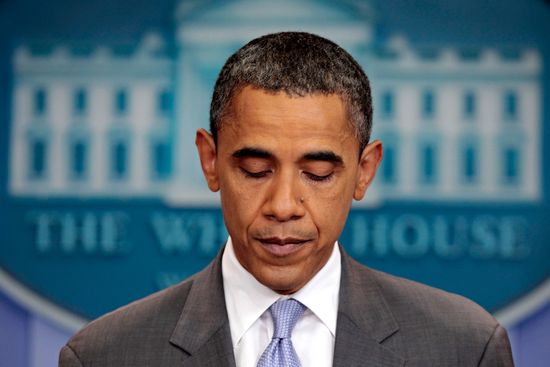
(Photo: Chip Somodevilla/Getty.)
Let The Ums Fly

Michael Erard explains why:

In the history of oratory and public speaking, the notion that good speaking requires umlessness is actually a fairly recent, and very American, invention. It didn't emerge as a cultural standard until the early 20th century, when the phonograph and radio suddenly held up to speakers' ears all the quirks and warbles that, before then, had flitted by. Another development was the codification of public speaking as an academic subject. Counting "ums" and noting perfect fluency gave teachers something to score.

What's more, "uhs" and "ums" do not necessarily damage a speaker's standing. Recently, a University of Michigan research team turned their attention to phone survey interviewers. They found that the most successful interviewers—the ones who convinced respondents to stay on the line and answer questions—spoke moderately fast and paused occasionally, either silently or with a filler "uh" or "um." "If interviewers made no pauses at all," the lead researcher, Jose Benki, told Science Daily, "they had the lowest success rates getting people to agree to do the survey. We think that's because they sound too scripted."

A previous study explained how "uh" or "um" helps babies learn new words.

Solving Dyslexia, One Letter At A Time

A cool project from Christian Boer, a dyslexic typographer in the Netherlands:

One of the key features of Dyslexie is the extra visual "weight" it adds to the bottom halves of the letters. According to Boer, this is to help pin the letters to the baseline, which helps make them easier to read. … "Dyslexie is not a cure, but I see the font as something like a wheelchair."

Correlation Still Not Equal To Causation

Kaiser Fung attacks the idea that everyone should go to college because graduates make more money:

[P]roducing more college grads will have two predictable outcomes: lower average salary for all college graduates, and more young people burdened with school loans. I think these same economists will label these "unintended consequences". Should we be implementing policies that have predictable "unintended" bad outcomes?

The British example on this issue is not encouraging.

Would More People Medium Chill With Universal Healthcare?

Dave Roberts suspects yes:

I suspect there are many, many medium chillers who would be happy working 30-hour weeks and trading the extra income for leisure time. Or perhaps they'd like to share a job. Or maybe they'd like to work more when they need money and less when they don't — just "work and get paid for it" when they need to. Those options aren't workable for most people today because of the specter of health insurance. To deviate from the 40-hour employee model is to take on risk beyond what all but a few brave souls are willing to bear.

Similarly, there are all sorts of people who might like to be "killers" and start their own business or invent something new but are inhibited from taking the leap by the fear of losing or not being able to afford health insurance. Plenty of people take that chance, of course, but how many more would there be if that risk were taken out of the equation?

Earlier thoughts on the medium chill and killers here, here and here.

Why Do Dogs Roll In Weird Shit?

One study traced the behavior to hyenas. Researchers sprayed hyenas with two scents, carrion or camphor, to try to understand the behavior:

Donning eau de carrion led to heightened and positive social interactions … regardless of the social status of the odor-wearer. Termination of the ceremony also ended peacefully with the carrion odor, unlike some of the other greetings, which met with aggression. It's probably wise to be on friendly terms with the guy who can lead you to the meat. …  Drea and her co-authors conclude, "rolling may ultimately promote social cohesion."

Fixing The Workplace

Allison Arieff argues that the cubicle isn't the problem:

We shouldn’t be rethinking the cubicle or corner office but rather rethinking all aspects of work: What careers are viable (and how should we train people for them?) Might companies and their employees be able to re-envision what loyalty looks like in an era where the average time spent in a job is hovering in the range of one to four years? If a post-consumer economy is truly coming, as many from Larry Summers to the collaborative consumption evangelist Rachel Botsman predict, what might it look like? And how will it affect our relationship to earning a paycheck? In other words, how can the workplace evolve to respond to the contemporary realities of work culture?

Commute Criminals

Jumping the turnstile in New York may make economic sense:

A report by New York City’s Metropolitan Transportation Authority seems to prove that hopping a subway turnstile is worth the risk of getting caught and fined. The MTA estimates that riders entered the subway without paying 18.5 million times in 2009 (an average of 50,684 a day) while the police issued just 120,000 summonses, or 1 for every 154 jumps. The report figures that a regular turnstile jumper has a chance of getting caught only once every 6 to 13 weeks. At $100 per fine, this works out to be cheaper than a $27 weekly unlimited Metrocard that would cost $162 over six weeks.

Are We Normalizing War?

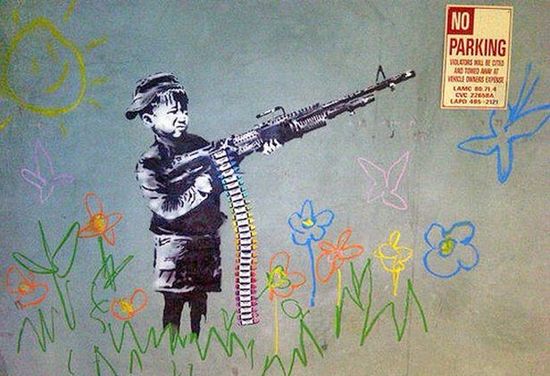
Banksy-Child-Soldier

History teacher Dwight Simon wonders:

I fear that those of us who stand up in front of America’s children every day have made a Faustian bargain. In accepting history courses shaped by war and structured around war, we allow our students to internalize war as normal, constant, at times attractive. In telling stories about war, we fall back on noble explanatory devices and encourage our students to appreciate high moral outcomes over bodies on the ground.

(Image by Banksy)