You’re Eating Bulgarian Yogurt

by Zoë Pollock

Sales of Greek yogurt have increased 2500% over the last five years. Margy Slattery ruins the marketing coup:

Ironically, not only is traditional Greek yogurt not particularly healthful, but, according to [Yale professor Paul Freedman], it’s also not particularly Greek. For one, the type of strained yogurt marketed in the U.S. as “Greek,” he says, is actually most closely associated with nearby parts of Eastern Europe and the Balkans, particularly Bulgaria.

(The subspecies of the bacterium used to produce yogurt is called bulgaricus.) The word yogurt, meanwhile, comes from Turkish, attesting to the food’s prominence in Middle Eastern diets, as well. … [Harvard anthropologist Ted Bestor], who studies the anthropology of food, explains that “if you’re trying to market something in the U.S., any label that’s Iraqi yogurt or Syrian yogurt or Lebanese yogurt—it just wouldn’t have a real positive feeling.”

I doubt that, but do agree that Greek yogurt, even with its misleading marketing, is a welcome respite from past schemes.


Are Big Ideas Over?

by Zoë Pollock

A couple of weeks ago, Neal Gabler accused the internet of killing them:

Ideas just aren’t what they used to be. Once upon a time, they could ignite fires of debate, stimulate other thoughts, incite revolutions and fundamentally change the ways we look at and think about the world.

Will Wilkinson fights back:

I'd bet my entire future income that more people read and discussed Kant last year than in 1950, or that the size of the class of people who study and produce ideas for a living is now much larger than it was in 1950.

It seems likely that intellectual specialisation and the division of labour have reduced the average "bigness" of the thoughts studied and produced by people in the ideas sector. Indeed, as an epistemological matter, breaking big problems into smaller problems and tackling them in a socially distributed way by means of a reliable, shared method of inquiry would tend to suggest that that the declining "size" of the average idea is correlated with increasing accuracy in distinguishing the true ideas from the false ones.

Kevin Drum came to a similar conclusion:

[B]ig ideas may or may not have been more common half a century ago than they are now, but at least back then we knew where to find them and we have a widely understood set of social conventions about how to discuss them. We haven't yet really figured that out for electronic media, and that makes the discussion of big ideas chaotic enough and inchoate enough that it can often seem as if the ideas themselves don't exist anymore. But I suspect they do. We just have to learn how to talk about them in a new language.

Megan Garber credits electronic media with being the Big Idea:

The idea of the idea is evolving. We don’t treat Google like a Big Idea — though, of course, that’s most definitely what it is; we treat it like Google. Ditto Facebook, ditto Twitter, ditto Reddit and Wikipedia. Those new infrastructures merge idea and practice, ars and tecnica, so seamlessly that it’s easy to forget how big (and how Big) the ideas that inform them actually are.

The Language Of Twins

by Zoë Pollock

It's called cryptophasia. Jon Lackman explains how it can be cute (see the wildly popular video above) but, if left to its own devices, can hamper socialization:

Oxford neuropsychologist Dorothy Bishop told me that twins generally get less intervention from speech therapists than nontwins. "People often assume that it's normal for twins to have funny language, and so they don't get a proper assessment and diagnosis. And then, when they are identified, they are often treated together as a unit, and so each gets half the attention of the professionals working with them."

What We Did Not Earn

by Patrick Appel

Sam Harris is getting pummelled by readers for his comments on inequality, wealth, and taxation:

Many of my critics pretend that they have been entirely self-made. They seem to feel responsible for their intellectual gifts, for their freedom from injury and disease, and for the fact that they were born at a specific moment in history. Many appear to have absolutely no awareness of how lucky one must be to succeed at anything in life, no matter how hard one works. One must be lucky to be able to work. One must be lucky to be intelligent, to not have cerebral palsy, or to not have been bankrupted in middle age by the mortal illness of a spouse.

Many of us have been extraordinarily lucky—and we did not earn it. Many good people have been extraordinarily unlucky—and they did not deserve it. And yet I get the distinct sense that if I asked some of my readers why they weren’t born with club feet, or orphaned before the age of five, they would not hesitate to take credit for these accomplishments. There is a stunning lack of insight into the unfolding of human events that passes for moral and economic wisdom in some circles.

Fellow atheist Timothy Sandefur is enraged. A sample of his many criticisms:

[Harris] believes that because people are “lucky” enough to be born with certain endowments, they must be reduced by force to being the means to other people’s happiness—literally forced, since he believes the state should “supersede” our “immediate, selfish interests” to accomplish a “fairness” that he does not define, but admits is based purely on emotion and intuition.

The Jack Mormon?

by Zoë Pollock

Jacob Weisberg's recent Huntsman profile examines his religion, among other things:

People tend to see Mormonism as a binary, you-are-or-you-aren’t question, but Jon Huntsman is something more like a Reform Jew, who honors the spirit rather than the letter of his faith. He describes his family on his father’s side as “saloon keepers and rabble rousers,” and his mother’s side as “ministers and proselytizers.” The Huntsman side ran a hotel in Fillmore, Utah’s first capital, where they arrived with the wagon trains in the 1850s. They were mostly what Utahans call “Jack Mormons”—people with positive feelings about the Latter-Day Saints church who don’t follow all of its strictures. “We blend a couple of different cultures in this family,” he says. You’d never hear a phrase like that from Romney, who has raised his sons as Mormons and sent them on missions. Nor would you see Tagg, Matt, Josh, Ben, or Craig Romney in a hotel bar, sipping a glass of wine, as you might see one of Huntsman’s adult children.

A recent Boston Globe piece covered similar territory, but avoided calling him a Jack Mormon. Mark Hemingway dissects why:

It's not a pejorative term, but in some select contexts Jack Mormon is not exactly a compliment. It’s often shorthand for “Mormon who drinks alcohol.” Jack Mormon may refer to fully lapsed or inactive members more often than not, though the definition is highly fungible. Given that [Mormon blogger Joanna Brooks] seems to have a similar Mormon identity as Huntsman, I wonder if there’s not some overt attempt at rebranding going on.

A Poem For Sunday

5386161881_0a150a2fb2_b
by Zoë Pollock

"Self Help" by Bruce Covey:

A chicken soup for the rainbow lover’s soul.
A chicken soup for the lover of chicken soup.
A carnage of birds, a devastation.
Chicken soup for the dried-up garden—
It’s been a lousy summer sucking us dry.
Chicken soup for the grocery list.
Chicken soup for unwanted potatoes.
Chicken soup for extinct animals.

The poem continues here.

(Photo by Flickr user paloetic)

The Argument For Epistemic Humility, Ctd

by Zack Beauchamp

Pete Wehner enlists Plato in the cause:

None of us can fully extricate ourselves from the dominant opinions of our day. In this world we see through a glass darkly; we can know only in part. Some people perceive truth more fully than others, but truth is still fragmentary. The shadows on the wall never fully disappear. And so we are all in need of dialogue, of conversation, and even, from time to time, of correction. As iron sharpens iron, so one person sharpens another.

Painting Religion Without The Iconography

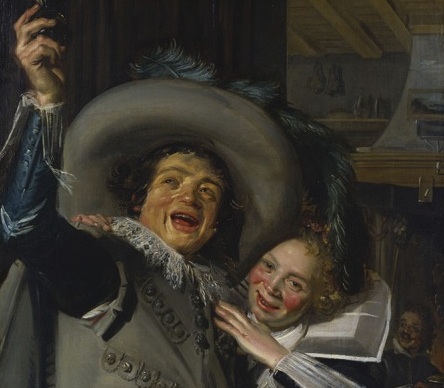
Hals3
by Zoë Pollock

Many argue that a painting by Frans Hals, often referred to as "Yonker Ramp and his Sweetheart" (seen partially above), depicts the prodigal son cavorting before his eventual return to his father. Morgan Meis extends the theory, which suggests "that we don't need to depict the prodigal son of the Bible since we can go out and see the prodigal son right there in our local pub":

And that matches up nicely with a bit of Protestant theology — namely, the idea that we do not need much mediation between ourselves and the truths of the Bible. … "God," taught Martin Luther, "writes the gospel not in the Bible alone, but on trees and flowers and clouds and stars." Marrying that thought with the iconoclastic impulses of Dutch Protestantism led to an almost inexorable conclusion for Frans Hals: He would paint the stories, morals, and lessons of religion into the immediacy of the world as it was presenting itself right there in front of him.

Is Secular Humanism Bunk?

by Zoë Pollock

Michael Lind brings the wrecking crew:

[T]he common theory of human nature underlying contemporary secular humanism seems to be cosmopolitan utilitarianism, the conviction that human beings, if liberated from superstition by science, would behave less like selfish, scheming social apes and more like self-sacrificing social insects, giving their all for the good of the 7 billion members of the global human hive. "Life’s fulfillment emerges from individual participation in the service of human ideals…" says Humanist Manifesto III. "Working to benefit society maximizes individual happiness." … But social animals are not altruists. Nor are they strict individualists. They are nepotists.

As a rule social animals, like wolves, deer, humans and chimps, show favoritism to their relatives and friends and allies, with little or no concern for members of their own species with whom they have no close connection. Abrahamic monotheism insists on the brotherhood of man under the fatherhood of God. Darwinism insists at best on the distant cousinhood of humanity. Among humans, nepotistic solidarity can be transferred, with difficulty, to political units larger than the extended family. But national patriotism is much harder to promote than city-state patriotism, and global patriotism may be a bridge too far.