
By Carline Jean/Sun Sentinel/MCT via Getty Images.
Today on the Dish, New York prepared for Hurricane Irene, including stockpiling wine, cards, ice and water to flush toilets, while some shrugged it off. On the political front, Rick Perry used to be a Democrat, and Frum concentrated on the problem of Perry's book. Douthat calmed Romney's nerves about the threat of Perry, while others wanted Romney to take some risks. It looked like no incumbent Republican will lose a primary to a Tea Partier in 2012, and we debated entitlement reform in the Republican party. Douthat urged Huntsman to get unconventional on the economy instead of the culture war, and even if Ron Paul was president, he wouldn't be able to stop the war on drugs on his own. Zack engaged Yglesias on abortion and libertarianism, and cutting 20 calories a day could solve our diabetes problem.
Internationally, John Yoo used Libya to blame GOP isolationists, and we assessed the hypocrisy of Obama supporters since they bashed Bush for going around the War Powers Act. Zack challenged Steve Hynd on intervention and aid, and protests continued in Syria. The TNC needed to deliver goods and services to Libya's citizens, and some hospitals were serving as mortuaries. We still shouldn't delist MEK from the terrorist list, Columbia isn't a failed state as it's portrayed in the movies, and we parsed whether China is planning a war against the US.
We explored how science affects the acceptance of bisexuality, a reader's life story refuted the argument that poverty is due to laziness, and we don't resent the wealthy if they earned it. Megabus probably isn't ruining the case for highspeed rail, Gambian rats can be cute, and we looked at other countries that privatized their mail system. Some think we should pay preschool teachers more, and we analyzed porn in India.
Creepy ad watch here, VFYW here, MHB here, and FOTD here.
Thursday on the Dish, Steve Jobs resigned from Apple, Wilkinson wondered why we don't resent his wealth, and we explored the new CEO's status as the most powerful gay man in the world. Steve Benen pounded in Perry's involvement in the execution of an innocent man, and we dissected Perry's lead over Romney. We had hoped Perry would embrace Texas' smart immigration policies, Karl Rove hit a nerve in Palin's thin skin, and climate scientists still agreed on climate science so politicians should follow suit. Raising the age of Medicare eligibility won't save us money, McArdle supported welfare reform, and poverty is a hard cycle to break. Fareed wondered if it was time to turn Congress into a parliamentary system, and Chuck Norris needed a gun to fight bad guys.
In Libya, rebels found Qaddafi's scrapbook of Condoleezza Rice but no Qaddafi. Mohammed Bamyeh downplayed tribal ties in Libya, while we found out Saif Qaddafi could have supported the protesters. Douthat allowed mild celebrations about Qaddafi's imminent fall and Drezner didn't want the Libya intervention to become the blueprint. Our foreign policy has been militarized, entrepreneurs could help rebuild the Libyan economy, and Jonathan Raab tried to explain why he needs to go back to war zones. In other international news, Japan decorated their manhole covers, China's porn industry thrived, and readers left a final round of kind messages about Jack Layton.
Groupon still isn't viable, rats bigger than cats terrorized Brooklyn, and toads can predict earthquakes. Heat doesn't make us violent, it just puts us into contact with more people which does, organ donors should get priority for organs, and we should have sympathy for the poor telemarketer. Readers nerded out on some more infinity, we underestimated the total number of species to be 8.7 million, and marijuana makes us more creative.
VFYW here, MHB here, and FOTD here.
Wednesday on the Dish, a rebel commandeered Qaddafi's hat, Muammar was still nowhere to be found, and Yglesias invoked Francis Fukuyama’s The End Of History. Factionalism among the rebels represented the next stage in the battle, Larison defended his use of stalemate in describing Libya, and Zack lobbied for humility in arguments. Fareed outlined a new model for intervention with an emphasis on local involvement, we kept an eye on revitalized revolutionaries in Syria and Yemen, and Wikileaks made McCain and Butters look just a tad hypocritical. Around the rest of the world, we ignored Iraqi agency in understanding the surge, Leonard Spector feared chemical warfare in Syria, the world car population passed one billion, and readers recalled Jack Layton as a defender of gay rights in the 80s.
On the campaign trail, the GOP continued its search for a "consensus conservative," Perry pulled ahead of Romney in the polls, and Patrick pinpointed the dangers of a Ron Paul presidency. We debated how much importance to give to politicians' scientific views, we exposed Peggy Noonan's pundit tricks, Maisie wondered if a black swan political event loomed in the US future, and the internet schemed about how to get Palin out of the spotlight. In other national news, we examined whether Clinton's welfare reform succeeded, education boomed even in poorer countries, and Stephen Rose offered perspective on just how bad the economy is. We tried to get to the bottom of the GOP's payroll tax cut position, and readers defended the USPS. The sports world garnered another marriage equality convert, a reader took issue with our drug arrests graphic, and telemarketers hit a nerve with readers.
We peeked inside Roger Ebert's new memoir, Sam Harris argued we'll reach a point where we'll all want wealth redistribution, and no one likes a moral crusader. We appreciate over-used positive words to talk about ourselves, one reader wished telemarketers stuck to the script, and men and women sleep differently. Marriage may cause weight gain among other hazards, asexual readers considered dishonesty cheating, and pronouns have a psychology all their own.
VFYW here, MHB here, and FOTD here.

Incline Village, Nevada, 10.30 am
Tuesday on the Dish, a big earthquake shook the Eastern US. On the Libyan front, Saif al-Qaddafi reemerged to give conflicting accounts about government forces on the rebound, and then rebel forces took over Qaddafi's compound. We weighed whether our intervention worked and Zack duked it out with Freddie deBoer over our Von Hoffman awards. We revisited the success curse and whether this war was really a war, and Qaddafi lived up to his narcissistic dictatorship tendencies. Ben Dunant questioned Robert Kagan's view of superpower suicide, and we wondered about the dissolution of trust in the Middle East.
In the political alley, Maisie tackled the GOP for catering to nostalgic white voters, Fallows bashed the GOP's allergy to taxes unless they're taxes on the poor, and libertarians still wanted to build their own island. Steve Kornacki charged Huntsman with copying McCain's campaign style, and Rick Perry challenged the Republican Party to decide whether they are Establishment or tea-vangelical. We poured over Obama's summer reading list, and a Quebecois reader remembered the great Jack Layton. Dale Carpenter debated whether the case against Prop 8 has sapped support for a repeal, and Simon Rippon made the case for not banning twin reduction.
In other international news, Felix Salmon proposed a more mobile, global workforce, and Ken Menkhaus tracked al-Shabaab's implosion in Somalia and advised us not to intervene. Peter Ackroyd argued rioting is a London tradition, Haiti hasn't been able to use all its recovery funds, and terror could kill the tent protests and move Israel to the right.
Chris explored intimacy in the asexual world, most women masturbate without feeling guilty about it, and one reader was ready to nix the postal service. Giving presents to coworkers makes us feel better, we learned how voice recognition works in computers, and the law-school-is-a-scam scandal escalated with the exposure of the man behind the blog. Scientists accepted their own mistakes, telemarketers follow the script, and readers boggled our minds some more on infinity (and beyond).
Hathos alert here, MHB here, FOTD here, VFYW here, and winner #64 here.
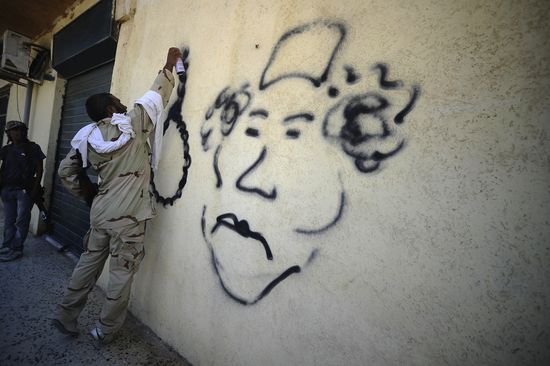
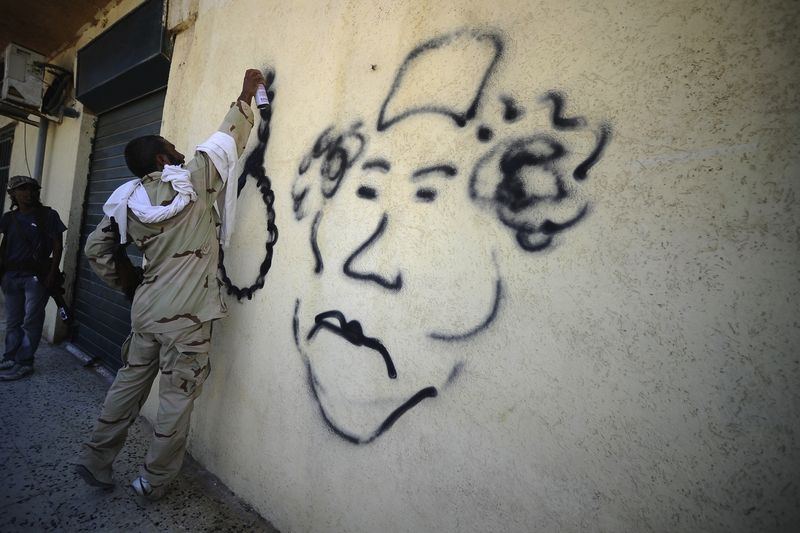
By Filippo MonteForte/AFP/Getty Images.
Monday on the Dish, we tracked the surrender of Qaddafi's sons overnight, everyone wondered where Muammar was, and we gathered the reax to his imminent downfall. The right twisted itself into contortions parsing the president's success, and McCain and Butters praised everyone but Obama, even though they were shaking Qaddafi's hand two years ago. Zack likened Obama's "leading from behind" to a global police chief, and didn't want us to try and seize the Lockerbie bomber right off the bat. We parsed the curse of success and what it will mean for future "interventions" or illegal wars, and wondered whether Qaddafi and his sons would be tried in Libya or at the International Criminal Court. James Traub kept his faith in the Arab Spring, even if loyalist forces have some fight left in them, and the Von Hoffman awards were flying off the shelf for predictions gone awry.
In campaign news, the right was still ignoring Huntsman as prophet, Maisie cataloged the arguments for and against Paul Ryan's run, and then he officially dropped out. Perry distanced himself from his own policies as stated in his (less than a year old) book and presidential candidate Bachmann referred to the IRS as the enemy. Nate Silver assured us the 2012 field isn't set yet and Palin's Iowa video either means she's running or she's the world's largest narcissist. Maxine Waters ordered the Tea Party to go straight to hell, Stephen Moore took another beating on Obama's economic policies, and military families fought against the neocons' empty support of the troops. An 8-year-old helped swing New York marriage equality into reality and the camo closet was finally about to let some sunlight in when DADT ends September 20th.
Chris weighed whether the iPhone could ever really replace a congregation's connections, and environmentalism took the backseat in war zones. Immigration remained vital to our economy, and Canada mourned for a lost politician. Yodeling started with monks in Tibet, we contemplated Korean reunification, Thomas Jefferson was originally skeptical of patents, and Brazil's poor pined for plastic surgery. Complex human societies developed in conjunction with high density living, everything we order on the internet is delivered by USPS, and minorities still bear the brunt of marijuana arrests. And in home news, Andrew's taking a breather so we're running the show while he's gone.
Email of the day here, chart of the day here, FOTD here, MHB here, VFYW here, and view from your airplane window here.
–Z.P.




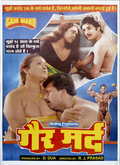 With a visual language that is at times daring, at times naïf, these posters echo the kitsch imagery of Indian movie posters – but they also represent sex, a subject that is particularly taboo in India despite its many religious manifestations. An underground, thriving design form, adult movie posters address Indian culture's forbidden fantasies, bringing them to life through often bizarre titles and explicit visuals. And while in the rest of the world Internet porn has killed adult movie cinema, in India it is still common to see groups of school students and men in shiny collar shirts and white suit-pants nonchalantly emerging from adult-only morning shows. In many cases, this represents the only form of eroticism in a situation where the joint family system makes a private life impossible.
 The Dish